Most prop accounts don’t close because of bad forecasts. They close because of drawdown. A trader finds a good market, takes a position, then two similar ones, and a single piece of news pushes equity past the limit. Prop Hub has two such limits, daily and total. Here is how each is calculated, how they differ and how to keep a buffer.
Equity, not balance
Both limits are measured on equity: free balance plus open positions at the current market price. This matters. If you bought an outcome at 60¢ and it drops to 40¢, your equity is already lower even though the event hasn’t resolved. A limit can trigger before the market resolves, simply because your positions lost value.
In practice, watch equity on the account page rather than free balance. Balance tells you how much cash isn’t deployed. Equity tells you what the account is worth right now.
Daily drawdown
In a single day equity can’t fall more than 10% from equity at the start of the day. The day runs on UTC, from 00:00.
Example. A $10,000 account starts the day with equity at $10,500. The floor for the day is $9,450. If equity touches that level at any point during the day, the account closes.
The reference resets every day. A good day lifts the next day’s reference, a bad one lowers it. Yesterday’s loss doesn’t carry into today’s limit: today you count from where you started the day.
Why the daily limit bites
It catches clusters. Five simultaneous positions at 2–3% each look harmless, but if they’re linked (the same match, the same news, the same coin) they lose together. That scenario closes more accounts in a single evening than any other.
Total drawdown
Equity must not drop to −20% from its peak. The peak only ever moves up.
Example. A $10,000 account grows to $12,000, a new peak. The floor is now $9,600, not $8,000 as at the start. Even if equity later falls back to $10,000, the floor stays at $9,600.
This is called a trailing limit because it follows the account’s best result. It sets a common trap. A trader grows equity quickly, then takes bigger positions “because there’s room”. But the room is measured from the peak, not from the start, and after a run-up there’s less of it than it feels.
Which limit triggers first
Both limits apply at once, and the account closes on whichever level equity reaches first.
Example. Peak $12,000, equity at the start of the day $11,000.
- Daily floor: $9,900.
- Total floor: $9,600.
Today the daily limit is closer. If the day had started at $10,200, the daily floor would be $9,180 and the total limit would trigger first. Both floors are shown in numbers on the account page, so there’s no need to work them out by hand.
Protection before the trade
Before every buy the system checks the worst case: what happens if this position and every open one lose. If equity in that scenario reaches a limit, the buy is rejected. The buy panel shows in advance how much you can still put in within the limits.
This check stops one burst of trades from closing the account, but it doesn’t protect you from open positions losing value before they resolve. An outcome can fall from 60¢ to 30¢ on news, and equity reflects it immediately. So you always need a buffer.
Full rules are in the help center: Challenge rules.
What happens on a breach
The account closes immediately. The account page and the email show which rule triggered and at what numbers, for example: “equity $9,550 at a floor of $9,600, −20% from a peak of $12,000”. Open positions run until the event resolves but no longer affect the challenge result.
A funded account has the same limits with one difference: withdrawn profit doesn’t count as drawdown. Take money out and the floor doesn’t rise. Details: Funded account risk rules.
The free welcome account uses a different rule: drawdown of at most 50% from the starting balance, and that floor never moves up.
Trading with a buffer
- Keep the daily floor in mind. Before entering, ask: if this position goes to zero, how far am I from the limit?
- Don’t stack linked positions. Three outcomes of one match or three windows of one coin are one position, not three.
- After a new peak, size down, not up. Room to the total limit is measured from the peak.
- Watch overnight positions. The UTC day may end in your evening, and open positions keep moving equity.
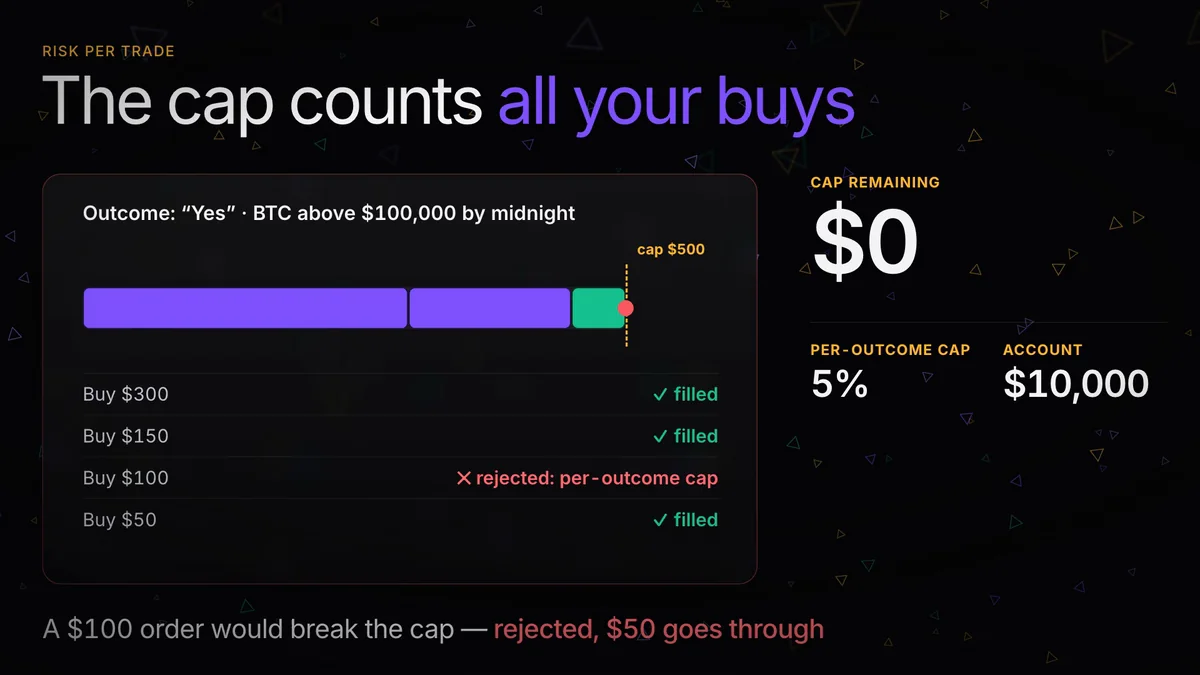
- Treat the per-outcome cap as a ceiling, not a target. You can put at most 5% of the starting balance into one outcome, but trading at the maximum every time is a fast route to the daily limit. More in risk per trade.
How drawdown fits into the whole path to funding is covered in prop challenge rules.