There are hundreds of prop firms and from the outside they look alike: account size, fee, target, profit split. The differences hide in the details of the rules, and those details decide whether you ever get paid. Below are nine questions to answer from a firm’s own documents before paying. There’s no ranking here. The right firm depends on what and how you trade.
1. How is drawdown measured?
The most important question, usually settled by a single line in the rules.
- From the start or from the peak. A limit of “−10% from the starting balance” stays put. A limit of “−20% from the peak” (trailing) rises with the account’s best result. The second is stricter than it looks: after a run-up there’s less room left.
- On closed trades or on live valuation. If the limit is measured on equity with open positions at market price, the account can close before a trade resolves.
- What the daily limit is based on, and in which time zone. Balance or equity at the start of the day, UTC or the firm’s server time.
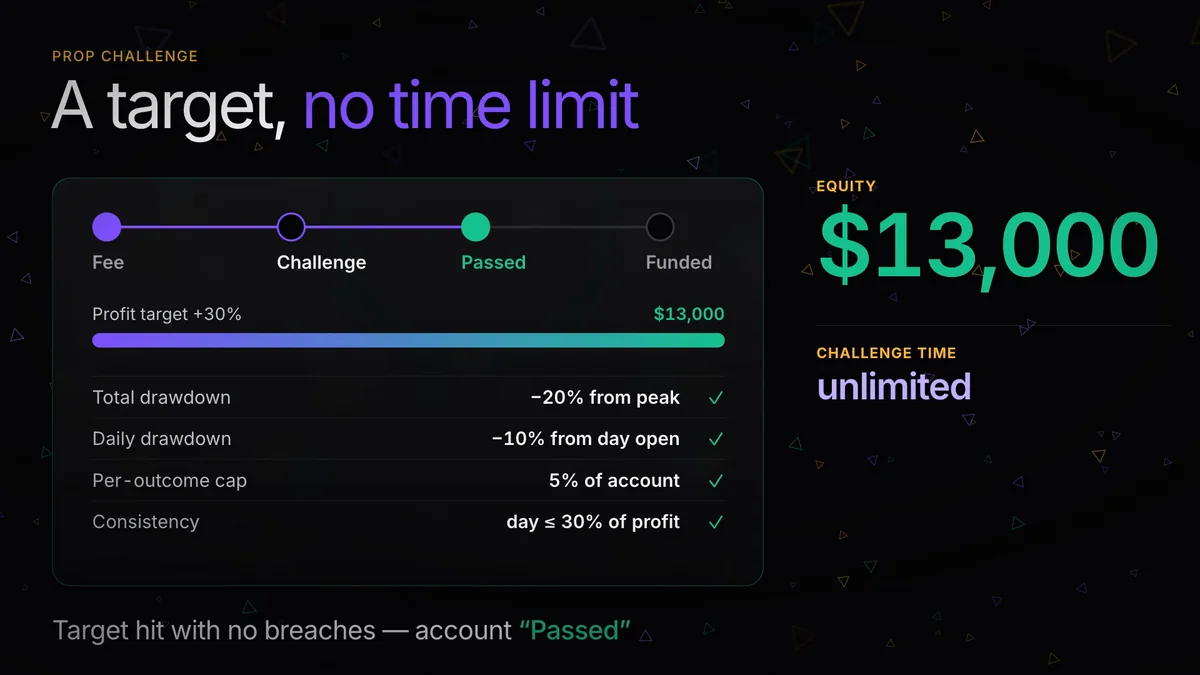
On Prop Hub total drawdown is −20% from peak equity, daily drawdown is −10% from equity at the start of the UTC day, and both are measured on equity including open positions. See the numbers in daily and total drawdown.
2. Is there a time limit?
Some firms give you 30 or 60 days for the challenge. A deadline pushes traders to size up near the end when the target isn’t reached yet, and that’s a common reason accounts close. Without a deadline you can wait for good markets. Prop Hub’s challenge has no time limit, but there’s an activity rule: at least one trade every 14 days.
3. What does the consistency rule require?
Many firms won’t pass a challenge or release profit if it was made in a single day. What matters is the wording:
- is it a violation (the account closes) or a condition (you just keep trading);
- what share of total profit the best day may represent.
On Prop Hub it’s a condition, not a violation: on the challenge the best day can be at most 30% of total profit, on a funded account 40%.
4. How do payouts work?
The profit split on the homepage is only the start. Check:
- the minimum withdrawal and how often you can withdraw;
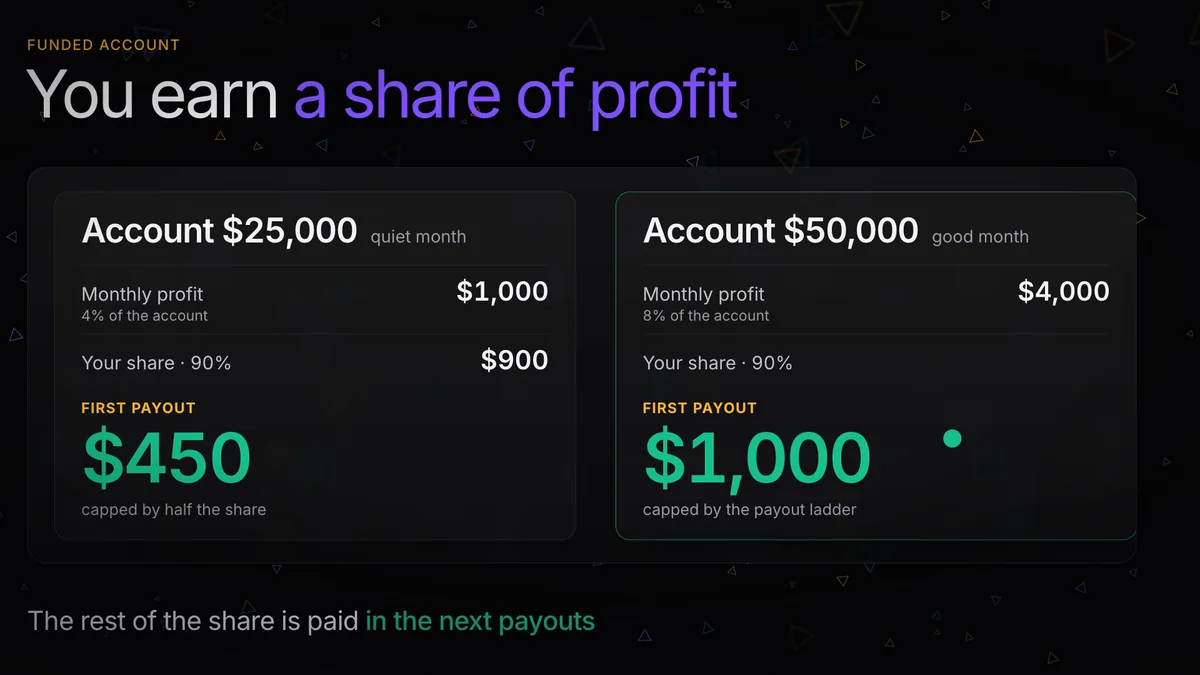
- caps on the first payouts, if any;
- methods: bank, crypto, which networks;
- the time from request to payment;
- what happens to trading while a request is reviewed.
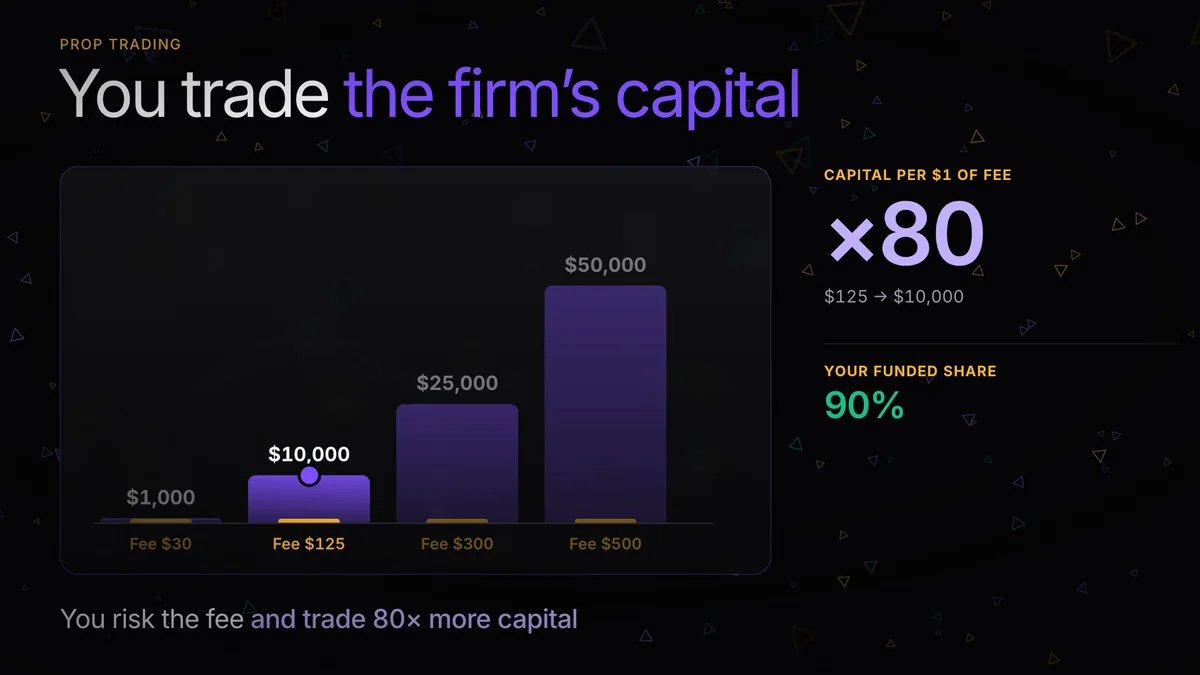
A good sign is when all of this is in the help center rather than discovered in a support chat after you request a payout. On Prop Hub you keep up to 90% of funded-account profit, payouts go out in USDT or USDC within 72 hours. Details in funded account payouts.
5. Is there identity verification, and when?
A firm that actually pays checks who it pays: KYC before the first payout is normal. A bad sign is KYC demanded only after a trader has made money, with no mention in the rules. It’s good when you know in advance which documents are needed and how long the check stays valid. Prop Hub uses Didit, and a check stays valid for 180 days.
6. Which countries can receive payouts?
Prop firms have country restrictions, and for many of them the restriction applies to withdrawals rather than trading. Find the list before paying. If your country is on it, you can trade but can’t get paid. Prop Hub’s list is in the help center: Country restrictions.
7. Which market will you trade?
Forex, futures, crypto and prediction markets are different skills. Forex is about leverage and stops. On prediction markets you buy an event outcome priced between $0 and $1, and the maximum loss of a position is known upfront. Pick a firm for the market you understand, not for the biggest number on the banner.
Prop Hub works with Polymarket markets: sports and esports, short crypto windows, politics and finance. How that differs from the classic setup is covered in what is prop trading.
8. How honest is the simulation?
Almost every online prop firm trades on a simulation. The question is how close it is to the real market:
- do large orders fill through the order book or always at the best price;
- are real fees applied;
- where do the quotes come from.
A simulation that’s too convenient feels like a perk until it turns out the results can’t be repeated on a real market and the firm rejects a payout over “non-market trades”. On Prop Hub prices and order books are live Polymarket data, orders fill like market orders through the book, and fees match what Polymarket charges.
9. Who is behind the firm?
Check the legal entity, country of registration, terms of use and privacy policy. If the site names no company and has no documents, you have nothing to base a claim on. Prop Hub is operated by Sharikat al-Marfa Ltd.; the documents are linked in the footer of every page.
Signs a firm won’t pay
- payout rules aren’t published, or change retroactively;
- drawdown limits are worded so you can’t check them on the account page;
- “bonuses” and “promotions” instead of clear terms;
- no legal entity and no documents;
- support promises that passing is “easy”.
Testing a firm in practice
The best test is to trade under a firm’s rules without paying. On Prop Hub there’s the free $100 account with a real payout of profit up to $100, and a $10,000 demo account with challenge rules. Read the rules in the help center, make a few dozen trades and watch how equity behaves on the account page. You’ll know whether the model suits you before you pay a fee.