“How much do funded traders make” is one of the most common questions about prop trading, and there is no single number. Earnings depend less on account size than on how much profit a trader makes and keeps through drawdowns. What can be calculated exactly is how much of that profit turns into real money in your wallet. Here is the math under Prop Hub rules, without “average incomes” or promises.
Where a funded trader’s money comes from
In the prop model the trader does not put up capital. They pay a fee for an evaluation, the challenge, and if they pass, they get a funded account. Money is paid only from the funded account: it is the trader’s share of the profit made on it.
On Prop Hub you trade a virtual account at live Polymarket prices. The fee pays for the evaluation; it is not a deposit. It cannot be withdrawn as balance, and you cannot lose more than the fee. Only payouts are real money.
Current plans:
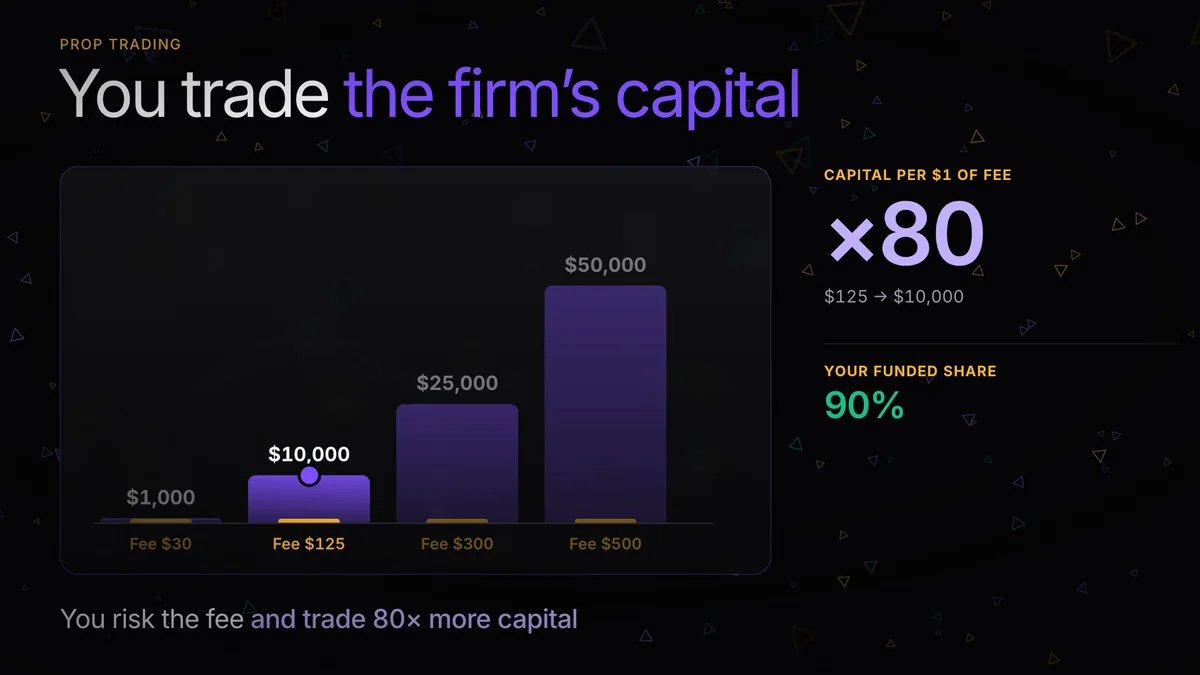
| Account size | Fee | Profit target | Min. equity | Daily limit | Per-outcome limit |
|---|---|---|---|---|---|
| $1,000 | $30 | $1,300 (+30%) | $800 (−20%) | −$100 (−10%) | $50 (5%) |
| $10,000 | $125 | $13,000 (+30%) | $8,000 (−20%) | −$1,000 (−10%) | $500 (5%) |
| $25,000 | $300 | $32,500 (+30%) | $20,000 (−20%) | −$2,500 (−10%) | $1,250 (5%) |
| $50,000 | $500 | $65,000 (+30%) | $40,000 (−20%) | −$5,000 (−10%) | $2,500 (5%) |
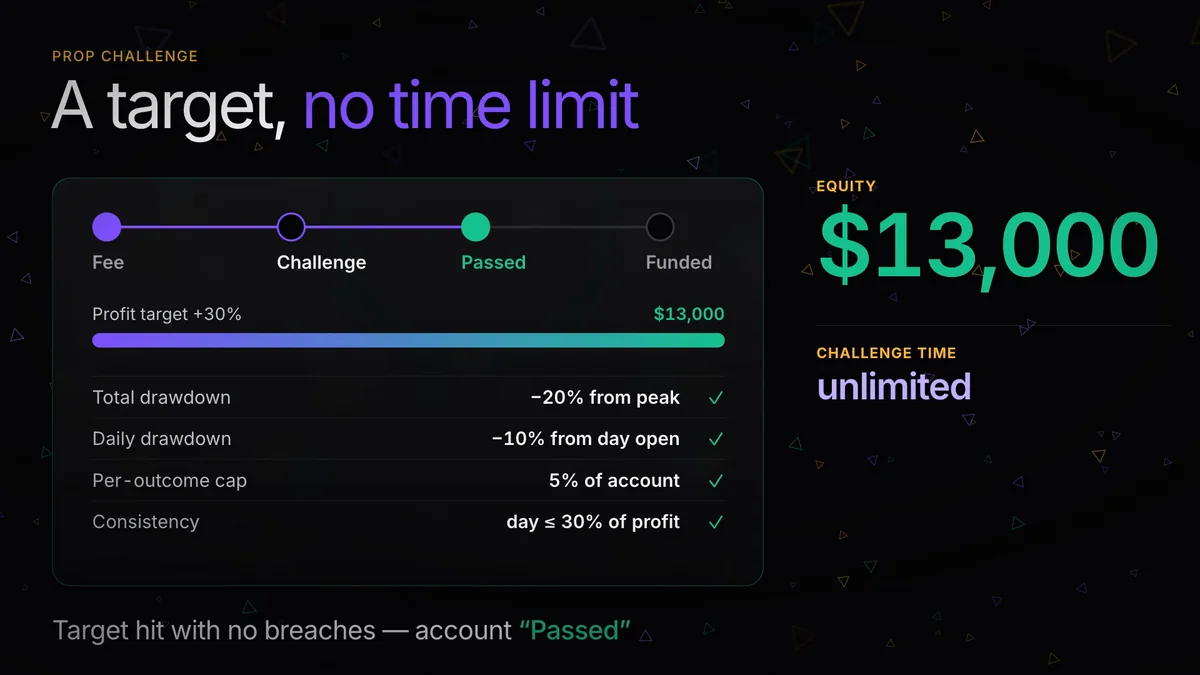
The challenge has no time limit. To pass, grow equity by +30% over the starting balance without breaking the drawdown limits, with your best day contributing no more than 30% of total profit. Challenge profit is not paid out; it is an exam. The steps are covered in the challenge rules article.
How profit is split on a funded account
Once your request is approved, a funded account of the same size opens with a clean balance. There is no profit target: you trade, and profit is split, up to 90% to you and the rest to Prop Hub.
Three limits cap a single payout, and the smallest one applies:
- Your share — 90% of qualifying profit minus what you have already withdrawn.
- The payout ladder — the first payout is capped at $1,000, the second at $2,000, the third and later ones at $5,000.
- Half of your available share per payout. The rest can be withdrawn next time.
Payouts must be at least 7 days apart. Two more conditions: no open positions on the account, and your best day contributes no more than 40% of the account’s total profit.
“Qualifying” profit is profit from closed positions opened at a price between 10¢ and 90¢. Buying a nearly settled outcome at 0.97 to collect pennies does not count.
Example 1: a $25,000 account, a steady month
Say a trader closes trades with $1,000 of qualifying profit in a month, which is 4% of the account.
- Trader’s share: $900.
- First payout, the smallest of $900, $1,000 and half the share: $450.
- The rest of the share can go out in later payouts, 7 days apart.
For comparison, the challenge fee for this account size is $300, paid once.
Example 2: a $50,000 account, a good month
Qualifying profit of $4,000, or 8% of the account.
- Trader’s share: $3,600.
- First payout, the smallest of $3,600, $1,000 and $1,800: $1,000. Here the ladder is the limit.
- The second payout can be up to $2,000 if your share allows it.
The ladder keeps early payouts quick and modest while the account shows steady results. The cap rises with each payout.
What eats into profit
The figures above are net profit after costs. In practice the result is reduced by:
- fees — as on Polymarket, the market’s rate × (1 − price) of the trade amount; some markets charge nothing, and across our trades the average is about 2.8%;
- slippage — a large buy walks several levels of the book, so the average price is worse than the best quote (see the order book article);
- losing days, which keep profit from growing in a straight line.
Why account size is not income
A $50,000 account gives you more room for positions, but its limits grow in dollars by the same proportion:
- daily drawdown — 10% of equity at the start of the day: $5,000 at the start;
- total drawdown — 20% below peak equity: a $40,000 floor at the start, rising with the peak;
- per-outcome limit — 5% of the starting balance, $2,500.
A trader who makes 4% a month on $10,000 makes the same 4% on $50,000 with the same discipline. A trader who loses, loses faster in dollars on a bigger account. The sensible route is to start at the size where you trust your strategy. How the limits are calculated is explained in daily and total drawdown.
How long until the first payout
The timeline has several stages:
- The challenge — no deadline; the pace is yours.
- The funding request — the team reviews your trades; trading is frozen meanwhile.
- Trading the funded account to a first profit.
- The payout request and identity verification (KYC), valid for 180 days.
- Sending the payout — within 72 hours of the request or of KYC approval. Money arrives in USDT or USDC to your wallet.
Payout conditions in detail: funded account payouts and the help center.
Where to start
Before paying a fee, test your approach on the free welcome account: $100 for 3 days, live prices and a one-time withdrawal of up to $100 of profit. If over those days you keep drawdown under control and close trades in profit, move on to a plan at the size you can trade just as calmly.