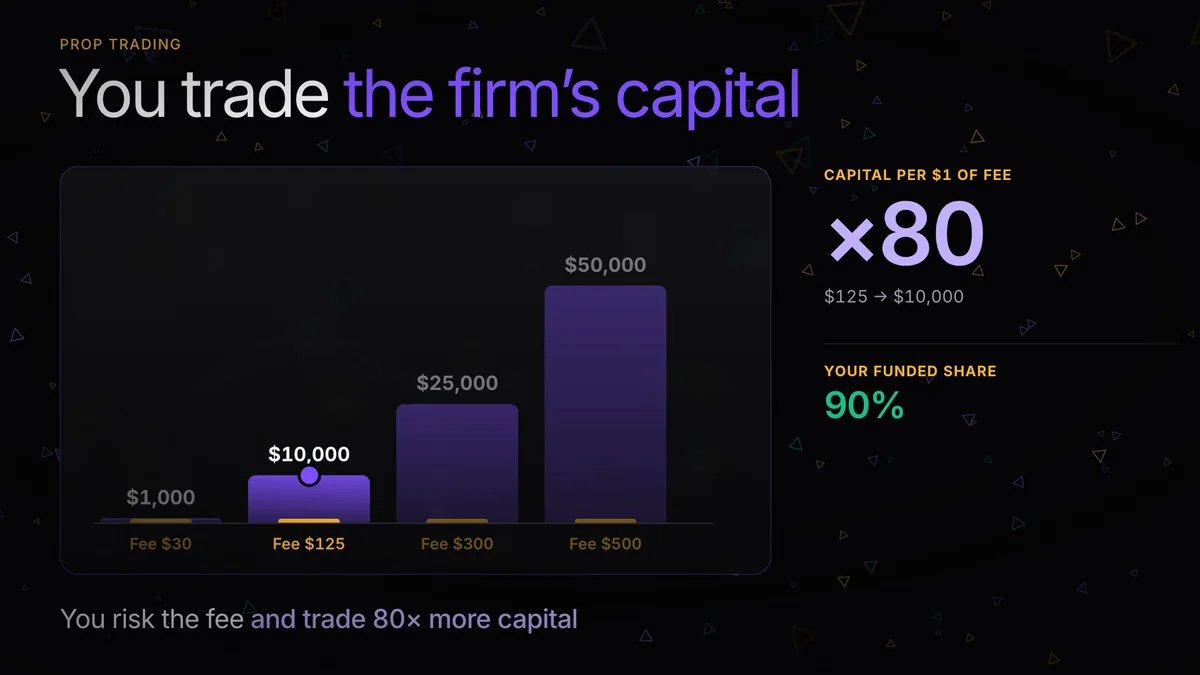
A prop challenge is the test a firm runs before trusting you with its capital. You reach a profit target and never cross a loss limit on the way. Below is every Prop Hub rule, worked through on a $10,000 account, plus the mistakes that close most accounts.
The steps from fee to funded account
- Pick an account size on the Plans page and pay the one-time fee in crypto.
- The challenge opens with virtual capital. You trade Polymarket markets at live prices.
- Once the target is reached and the other conditions are met, the account is marked Passed.
- You close your positions and request funding. The team reviews your trades and opens a funded account of the same size.
There is no time limit. Your account’s conditions are locked in at purchase and carry over to the funded account unchanged; if a plan changes later, that only affects new purchases.
Equity: what every limit is measured against
All rules look at equity: free balance plus open positions at their current market price. Buy “Yes” at $0.60, watch the market slip to $0.45, and your equity drops right away, without waiting for the event to resolve. Keep this in mind above everything else: a loss on an open position already counts.
Profit target
Grow equity by +30% from the starting balance. On a $10,000 account that means $13,000.
The Passed status is based on closed trades. While positions are open, the result isn’t locked in yet. A target reached on paper at current prices becomes a pass once those positions are sold or their markets resolve.
Total drawdown, measured from the peak
Equity must not fall 20% below its highest point. The peak only moves up. If a $10,000 account grows to $12,000, the floor becomes $9,600, not $8,000.
The practical takeaway: profit lifts the floor along with your equity. If you start sizing up after a good week, you have less room than it feels like.
Daily drawdown, from the start of the UTC day
In a single day equity can’t drop more than 10% from where it started the day. The day runs on UTC from 00:00. Start the day at $10,500 and today’s floor is $9,450.
This rule closes more accounts than any other. The classic case is an evening of football: a trader opens five positions, three move against them at once, and the daily limit runs out before the matches do. Both types are covered in detail in Daily and total drawdown.
Per-outcome limit
Your total position in one outcome of one market can’t exceed 5% of the starting balance. On a $10,000 account that’s $500. The whole exposure counts: if you already hold $300 of “Yes” and try to add another $300, the order is rejected.
Before every buy the system also checks the worst case: what happens if this position and all your open ones settle at zero. If equity in that scenario would reach the drawdown limit, the order isn’t accepted. The buy panel shows how much room you have before you click. Working with this limit is covered in The per-outcome limit.
Consistency
Your best day can’t be more than 30% of total profit. It checks that the result was built over several days rather than one lucky evening.
Example: over five days you made $600, $100, $100, $100 and $100, so $1,000 in total. The best day is 60% of it, above the 30% limit, so the challenge doesn’t count yet. For $600 to be an acceptable share, total profit has to reach $2,000.
This isn’t a breach. The account stays active; keep trading at your normal pace.
Activity and markets
You need at least one trade every 14 days, or the account closes for inactivity. The clock runs from your last trade.
Only events resolving within 2 days are tradable: upcoming matches, crypto windows from 5 minutes, daily macro markets. Anything further out is unavailable.
What happens on a breach
The account closes immediately. Its page and the email tell you which rule triggered and with what numbers, for example: equity $7,950 against a floor of $8,000, which is −20% from a $10,000 peak. The fee isn’t refunded, and you can buy a new challenge at any time.
How not to blow the challenge
- Keep a buffer to the daily limit. If less than half of it is left, skip new positions for the rest of the day.
- Don’t stack positions that lose on the same move: “Up” on BTC and “Up” on ETH in the same window usually go together.
- Plan the target as a series of modest green days. The consistency rule won’t count one huge day anyway.
- Start on the free $100 account to see how the limits behave on live markets.
The full rules table is in the Help Center.