On a Prop Hub account you can’t put more than 5% of the starting balance into a single outcome. On a $10,000 account that’s $500; on a $50,000 account, $2,500. The rule feels strict until you count how many losing trades in a row an account survives with it and without it.
How the limit is counted
The limit applies to one outcome of one market — say, “Yes” on “BTC above $100,000 by midnight”, or a specific team winning a match. What’s counted is the total of all open buys in that outcome, not the size of one order.
Example on a $10,000 account. You buy “Yes” for $300, then add $150 an hour later. You now have $450 open, with $50 left before the limit. A $100 order in the same outcome will be rejected; a $50 one will go through.
Splitting a large position into a series of small buys doesn’t help — the limit sees the total. It does free up when the position closes. Sell the outcome or let the market resolve, and your exposure to it drops to zero, so the full limit is available again.
Different outcomes are counted separately. A position in one match doesn’t reduce your room in another. That doesn’t mean you can open ten positions at the maximum, though, because a second check kicks in.
Drawdown protection
Before every buy, the system checks the worst case: what happens to equity if the new position and every position already open all lose. If equity in that scenario hits the daily or overall drawdown limit, the order doesn’t go through.
Here’s how it plays out. A $10,000 account with a daily limit of 10% can lose up to $1,000 in a day from the day’s opening equity. Two open positions of $400 cost the account $800 in the worst case — within the limit. A third $400 position won’t go through: three losses together would be $1,200 down on the day. The overall drawdown from the peak is checked too, and the stricter of the two levels applies.
The buy panel shows how much you can still put in, with both checks applied, right under the amount field. The limits themselves are explained in the article on daily and overall drawdown.
Why the limit is on your side
The limit doesn’t protect the prop firm from the trader. It protects the account from one bad decision.
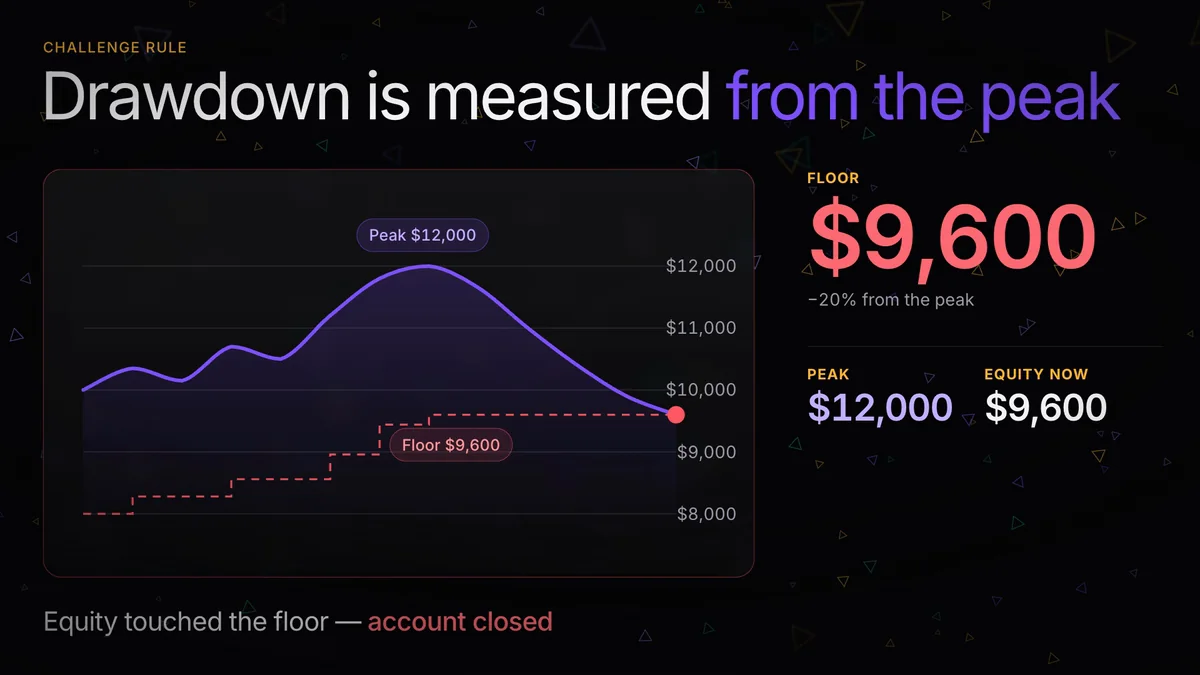
Do the math. On a $10,000 account the overall drawdown limit is 20%, or $2,000. Put $2,000 into each trade and one bad streak of two or three markets ends the account. With positions of $500, you’d need to lose four full positions in a row to reach the limit — and that’s before counting any winners in between.
This matters more on prediction markets than almost anywhere else, because a position can go to zero in a minute: a goal in the 89th minute, a surprise number in a data release, a sharp BTC move in the last seconds of a five-minute window. There’s no stop-loss that closes you out at −2%. The outcome either happens or it doesn’t.
Choosing a position size
5% is a ceiling, not a recommended size. A workable approach is to decide in advance how much you’re willing to lose on one idea and size from there.
- A strong view on a liquid market — you can get closer to the maximum. Think of a top-league match with a deep order book and a stable price.
- Short crypto windows — go smaller. Five-minute BTC windows often trade around 50¢ and the result depends heavily on noise. Several positions at 1–2% of the account survive a bad run better than one large one.
- A thin order book — go smaller. A big buy in a low-volume market fills at an average price above the current one, or doesn’t fill at all. More on that in the article on the order book and slippage.
Keep the outcome price in mind too. A $500 position at 20¢ is 2,500 shares and can return up to $2,500. The same $500 at 80¢ is 625 shares and a maximum of $625. The risk is the same, the upside isn’t, so size each trade against the price and your own estimate of the probability.
When an order is rejected
The buy panel always shows the reason. If it’s the per-outcome limit, cut the amount to the remaining room shown or close part of the position. If it’s drawdown protection, wait for the open markets to resolve — room frees up as they close.
If the order was rejected because of the order book, the limits have nothing to do with it: the market simply doesn’t have enough offers for that amount.