Polymarket is the largest prediction market: a venue where event outcomes are traded. Every outcome has a price between $0 and $1, and that price shows how likely the market thinks the event is right now. When the event resolves, shares of the correct outcome pay $1 each and the rest pay nothing.
What a market is made of
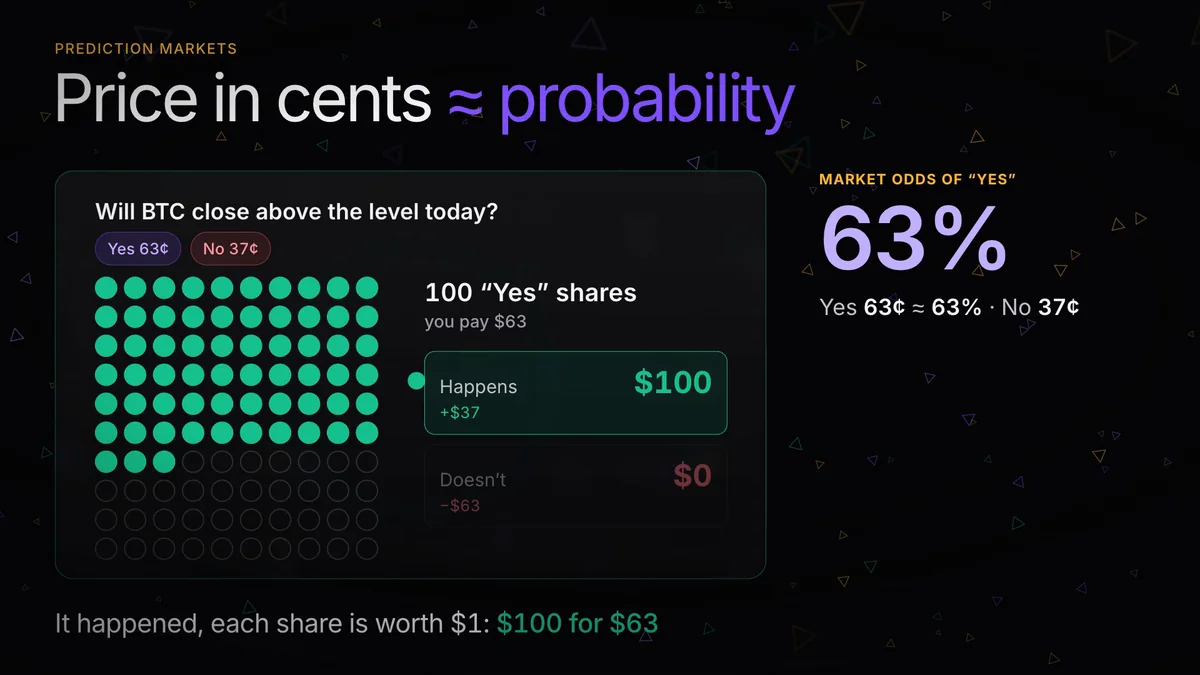
Take the question “Will Bitcoin close above $100,000 today?”. It has two outcomes, “Yes” and “No”. If “Yes” trades at $0.63, the market puts the probability at roughly 63%. “No” sits near $0.37, because together the two outcomes add up to a dollar.
Buy 100 “Yes” shares at $0.63 and you pay $63. Bitcoin closes above the level: you receive $100, a $37 profit. It doesn’t: the shares go to zero and you lose $63.
Questions are often grouped into an event with several markets. “Who wins the match” means separate markets on each team and on a draw. “Bitcoin price at 6 PM” is a ladder of markets at different levels. Each market has its own order book and its own price.
Price as probability
On a stock exchange, a share price doesn’t directly tell you anything about the future. On a prediction market the price is the estimate: $0.20 means roughly a 20% chance, $0.90 means 90%. A trader here profits from the gap between the price and their own estimate, not from “the price going up”.
If you think an event has a 50% chance and it trades at $0.35, buying “Yes” has positive expected value. If your estimate matches the market price, you have no edge, however confident you feel about the outcome. More on this in Prices are probabilities.
How the price is formed
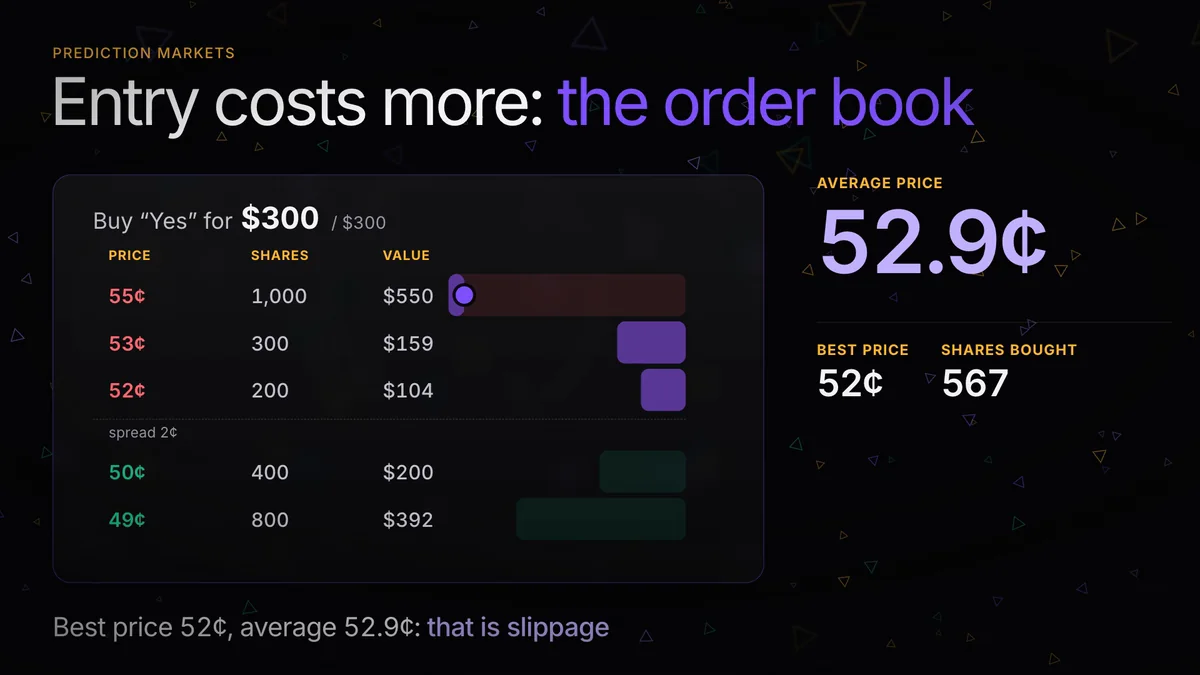
Polymarket runs an order book, like an exchange. Some participants post offers to sell (asks), others post bids. A market buy takes the cheapest offers one after another, so a large order in a thin market fills at an average price worse than the top of the book.
You don’t have to hold to resolution. During a match the “Yes” price might move from $0.40 to $0.75, and you can sell into the book and lock in profit before the final whistle. Plenty of traders work exactly like that: they trade the movement of the probability rather than the result itself. How this plays out in practice: Order book and slippage.
Who decides how the event ended
Each market has rules and a resolution source. For sports it’s the official match result; for crypto up/down windows it’s the Chainlink price at the moment the window closes; for macro data it’s the official release. Read the rules before you trade: they define what counts as the event happening and what happens if a match is postponed or a result is disputed.
When an event can’t be determined cleanly, the rules sometimes call for a 50/50 resolution, where every share is worth $0.50.
What markets you’ll find
Polymarket lists thousands of markets: politics and elections, sports and esports, crypto, economics, tech, culture, weather, even how many posts a public figure makes in a week. Some markets run for months, others for minutes. Bitcoin and Ether up/down windows, for example, open every 5 and 15 minutes.
Who sets the price
Prices on Polymarket come from the participants themselves through the order book; the venue has no line of its own. One trader’s profit is another trader’s loss after a worse probability estimate. Structurally it’s closer to a derivatives exchange: you buy and sell outcome contracts, can exit at any time and can see the full depth of the market.
Trading Polymarket markets without a wallet
Trading on Polymarket itself requires a crypto wallet, USDC deposits and access from your country: placing orders is restricted in some jurisdictions. Viewing prices and order books works from anywhere.
Prop Hub takes that live data, meaning prices, order books and results, and lets you trade it with virtual capital. No wallet or crypto needed: you buy and sell outcomes against the real Polymarket book, and positions settle on Polymarket’s results. Events that resolve within 2 days are tradable; the categories are listed in the Help Center.
Real money enters on the funded account: pass the prop challenge and you keep up to 90% of the profit. You can start with the free $100 account that opens when you sign up.