An outcome trading at 63¢ on Polymarket is the market saying the event has about a 63% chance. Each share pays $1 if the outcome happens and $0 if it doesn’t, so the share price and the probability are the same number written two ways. Here is where that link comes from, how to build trades on it, and when not to take it literally.
Why price equals probability
Take a market such as “Will BTC close above a given level today?”. The “Yes” outcome trades at 0.63. Buy 100 shares and you pay $63. If it happens you get $100. If it doesn’t, you get $0.
A fair price for that share is the one where the trade breaks even on average. If the event happens with probability p, one share is worth p × $1 on average. Buyers and sellers keep trading until the price sits near the p they collectively believe in. Hence the rule of thumb: price in cents ≈ probability in percent.
In a Yes/No market the two sides complement each other. If Yes costs 63¢, No costs about 37¢. They add up to slightly more than $1 because of the spread between buy and sell prices, covered below.
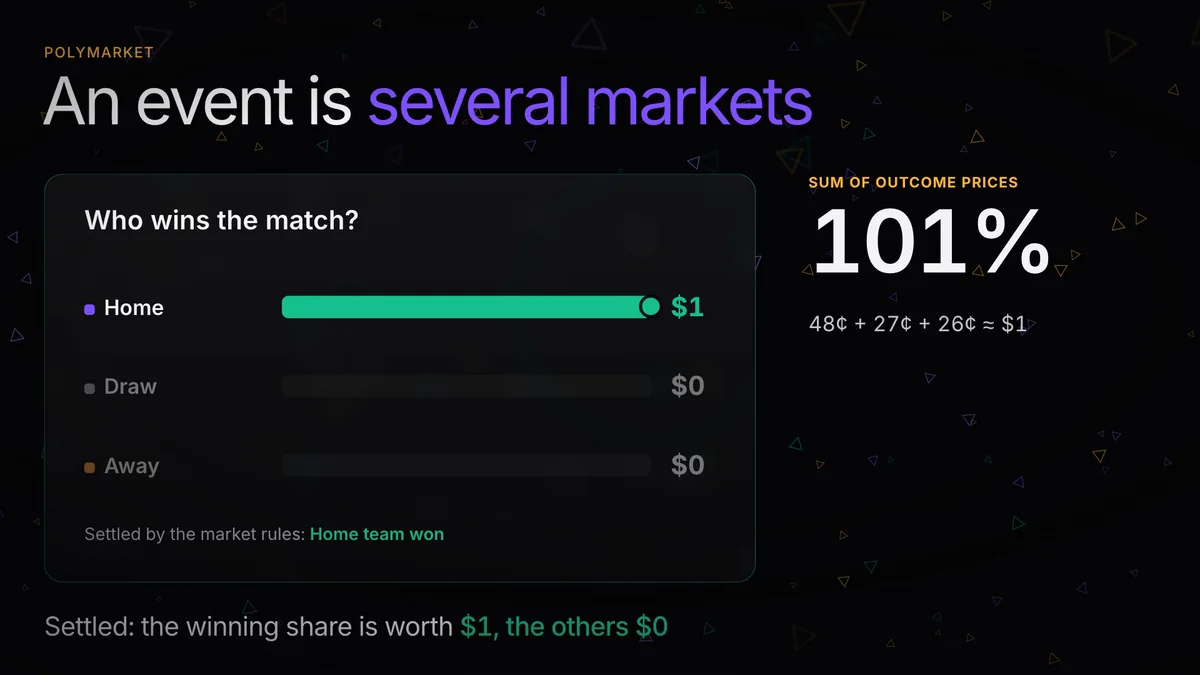
Events with several outcomes (who wins a tournament, which range a price lands in) work the same way: all outcome prices together add up to roughly 100%. A noticeably higher total means the market is overpriced as a whole; a lower one means something is cheap.
Pricing a trade before you enter
Before every buy, answer one question: how far is your estimate from the market price?
Example. The market prices an outcome at 40¢. You think the real chance is closer to 50%. You buy $50 worth, which is 125 shares.
- It happens: 125 × $1 = $125, a $75 profit before fees.
- It doesn’t: a $50 loss.
- Average result at your 50% estimate: 0.5 × $75 − 0.5 × $50 = +$12.50 per trade.
If you agreed with the market at 40%, the average result would be about zero and negative after fees. So the core idea is simple: buy where your estimate differs from the price and you can say why. Buying a favourite at 85¢ gives you nothing on its own. You pay almost the full value for an almost certain outcome.
Fees change the maths
On some markets Polymarket charges a taker fee, and Prop Hub deducts exactly the same fee from the virtual balance. As a share of the trade amount it equals the market’s fee rate × (1 − price), so cheap outcomes pay more and expensive ones less. The average fee across trades on the platform is about 2.8%. If your edge over the market is two or three percentage points, the fee can eat all of it. The formula and worked examples are in the help center: Fees and execution.
When the price misleads
A price is the crowd’s estimate, not a fact. A few situations make it dangerous to read literally.
Thin order book
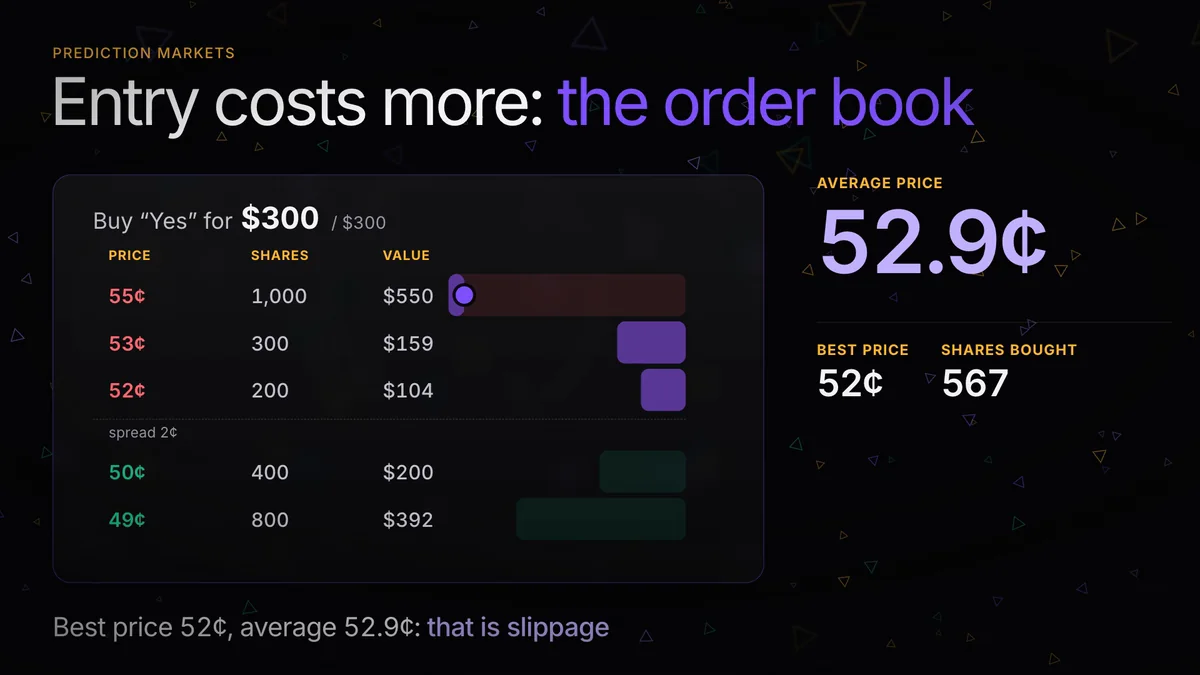
The price on the button is the best offer in the order book. If only a handful of shares sit behind it, a large buy fills at a higher weighted average because it eats the next levels too. On a market with a couple of thousand dollars of volume, one trade can move the price 5–10 points. Such a price tells you less about probability than the price of a liquid market. More in the article on the order book and slippage.
Spread
Every outcome has two prices: the one you can buy at and the one you can sell at. The gap is the spread. On liquid markets it is 1¢, on thin ones 5¢ or more. Buy and sell straight away and you lose the spread. Keep it in mind if you plan to exit before the outcome is known.
Extreme prices
Outcomes at 2¢ and at 97¢ behave differently from what they seem. Buying at 97¢ earns 3¢ per share while risking all 97¢. One surprise wipes out the profit of dozens of such trades. Cheap outcomes at 2–3¢, on the other hand, are often priced above their real chance: sellers want a premium for holding the nearly hopeless side.
News moves faster than the book
Prices don’t react to news instantly. On sports markets a goal or a red card changes the probability within seconds, and the quotes in the book are stale at that moment. That’s why sports orders wait for a short market delay before they fill, the same way Polymarket handles them. More in the article on live sports markets.
Using it on your account
The price is a starting point. The job of a prediction market trader is to find where the crowd is wrong and take a position sized so that a mistake doesn’t wreck the account.
- Write down your estimate before you look at the price. It shows whether you really see something the market doesn’t.
- Work out the average result after fees. No edge after fees, no trade.
- Check volume and the order book. On a thin market, trade smaller.
- Keep the position size within the rules. On Prop Hub the total you buy into one outcome is capped at 5% of the starting balance, which is $500 on a $10,000 account. Why that cap helps is covered in risk per trade.
You can switch how prices are shown in the app settings: cents, decimal, American and other formats. Underneath it is the same number, a probability.
The easiest place to practise is the free $100 account: the same prices and rules, with cheaper mistakes.