The 2026–27 NBA regular season opened on October 20 with three games, and all 30 teams will have played by October 22. From there each team plays 82 games through April 11, 2027, and almost every night Polymarket lists dozens of new markets. For a trader, no other league produces this many short-dated markets in a season.
Here is what a single NBA game offers, how to read it using an opening-night example, and which part of it you can trade on a Prop Hub account.
The markets on a single game
Every game on Polymarket comes with a whole set of markets. Sixers at Knicks on October 20 had more than forty. The main groups:
| Market | What it pays on | Price on October 20 |
|---|---|---|
| Moneyline | who wins the game, overtime included | 76ers 38.5¢, Knicks 61.5¢ |
| Spread | winning by more than a set margin | Knicks −5.5 at 46.5¢ |
| Total | combined points over or under a line | Over 231.5 at 52.5¢ |
| First half | moneyline, spread and total for the first two quarters | 1H winner close to 50/50 |
| Player props | a player’s points, rebounds or assists over a line | dozens of lines per game |
| Other | first team to score, odd/even final score | around 50¢ |
The NBA moneyline has two sides only. Basketball has no draws; a tie goes to overtime, and overtime counts. If the game is postponed, the market stays open until it’s played. If it’s cancelled outright, this market’s rules settle it 50-50. Each market has its own rules page, and it’s worth reading before you buy.
Reading the prices
A share price is a probability estimate. Knicks at 61.5¢ means the market gave the home side roughly a 61% chance. The share pays $1 if the outcome happens and $0 if it doesn’t. There’s a longer explanation in prices are probabilities.
A game carries several spread and total lines. Knicks −2.5 traded at 57.5¢, −5.5 at 46.5¢, −8.5 at 37¢. The bigger the margin, the cheaper the outcome. The line sitting near 50¢ is the margin the market considers most likely, which makes it a quick way to compare your view with the market’s. If you expect New York by ten and the market centers around five, that gap is your trade.
Totals work the same way. Lines at 229.5, 231.5 and 235.5 show how the market spreads probability across the combined score. Early in the season totals move a lot: teams are still finding their pace, and there’s little data on new lineups.
Why the first weeks are different
In October the market knows less than it will in January. Rosters changed over the summer, newcomers have no numbers with their new teams, and every record reads 0–0. Prices lean on last season and the offseason, then reprice quickly after the first results.
What that means in practice:
- News moves prices harder. Whether a star suits up can shift a moneyline by several cents. Before buying, check when the price last moved, not just where it is.
- Player props are noisy. A points line in game one is based on last year. For a player in a new role or a new uniform, the miss can be large either way.
- One game proves little. A blowout on opening night is a reason to look closely at the next price, not a verdict on the season.
What you can trade on Prop Hub
Prop Hub only lists short-horizon markets: a game becomes available once it starts within 2 days. NBA games show up under Sports at that point and stay there while the game is played. Trading continues after tip-off for as long as Polymarket accepts orders; the details are in live sports trading.
Season-long markets aren’t on the account. “NBA 2027 Champion” was trading on Polymarket on October 20 (Spurs 22.5¢, Thunder 19.5¢), but it doesn’t close until summer 2027, so it falls outside the Prop Hub horizon. The same goes for conference winners and the NBA Cup.
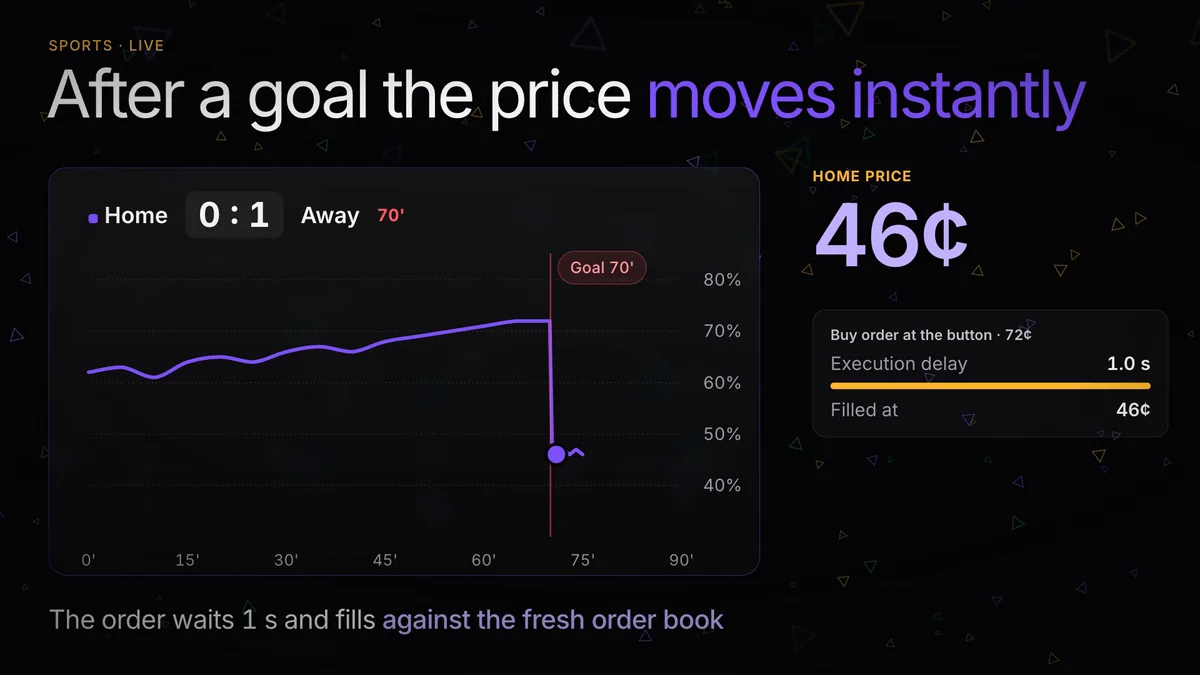
Orders fill against the Polymarket order book, and the fee is whatever Polymarket charges on that market, about 2.8% of the trade amount on average. Where a sports market has an execution delay, the order waits it out and then fills against the fresh book.
Late tip-offs and the daily limit
Most NBA games start between 23:00 and 03:30 UTC. That matters for your account: daily drawdown is measured from equity at the start of the UTC day, capped at 10%. A game tipping off at 01:30 UTC belongs to the next trading day, even if for you in Europe it’s the same night. A position opened for a 23:00 game and one for a 02:00 game land on different days.
The second rule is the per-outcome cap: the total of all buys in one outcome can’t exceed 5% of the starting balance, which is $500 on a $10,000 account. On a ten-game night the easier mistake is a different one: a position in almost every game, each within the cap, all losing together. Daily and total drawdown walks through how that adds up.
A plan for the opening weeks
- Pick two or three teams whose rosters you actually follow and trade their games. Nobody tracks all thirty in week one.
- Compare moneyline, spread and total on the same game. If you’re confident in a home win but not the margin, the moneyline fits your view better than the spread.
- Log your entry price and the reason for each trade. After two weeks you’ll see where your view beats the market and where it doesn’t.
- Start on the free welcome account: the same markets and execution rules. When you’re ready, pick a challenge on the plans page.
How the Market page and sports filters work is covered in the help center.