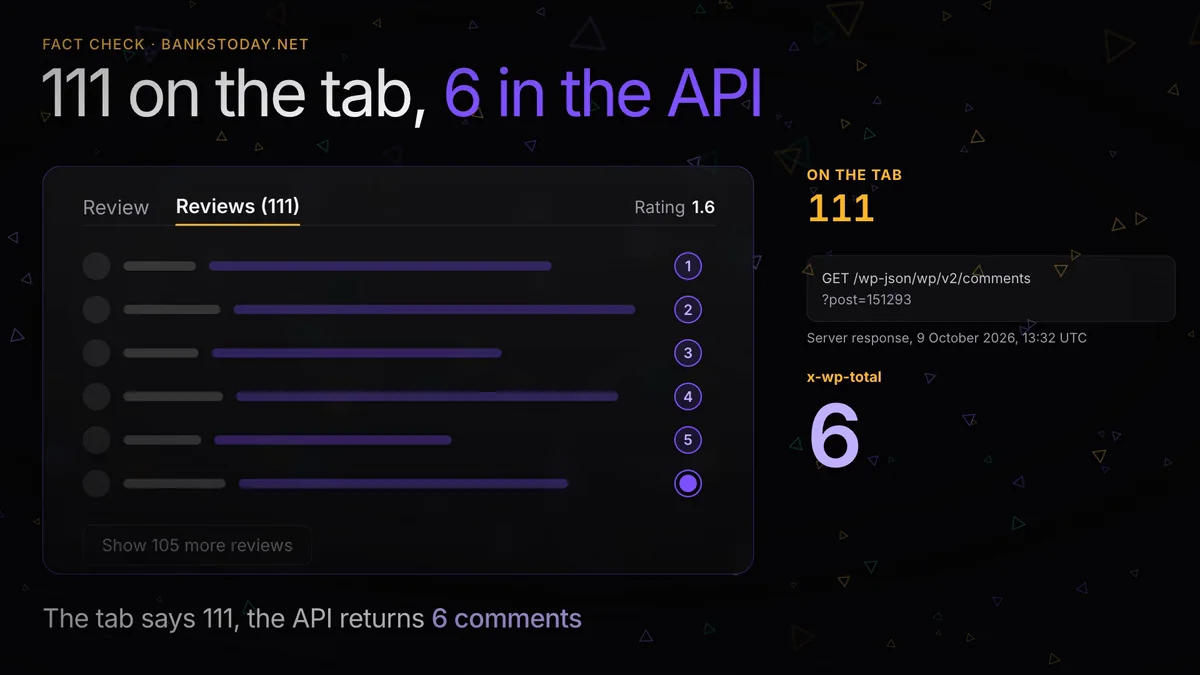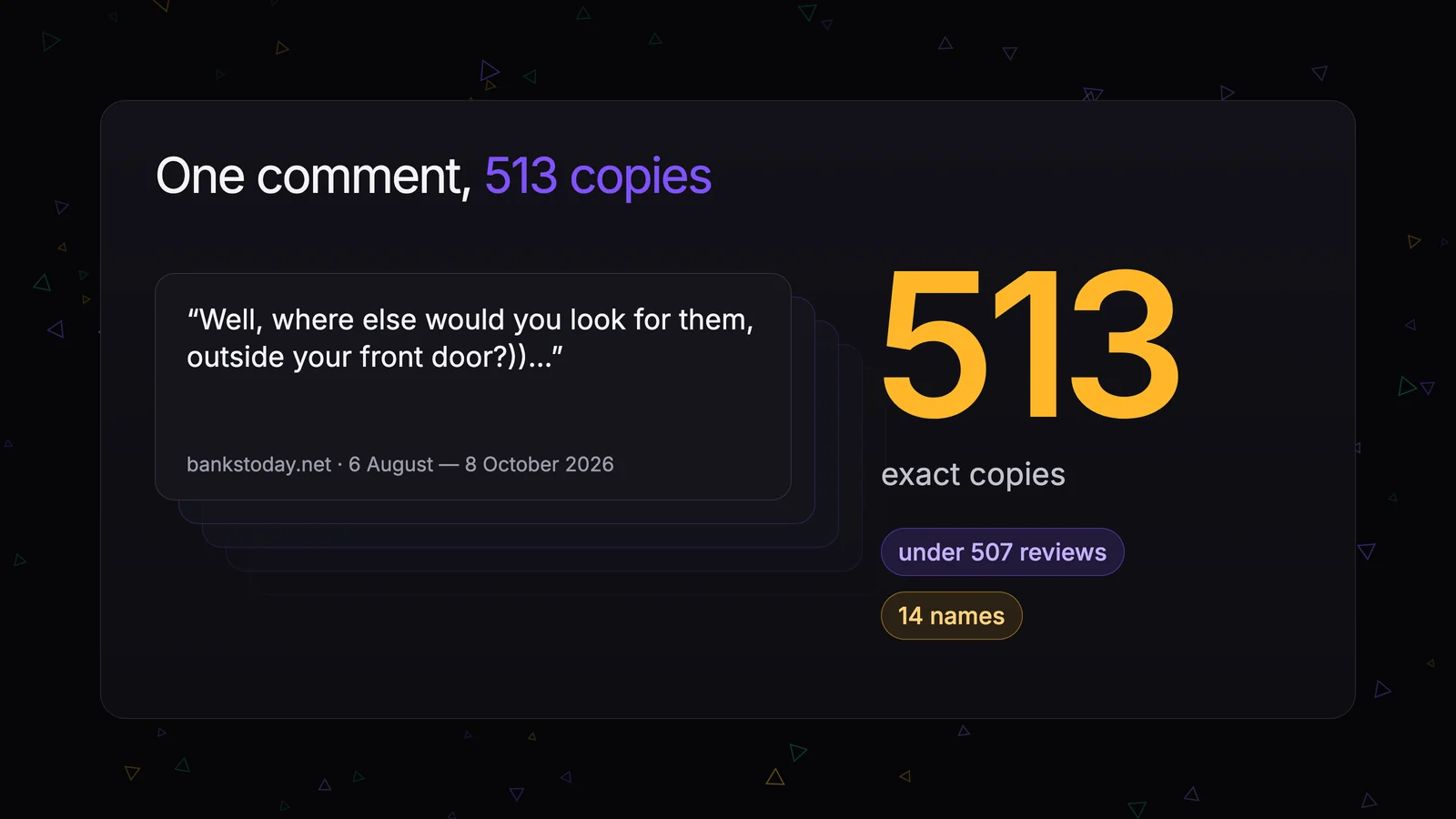
Under the “review” of Prop Hub on bankstoday.net, a Russian-language broker rating site, there is a reply that reads, in translation, “Well, where else would you look for them, outside your front door?))…”. The same text, down to the last comma, is published on that site 513 times under 507 different reviews. It is signed by 14 different “users”, with dates from 6 August to 8 October 2026. Next to it sits another comment, “Right. I also used to think they were all more or less the same…”, also in 513 copies, and every copy ends with a link to a project called Eldor, ranked first on the site’s own list.
Below is how we counted this and how you can repeat the check without us. A browser is enough, and the method works on many review sites, not only this one. The review itself and its factual errors are covered in 111 Prop Hub reviews that don’t exist.
Where the numbers come from
bankstoday runs on WordPress. WordPress ships with a REST API that is open by default: anyone can request published comments as JSON.
Two requests do the job:
bankstoday.net/wp-json/wp/v2/comments?post=151293lists every published comment on the Prop Hub review (151293 is the post ID).bankstoday.net/wp-json/wp/v2/comments?search=<phrase>searches comments across the whole site.
The server reports the total number of matches in the x-wp-total response header and the number of pages in x-wp-totalpages. Results come in pages of up to 100 (per_page=100&page=2 and so on).
On 9 October 2026 at 13:32 UTC the responses were as follows. The headers are saved in the Internet Archive; the phrases are searched in the original Russian.
| Request | x-wp-total | Copy |
|---|---|---|
| Comments on the Prop Hub review | 6 | headers |
| Search for the “front door” reply | 616 | headers |
| Search for the “Right. I also used to think” comment | 515 | headers |
| Search for “luring gullible clients with promises of high returns” | 14 | headers |
WordPress search matches comments containing the words of the phrase, so its counter runs higher. Download the results and compare full texts, and you get 513 exact copies of each of the two comments.
Two texts, 513 copies each
The “front door” reply answers a generic comment about brokers. 513 copies under 507 reviews, 14 author names, 6 August to 8 October. It names no project at all, which is why it fits under any review.
“Right. I also used to think they were all more or less the same…” also has 513 word-for-word copies. Each ends with a link to a “top project”, Eldor. Eldor is ranked first in bankstoday’s rating “by visitor scores”. On our page this text is not a review of Prop Hub. It is an advert for another project.
On 9 October the same two texts were also running in the site’s “Comments LIVE” block under yet other names (screenshot).
The “yet another pseudo-broker” template
Another comment under our review opens with “Apparently, Prop Hub is yet another pseudo-broker…”. Searching for the rest of the sentence, “luring gullible clients with promises of high returns”, returns 14 matches. The text is identical each time except for the company name, for example “EFG is yet another pseudo-broker…”. It is a fill-in-the-name template, not anyone’s experience.
Timestamps with identical seconds
Every comment in the API has an id (its database number) and a date (the date the site displays). WordPress hands out IDs in the order records are written, so a later record gets a higher number.
Three comments under our review, the Liquidity Hub one, the “pseudo-broker” one and “Prop Hub is yet another rip-off!”, are dated:
- 24.09, 12:14:29
- 27.09, 00:14:29
- 30.09, 12:14:29
Same seconds, exactly 60 hours apart. Yet all three IDs (326901–326908) are higher than that of a comment dated 30.09, 21:57 (325826). They were written to the database later and given earlier dates.
The “pseudo-broker” comment of 27.09 says users complain they can’t withdraw. Our first withdrawal request came in on 5 October. On 27 September there was nothing to withdraw and nothing to complain about.
Is it advertising?
bankstoday has an “Advertise with us” page (copy) linking to a price list (copy). One of the services listed is “native integration into an existing article: placing materials, links, images or notes into content already published on the site”.
We don’t know whether the comment linking to Eldor was paid for. But the question is obvious: if the review section can carry advertising, how much is a rating “by visitor scores” worth? And where is the ad label? More on that, and on the site’s claimed media status, in a media license missing from the registry.
Check it yourself
- Open
https://bankstoday.net/wp-json/wp/v2/comments?search=Вот да. Я тоже раньше думал&per_page=100in your browser. The site only serves content on the second request: the first response is a redirect that sets a check cookie. If you don’t see JSON, reload. - Open developer tools (F12), go to the Network tab, click the request and look under Response Headers for
x-wp-total. - To see which posts the copies sit under, add
&_fields=id,date,post,link.postis the review ID,linkis the comment’s address on the site,idanddateare the database number and the displayed date. - Further pages:
&page=2,&page=3and so on up tox-wp-totalpages.
The same approach works on any WordPress site where the API hasn’t been closed. Signs of manufactured reviews worth looking for:
- the same text under reviews of different companies;
- identical seconds and round intervals in the timestamps;
- comment IDs that don’t match the order of the dates;
- a link to the site’s own “number one” project;
- a review counter on the page that is higher than
x-wp-totalin the API.
What Prop Hub actually is
If you are here to work out what we are: Prop Hub evaluates trading skill on a virtual account using live Polymarket prices. A challenge costs $30 to $500, which pays for the evaluation; we take no deposits. Pass, and you get a funded account with up to 90% of the profit paid in real money. You can try it without paying: sign-up comes with a welcome account of $100 for 3 days. How to judge any prop firm by its documents rather than its reviews is covered in how to choose a prop firm.