With a broker, you trade your own money. Deposit $1,000 and every dollar you make or lose is yours. With a prop firm, you pay a fee to be evaluated, trade the firm’s capital under its rules and keep a share of the profit. Nearly every other difference follows from that: risk, rules, withdrawals, even the way you end up making decisions in the market.
If you want the basics of prop trading first, start with what prop trading is. This article sticks to the comparison, so you can work out which model fits you.
The short version
| Broker | Prop firm | |
|---|---|---|
| Money in your trades | your deposit | the firm’s capital (often simulated) |
| What you pay | commissions, spread, sometimes overnight financing | a one-time challenge fee |
| Worst-case loss | the whole deposit, more with leverage | the fee |
| Trading rules | margin requirements only | profit target, drawdown limits, position limit |
| Profit | all yours | a split, usually 80–90% |
| Withdrawals | any time, up to free balance | on request, after a trade review and ID check |
| Account size | whatever you can fund | chosen from a price list |
Whose money is on the line
A broker is an intermediary. It holds your funds, routes your orders to an exchange or fills them itself, and earns on every trade. Whether you finish the month up or down makes little difference to it: the commission is charged either way.
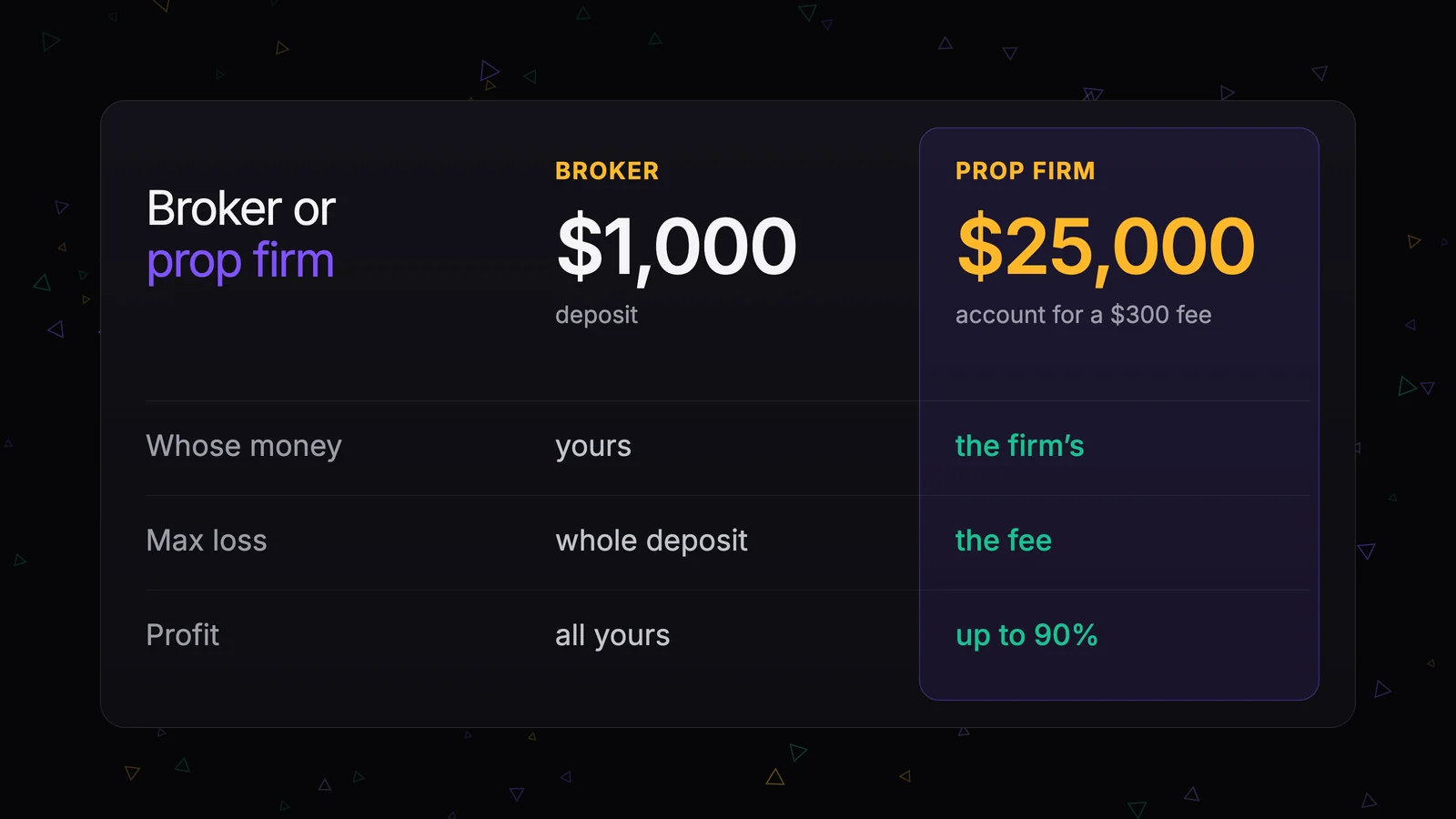
A prop firm puts up the capital, so it decides in advance how much you’re allowed to lose. Break a limit and the account closes. You don’t owe the firm anything. The money you can actually lose is the fee you paid.
Here’s how that looks in numbers. A trader with $300 at a broker can trade $300 and, in the worst case, lose all of it. The same trader pays $300 for a challenge and trades a $25,000 account. The worst case is losing the fee, while positions — and potential profit — are many times larger.
What trading costs
Broker costs are spread across your activity: a commission per order, the spread, financing on leveraged positions held overnight. Trade a lot and you pay a lot, even if you end the month flat.
At a prop firm, the main cost is the fee. On Prop Hub it is not refunded, whether you pass the challenge or not. Costs inside each trade usually mirror the market. On Prop Hub the trading fee is exactly what Polymarket charges on that market — about 2.8% of the purchase amount on average — and orders fill against the live order book. The details are in our piece on the order book and slippage.
Margin versus hard limits
A broker only limits you through margin. As long as you have enough collateral, you can hold a position that would wipe out the account if it goes wrong. Protecting you from that is your job.
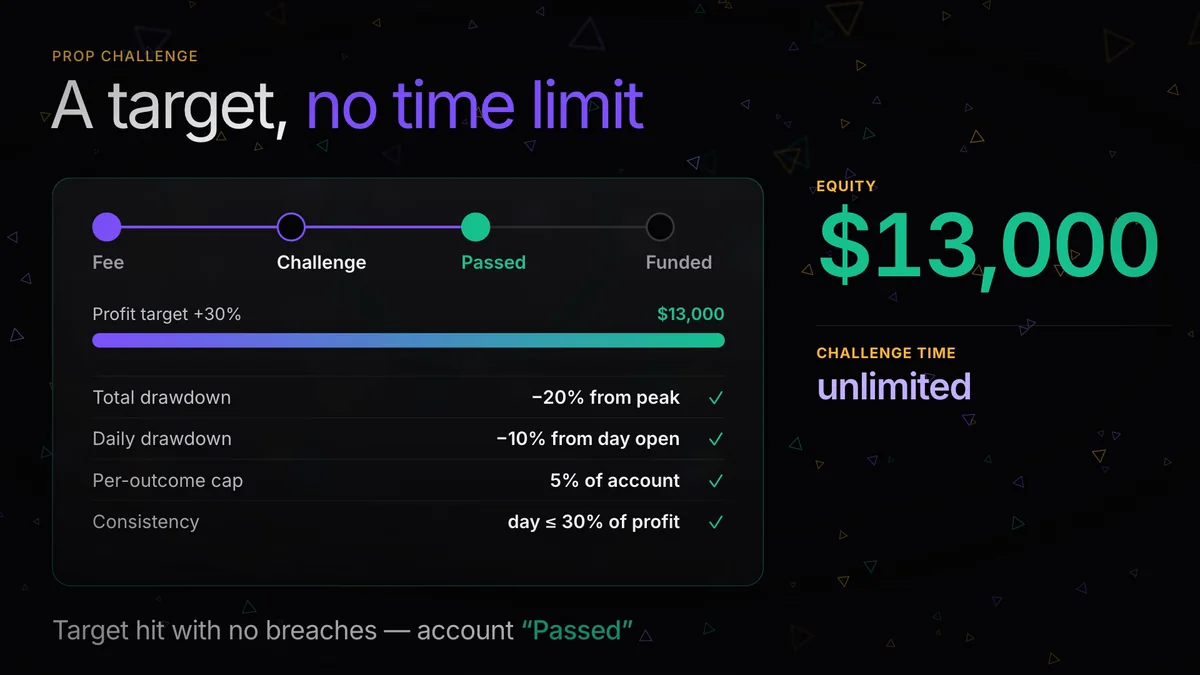
A prop firm writes its rules down up front and enforces them automatically. On Prop Hub they are:
- challenge target: +30% on the starting balance;
- overall drawdown: equity must stay above −20% from its peak;
- daily drawdown: no more than −10% from equity at the start of the UTC day;
- per outcome: no more than 5% of the starting balance;
- at least one trade every 14 days.
Plenty of traders find these limits annoying at first and useful later. Capping a single outcome at $500 on a $10,000 account is exactly the discipline most people skip when trading their own deposit. The full rulebook is covered in prop challenge rules.
Profit and getting paid
At a broker, what you earn is yours in full. You withdraw it, and the only thing left to think about is tax in your country.
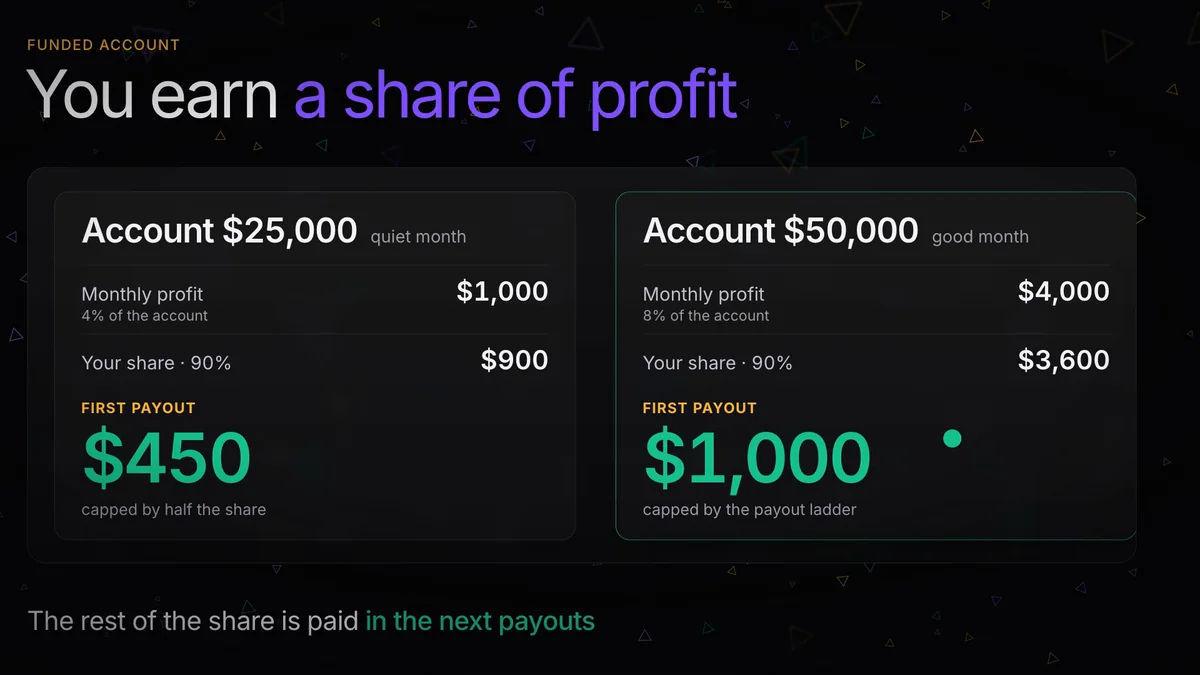
On a prop account the profit is split. On a Prop Hub funded account, the trader keeps up to 90%. Payouts are requested, not instant: no open positions, a review of your trades and identity verification (KYC). Each payout also has a size cap — up to $1,000 for the first, $2,000 for the second and $5,000 after that — with at least 7 days between payouts. Money arrives in USDT or USDC to your own wallet.
It’s slower than a broker withdrawal. The trade-off is that you’re earning on capital you never had to put up.
Regulation and what happens to your order
Brokers usually operate under a licence from a financial regulator, and your orders reach the market. A prop firm isn’t a broker. At most online firms, both the challenge and the funded account are simulations on real prices: trades fill at market quotes, but no order goes to the exchange. The fee pays for the evaluation. It isn’t a deposit.
Prop Hub works the same way. We read Polymarket’s prices and order books, fill your trades against them and settle positions on the results Polymarket itself announces. You don’t need a wallet or crypto to trade, and none of your own money sits in the account. Real money changes hands twice: when you pay the fee and when you receive a payout.
Which one suits you
A broker makes sense if you have capital you’re prepared to risk in full and you want complete freedom: any position size, any holding period, withdrawals whenever you like.
A prop firm makes sense if your skills are ahead of your savings. You risk a fixed amount, get a large account and rules that stop one bad run from ending it. You pay for that with a profit split and a review before each payout.
On prediction markets the gap is wider still. Trading Polymarket directly means a wallet, stablecoins and living somewhere Polymarket allows trading. A prop account needs none of that. You can try the model for free on the welcome account — $100 for 3 days on live markets with the same execution — and compare paid account sizes on the plans page.