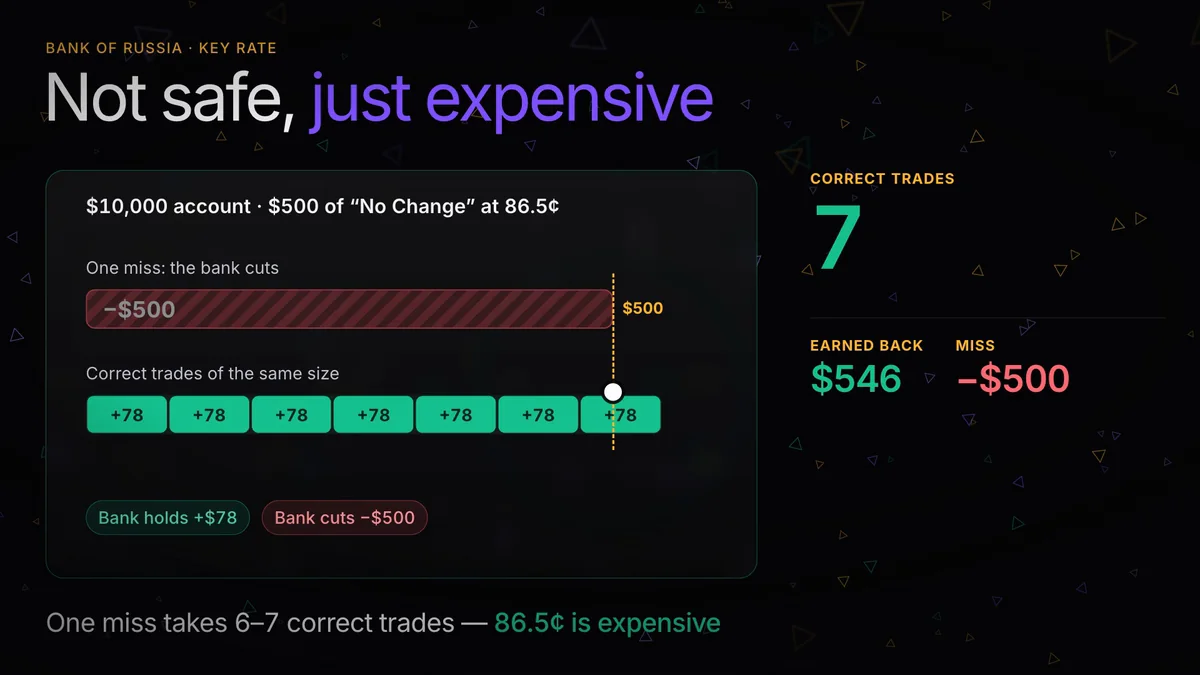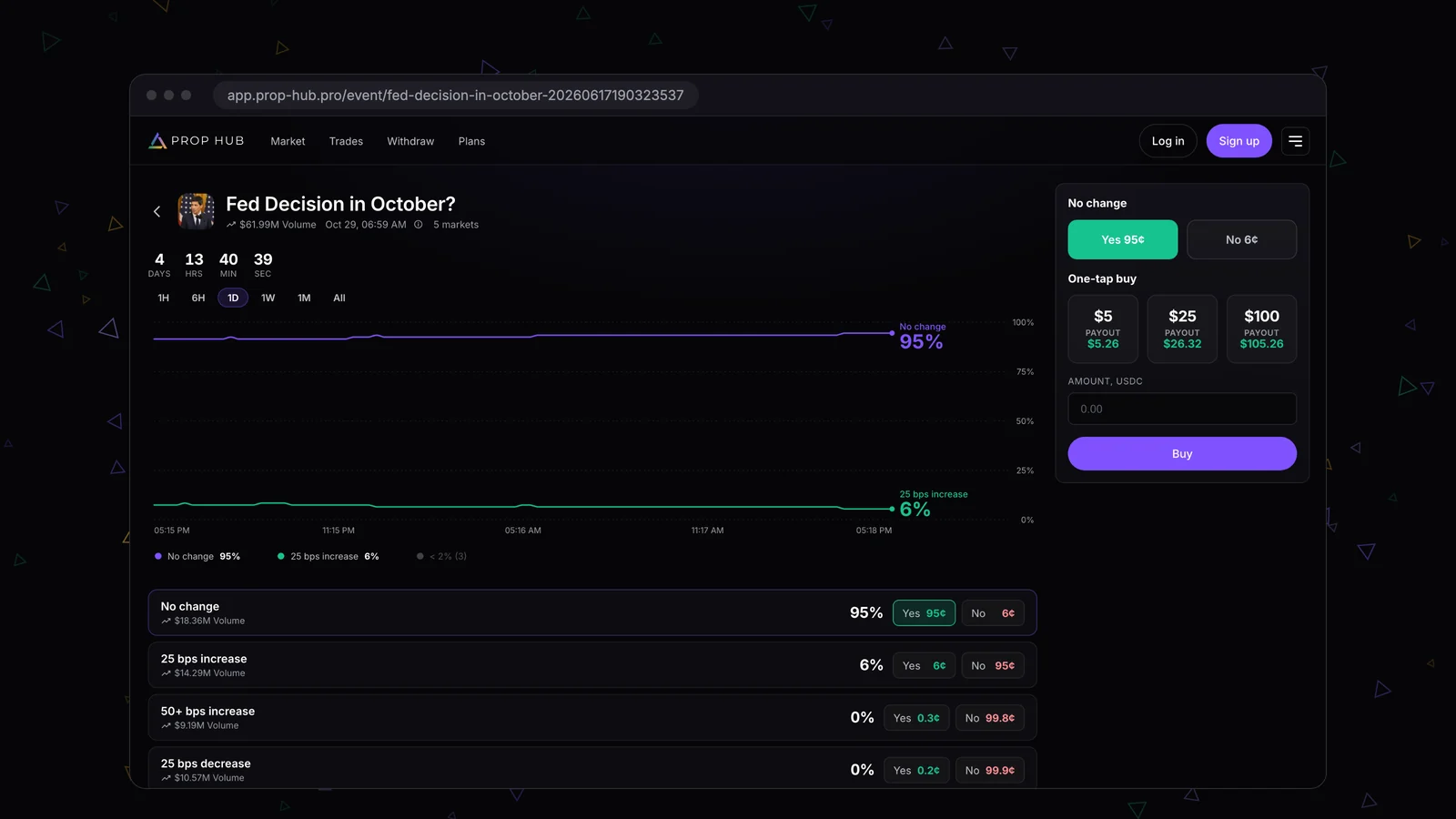
The FOMC meets on October 27–28, with the statement due on October 28 at 2:00 p.m. ET (18:00 UTC). As of October 20, Polymarket’s “Fed Decision in October?” prices a hold at 86.5¢ and a 25 bps hike at 13.5¢. A cut is barely on the board.
A month ago the Fed raised rates for the first time since 2023. So October comes down to a single question: a second hike in a row, or a pause.
Where rates stand
At the September 15–16 meeting the FOMC voted 12–0 to raise the federal funds target range by a quarter point, to 3.75–4.00%. The range had sat at 3.50–3.75% at every meeting from January through July. The statement pointed to solid economic growth and inflation still above the 2% goal.
October is one of the four meetings a year without a Summary of Economic Projections, so there’s no dot plot. Markets will read the decision from the statement itself and from the Chair’s press conference at 2:30 p.m. ET. The next meeting after this one is December 8–9.
How the Fed decision market works
The market measures the change in the upper bound of the target range against its level before the meeting. The upper bound is currently 4.00%. If it stays there, “No change” resolves Yes; if it moves to 4.25%, “25 bps increase” does.
There are five outcomes. “Yes” prices as of October 20:
| Outcome | “Yes” price |
|---|---|
| 50+ bps decrease | 0.05¢ |
| 25 bps decrease | 0.35¢ |
| No change | 86.5¢ |
| 25 bps increase | 13.5¢ |
| 50+ bps increase | 0.35¢ |
A few details from the market rules:
- a move that doesn’t match any bracket is rounded up to the nearest 25 bps, so a 12.5 bps hike counts as 25;
- the resolution source is the FOMC statement after the meeting, along with the Fed’s open market operations page;
- the market can resolve as soon as the statement is out; if no statement is released by the date of the next scheduled meeting, it resolves to “No change”.
Every outcome is its own Yes/No market. “No” on “25 bps increase” trades around 86.5¢ and means almost the same thing as “Yes” on “No change”. The two only diverge if the Fed surprises — cuts, or hikes by 50. Then “No” on the 25 bps hike pays $1 and “Yes” on “No change” goes to zero. For more on reading prices as probabilities, see prices are probabilities.
Polymarket vs. fed funds futures
Wall Street prices Fed decisions through 30-day fed funds futures on CME. Probabilities are backed out of those prices, most famously by the CME FedWatch tool. Polymarket skips that step: the price of an outcome already is a probability.
Most of the time the two agree. When they’re a few points apart, it’s usually one of these:
- Different participants. CME is banks and funds, many of them hedging; Polymarket is mostly individual traders.
- Different mechanics. A futures contract reflects the average rate over a month, so turning it into probabilities takes assumptions. The Polymarket market answers one narrow question: how far does the upper bound move.
- Reaction speed. After a hot CPI print or a jobs report, CME reprices in seconds; Polymarket tends to lag a little.
The comparison is worth making, but a gap alone isn’t a reason to trade. Work out which side is stale first.
Side markets
Polymarket also runs markets around the decision. “How many dissent at the October Fed meeting?” asks how many voters break from the majority. September was unanimous, yet on October 20 “0 dissents” trades at only 26¢, with “2” at 24.5¢, “1” at 19¢ and “3” at 17.5¢. Traders expect a split committee. That market has its own end date, October 28 at 15:59 UTC — before the statement comes out.
When it opens on Prop Hub
Prop Hub lists markets that close within 2 days, based on each market’s end date on Polymarket.
For “Fed Decision in October?” that’s October 29, 03:59 UTC, so it shows up in the app on the morning of October 27 (UTC), as the meeting begins. Until then you can watch the price on Polymarket but can’t buy it. The dissent market, ending October 28 at 15:59 UTC, enters the window earlier, on the afternoon of October 26, and stops accepting buys a couple of hours before the statement.
Positions settle on Polymarket’s resolution. Once the statement is out, market makers pull their offers on the losing outcomes, so there’s nothing left to buy at the old price. On Prop Hub, orders fill against the Polymarket order book at a volume-weighted price, with no partial fills. The Fed market is one of the deepest on the platform, with over $50 million traded, so slippage on normal sizes is small. Details in order book and slippage.
Managing risk on Fed day
A Fed decision is one headline that settles every related market at once. Holding “No change: Yes” and “25 bps increase: No” means two outcomes with separate limits and a single view.
The Prop Hub account rules:
- no more than 5% of the starting balance in one outcome — $1,250 on a $25,000 account;
- before each buy, the system runs the worst case, where every open position goes to zero; if equity would break the daily (10%) or total (20%) drawdown limit, the order is rejected.
Example on a $25,000 account. $1,000 of “No change” at 86.5¢ buys about 1,156 shares. If the Fed holds, that’s roughly $156 profit before fees; if it hikes, you’re down $1,000. The same $1,000 on “25 bps increase” at 13.5¢ buys about 7,407 shares: around $6,400 profit on a quarter-point hike, a $1,000 loss on anything else.
Neither trade is the “right” one. The first usually makes a little; the second rarely makes a lot. Pick the side where your probability differs from the price, and size it so one bad day doesn’t eat a big chunk of your daily limit. The drawdown rules are covered in daily and total drawdown.
On a funded account, keep the price band in mind: profit from positions bought above 90¢ or below 10¢ doesn’t count toward payouts. “No change” at 86.5¢ is inside the band for now, but if it climbs above 90¢, a buy there won’t count toward a payout.
Before October 28
- Compare the Polymarket price with CME FedWatch and note the gap.
- Mark the US inflation and jobs data due before the meeting. Those releases move the price most.
- Decide which view you’re trading — pause or hike — and put one limit’s worth on it, not a full limit on every outcome.
- On October 27, check the market and the book in the app. If you’ve already used part of the day’s drawdown limit, the buy check will take it into account.
Account sizes and fees are on the plans page.