The ATP Finals close the men’s season, and only the year’s top eight singles players and top eight doubles teams get in. The 2026 edition runs November 15–22 on indoor hard courts at the Inalpi Arena in Turin: fifteen sessions over eight days, a group stage, semifinals and a Sunday final.
It’s a convenient event for markets. Top players are on court every day and the field is known in advance. Below: where the tournament came from, how the format works, and which of its markets you can trade on a Prop Hub account.
A short history
The season finale was first played in Tokyo in 1970. It has changed names and homes several times since:
| Years | Name | Where |
|---|---|---|
| 1970–1989 | Masters Grand Prix | various cities, New York’s Madison Square Garden among them |
| 1990–1999 | ATP Tour World Championship | Frankfurt, then Hanover |
| 2000–2008 | Tennis Masters Cup | Shanghai and Houston among others |
| 2009–2020 | ATP World Tour Finals, renamed ATP Finals in 2017 | London, The O2 |
| 2021 on | ATP Finals | Turin |
Novak Djokovic holds the singles record with seven titles; Roger Federer has six. Turin has crowned Alexander Zverev (2021), Djokovic (2022, 2023) and Jannik Sinner (2024, 2025). The 2026 event is the 57th singles edition and the sixth straight in Turin.
Who qualifies
Qualification runs on the year-to-date race ranking, which counts only points earned this season. After the last Masters event of the year in Paris, places go out in this order:
- The top seven in the race.
- Up to two 2026 Grand Slam champions, if they sit between 8th and 20th in the race.
- Any remaining place to the next player in the race.
Two more players travel as alternates. If someone in the top eight withdraws during the week, an alternate takes his spot in the group. That’s why “will he qualify?” and “will he play a match?” are different markets: an alternate can step on court without having qualified.
The format: groups first
The eight players split into two groups of four. The top seed goes into Group A and the second seed into Group B; the rest are drawn. Everyone plays everyone in the group, so three matches each. The top two from each group reach the semifinals, where a group winner meets the runner-up of the other group. Semifinal winners play the final.
Every singles match, final included, is best of three tiebreak sets. Group standings are decided by:
- matches won;
- then matches played (relevant if someone withdraws);
- head-to-head if two players are tied;
- percentage of sets won, then games won, if three are tied.
A round-robin win is worth 200 ranking points, a semifinal win 400 and the final 500. An undefeated champion collects 1,500.
The format creates situations you don’t get at a regular event. Losing your opener doesn’t knock you out. And in the last round one player sometimes has little left to play for, having already qualified or been eliminated. The group table shows it, and the market usually prices it in.
Polymarket markets on the event
As of October 20, Polymarket already had markets on the tournament as a whole:
- Player to Qualify: a separate Yes/No market for each contender. Carlos Alcaraz and Ben Shelton were at $1 for Yes, Daniil Medvedev at 96.4¢, Flavio Cobolli at 89.5¢, Djokovic at 13.75¢.
- Will Djokovic play a match at the ATP Finals?: 26.35¢ for Yes, higher than his qualifying price precisely because he could come in as an alternate.
- Unbeaten Champion?: 59.5¢ for Yes.
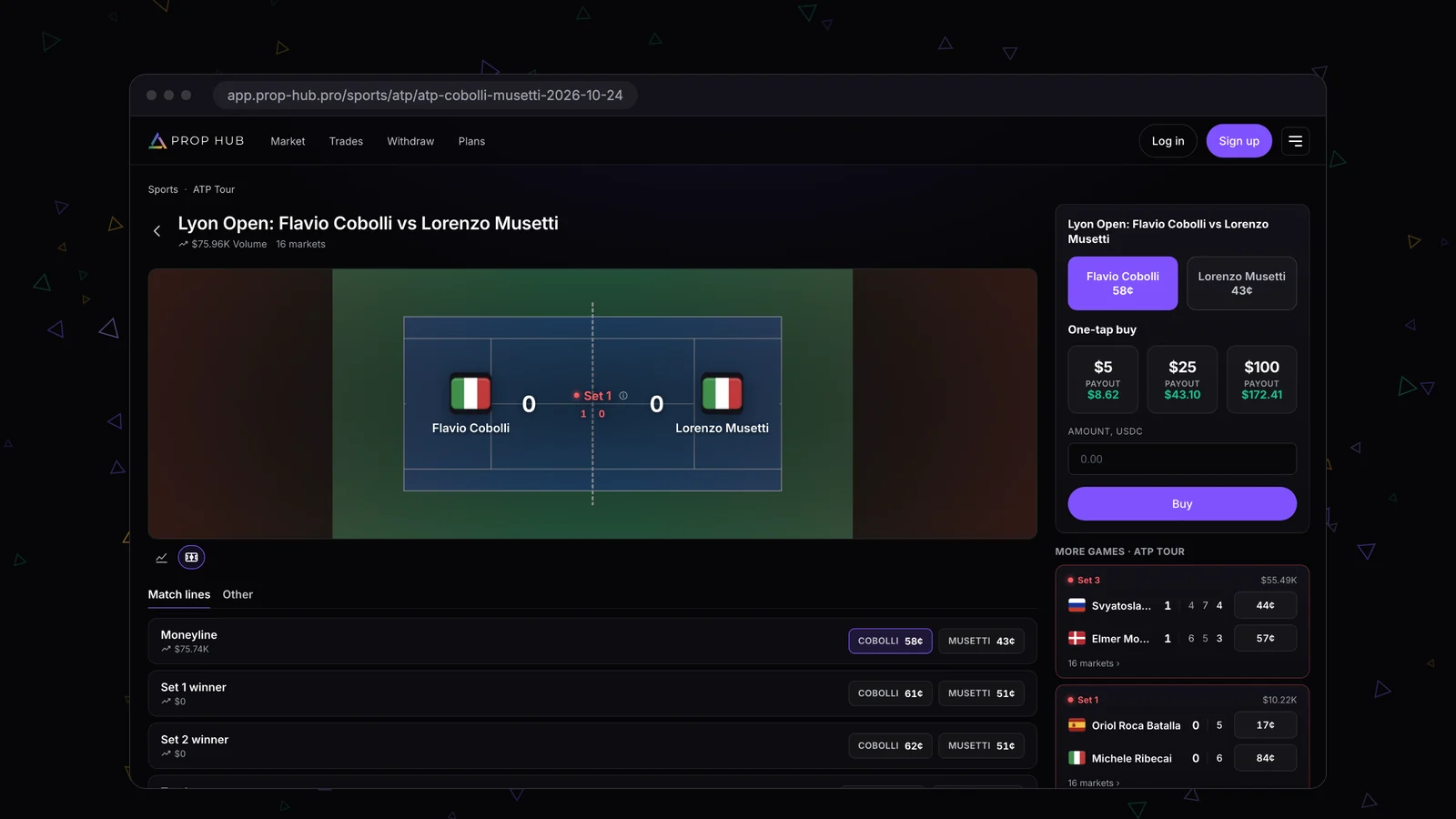
Closer to the start, markets open on each match. A tennis match on Polymarket usually carries the match winner, each set winner, total sets (over or under 2.5, in other words whether there’s a third set), total games in the match and per set, and a set handicap.
How it works on Prop Hub
Prop Hub only lists short-horizon markets. For sports the clock runs from the start of play: a match is available once it starts within 2 days. Every group match in Turin will appear under Sports inside that window and stay tradable during play for as long as Polymarket accepts orders.
The tournament-wide markets won’t show up. Their end date on Polymarket is December 7, and Prop Hub lists a market only when that date is within 2 days. By then the tournament is long over.
A Turin match trades like any other sports market:
- orders fill against the Polymarket order book, with no partial fills;
- the fee is whatever Polymarket charges on that market, about 2.8% of the trade on average;
- if the market has an execution delay, the order waits it out and fills against fresh quotes;
- positions settle on Polymarket’s result: each share of the winning outcome closes at $1, the losing one at $0.
More on in-play trading in live sports markets.
Things to watch during the week
A tiebreak in every set. Best-of-three matches are short, and one break carries more weight than in a five-setter. The match-winner price can swing hard within a set.
Set and match markets overlap. If you hold a player to win the match and add him to win the second set, that’s nearly the same position. The per-outcome cap is counted separately for each market, but the two will most likely lose together.
Two sessions, one trading day. Sessions start at 11:30 and 18:00 Central European Time, both inside the same UTC day. Positions on the afternoon and evening matches share one daily drawdown limit of 10% from start-of-day equity.
Withdrawals. If a player pulls out before or during a match, the market’s own rules decide how it settles. Read the market description before you buy.
Favorites are expensive. A share at 85¢ makes 15¢ on 85¢ invested. On a funded account, profit from positions opened above 90¢ doesn’t count toward the withdrawable amount.
If a price looks wrong to you, test the idea on the free welcome account before buying a challenge on the plans page. The sports section of the Market page is described in the help center.