Every Polymarket market has two sides, Yes and No, and every Yes/No pair is backed by exactly one dollar of collateral. Almost everything else follows from that rule: why the two prices add up to about $1, where new shares come from, how an order finds a counterparty and why a share ends up worth $1, $0 or $0.50 once the event is over. This piece walks through the mechanics from order to payout.
If you want the broader picture first — what Polymarket is and what it lists — start with What is Polymarket. Here we stick to how it runs.
Shares: how they’re created and destroyed
An outcome share is a token that becomes $1 or nothing after the result. There’s no fixed supply. A new pair is created whenever someone puts in a dollar: the contract mints one Yes share and one No share. It also works in reverse — hand in a Yes and a No together and you get the dollar back.
That anchors the prices. A pair can always be minted for $1 and redeemed for $1, so if Yes traded at 60¢ and No at 55¢, someone would mint a pair for a dollar and sell both halves for $1.15. Gaps like that close quickly.
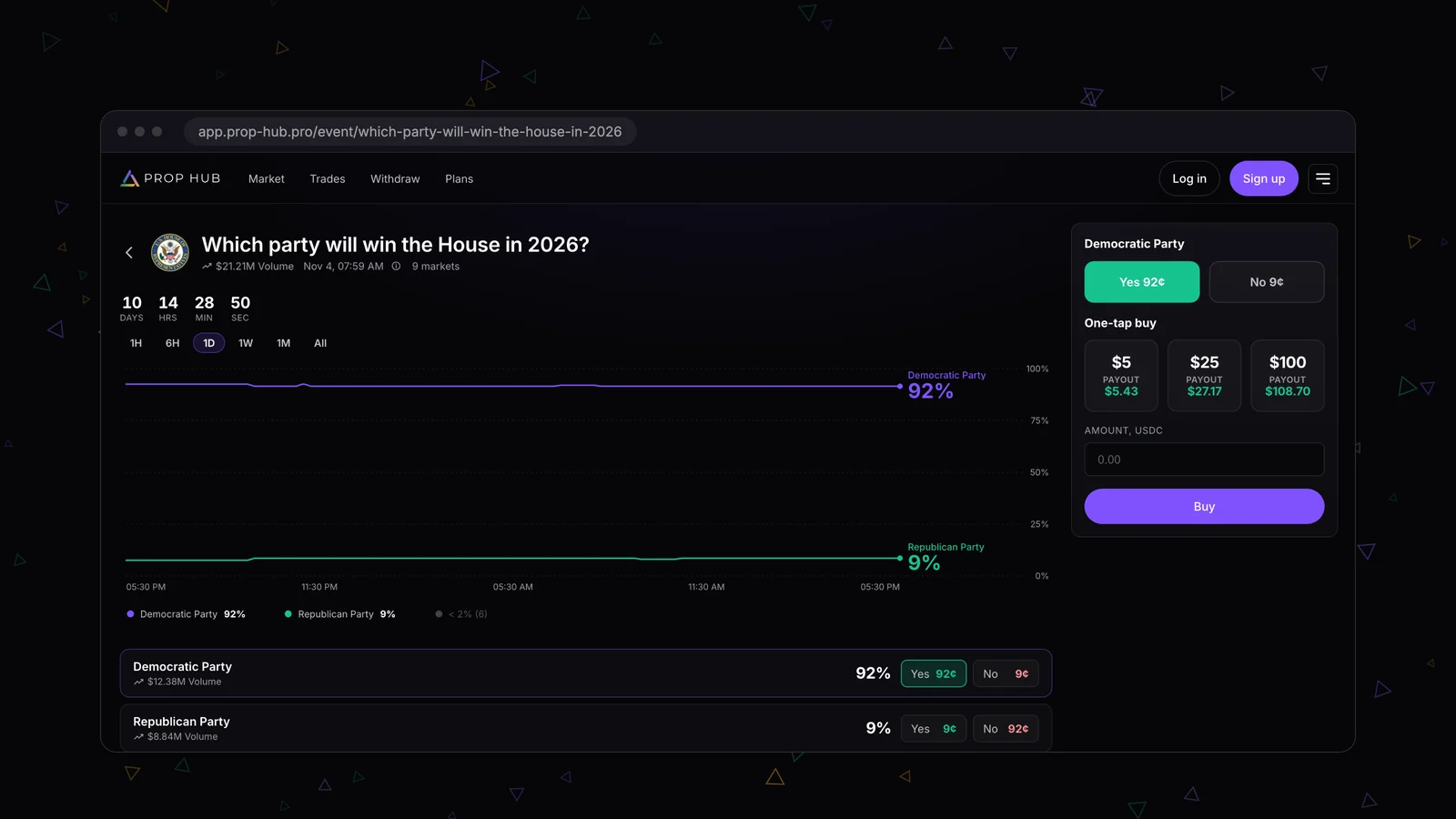
On October 20, the “Which party will win the Senate in 2026?” market had Democrats at 64.5¢ and Republicans at 36.5¢ — $1.01 combined. That extra cent is the spread: you’re looking at prices you’d pay to buy, and buying both sides costs slightly more than the dollar they pay out.
The order book: how orders get matched
Trading runs on a central limit order book (CLOB). Traders post limit orders — “buy Yes at 58¢”, “sell Yes at 61¢”. Polymarket’s operator matches orders off-chain, and settlement happens on the Polygon blockchain, so traders keep custody of their funds throughout.
A match can happen three ways:
| What meets | What happens |
|---|---|
| A Yes buyer and a Yes seller | Shares change hands, as on any exchange |
| A Yes buyer at 60¢ and a No buyer at 40¢ | Together they put in $1, a new pair is minted, each gets their side |
| A Yes seller at 60¢ and a No seller at 40¢ | The pair is redeemed, the sellers receive 60¢ and 40¢ |
The middle row is why the Yes book and the No book are really one book seen from two sides. A bid for No at 40¢ shows up in the Yes book as an offer to sell at 60¢.
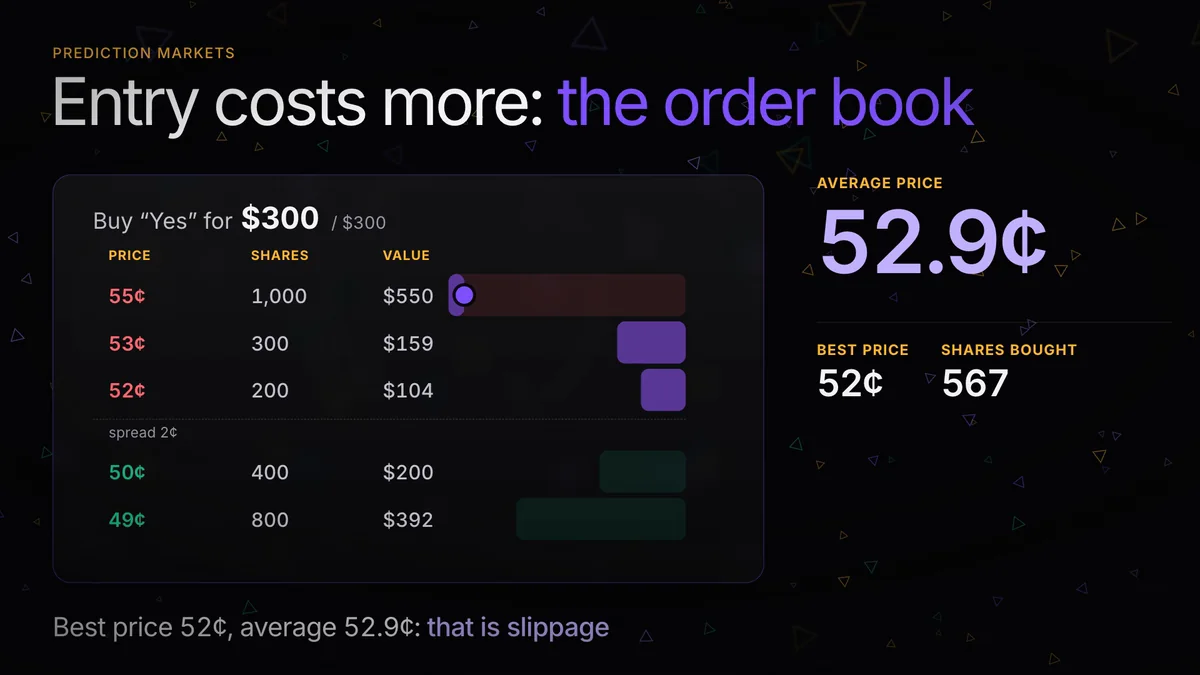
A market buy takes the cheapest offers first and works upward. On a large order the average price ends up worse than the top of the book — that’s slippage, covered in detail in our piece on the order book and slippage.
Events with many outcomes
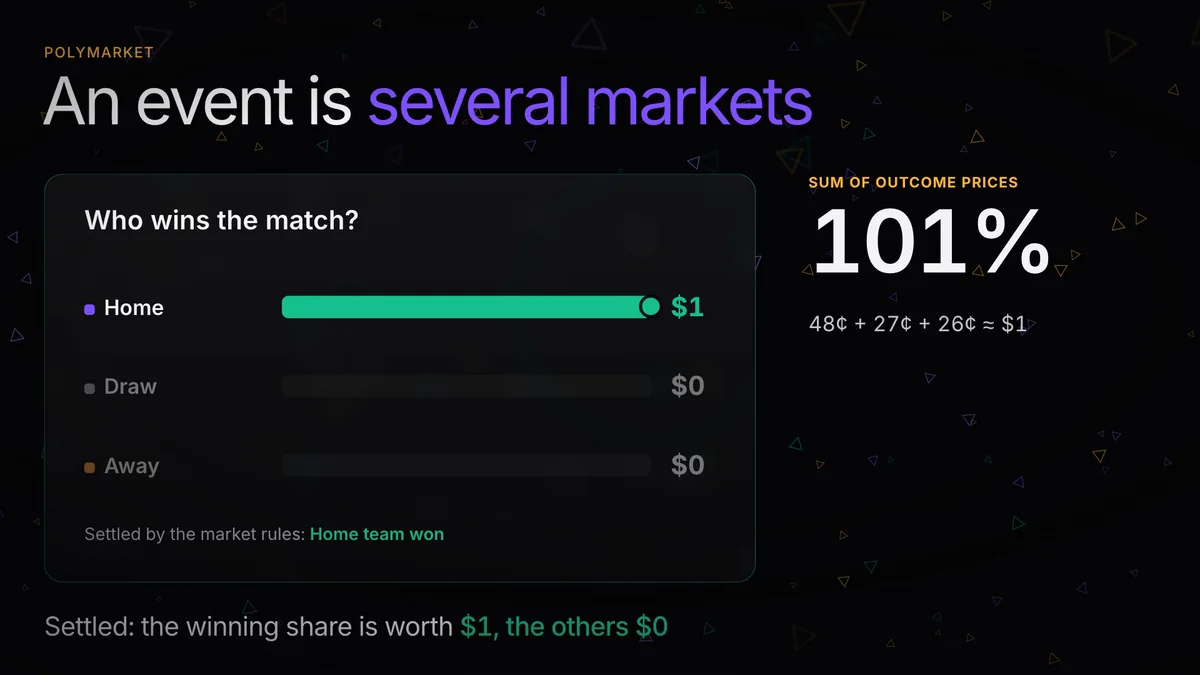
“Who will win the tournament?” is a set of separate Yes/No markets, one per contender, each with its own book. The Yes prices across contenders add up to roughly 100%, because only one of them wins.
The rules decide everything
Each market comes with written rules: what exactly counts as the event happening, which source settles it and what happens in edge cases. A postponed game, a delayed government release, a price that ties to the cent — the answers are written down before trading starts.
Read them before you trade. Two similar-looking Bitcoin markets can settle on different sources: short up/down windows use the Chainlink price, while the hourly and daily ones use Binance candles. A couple of dollars near the line decides the outcome.
Who confirms the result
Polymarket doesn’t announce results itself. Most markets settle through the UMA oracle:
- After the event, someone proposes the result and posts a bond.
- A challenge window opens, usually two hours. Anyone can dispute by posting a matching bond.
- If nobody disputes, the result is final and the proposer gets the bond back.
- If someone does, the question goes to a new round, and a second dispute sends it to a vote of UMA token holders. That takes several days.
The losing side of a dispute forfeits its bond, so proposing a wrong result costs money. Most markets settle without any dispute, roughly two hours after the event.
The payout: $1, $0 or 50/50
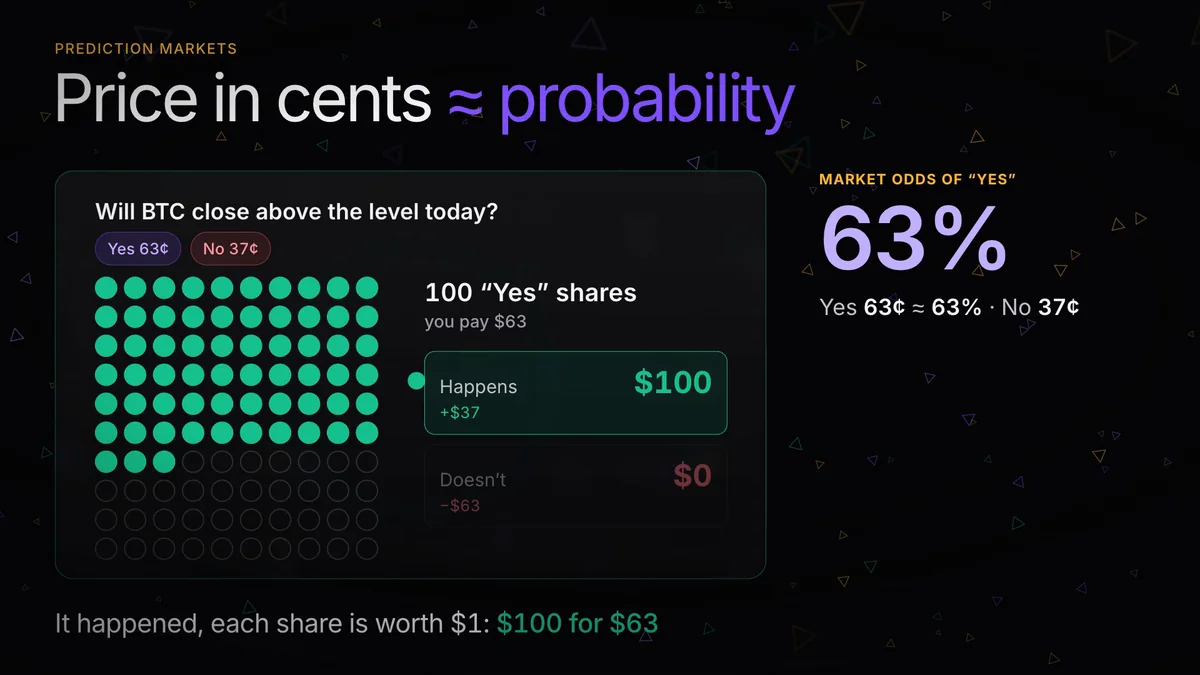
Once the result is final, winning shares redeem for $1 each and losing shares are worth zero. Buy 100 Yes shares at 58¢ for $58 and you collect $100 if Yes happens.
The third possibility is 50/50. Some markets’ rules call for it when the result can’t be determined cleanly, or when two prices tie exactly. Then every share, Yes and No alike, is worth $0.50. If you bought at 58¢, that’s an 8¢ loss per share; at 30¢, a 20¢ gain.
When the event ends, the market stops taking orders. From then until the result is confirmed, a position simply waits — it can’t be sold into the book.
How this works on Prop Hub
Prop Hub doesn’t place orders on Polymarket. We read its prices, order books and results and let you trade them on a virtual account:
- Buys and sells fill against Polymarket’s live order book at the moment of the trade, like a market order. There are no limit orders and no partial fills: if the book can’t absorb the full amount, the order is rejected.
- Fees match what Polymarket charges on that market and come out of the virtual balance.
- Markets are limited to those ending within 2 days. A market on an election a month away appears once it’s 2 days from its end date.
- Results are Polymarket’s. As soon as a market resolves, positions close automatically at $1, $0 or $0.50 per share. Until the result is final — including during a dispute — the position stays open.
How an open position is valued before the result, and where unrealized PnL comes from, is in the help center: positions and PnL.