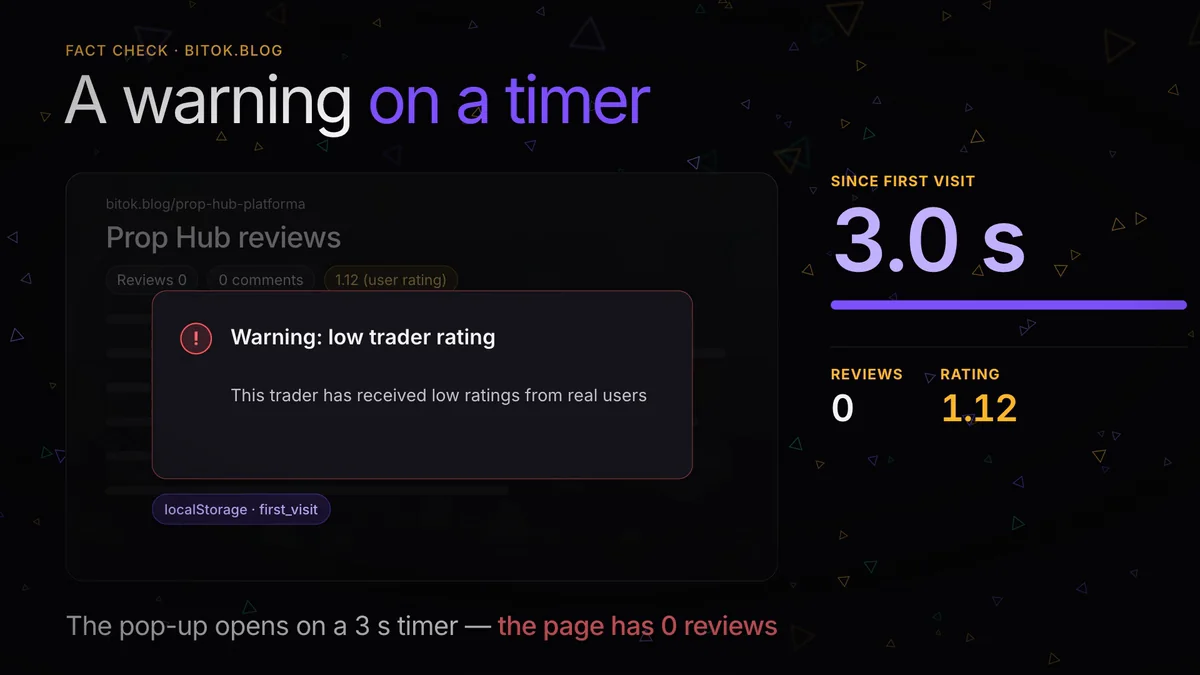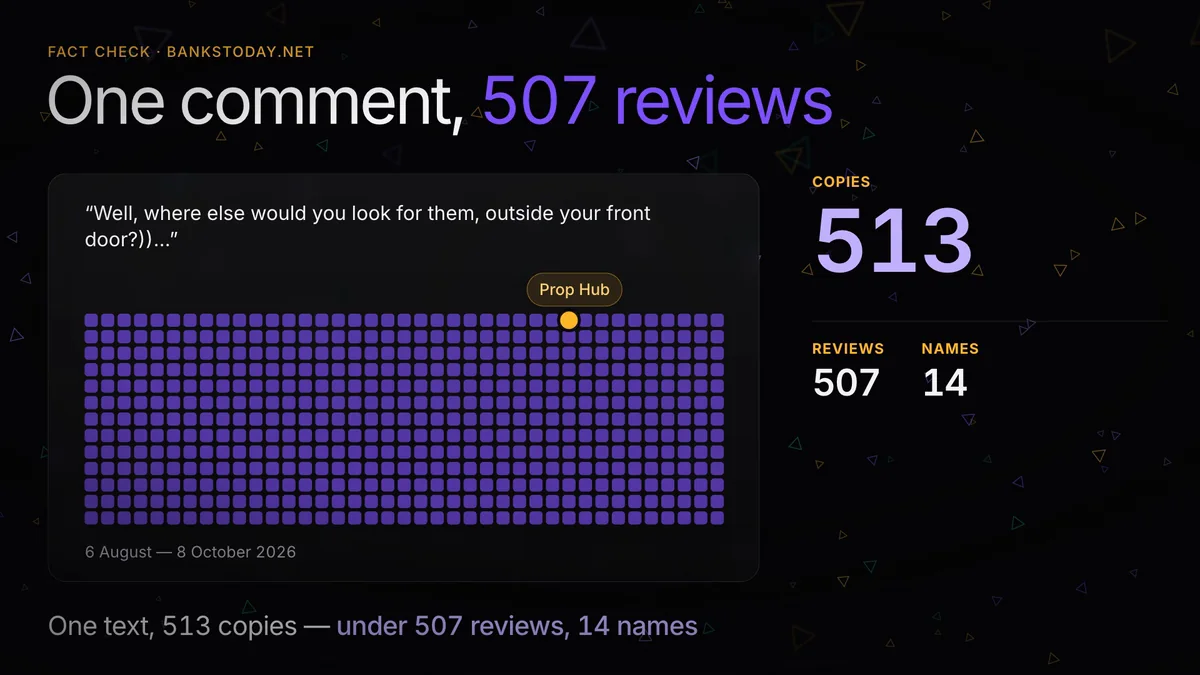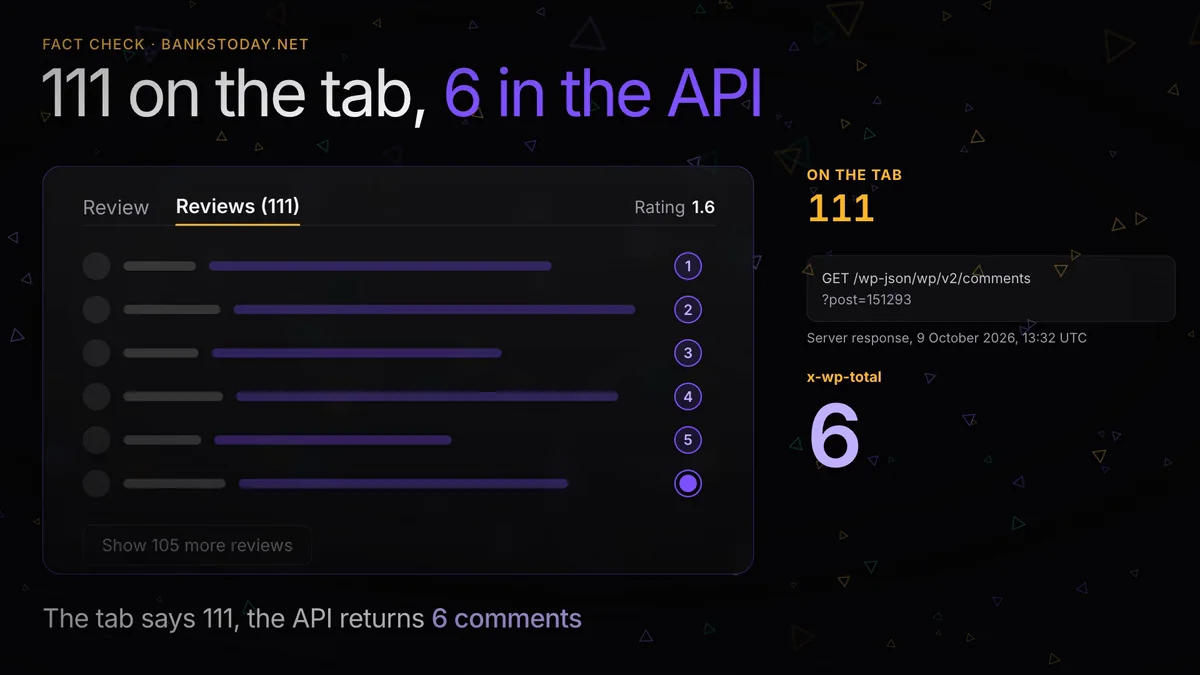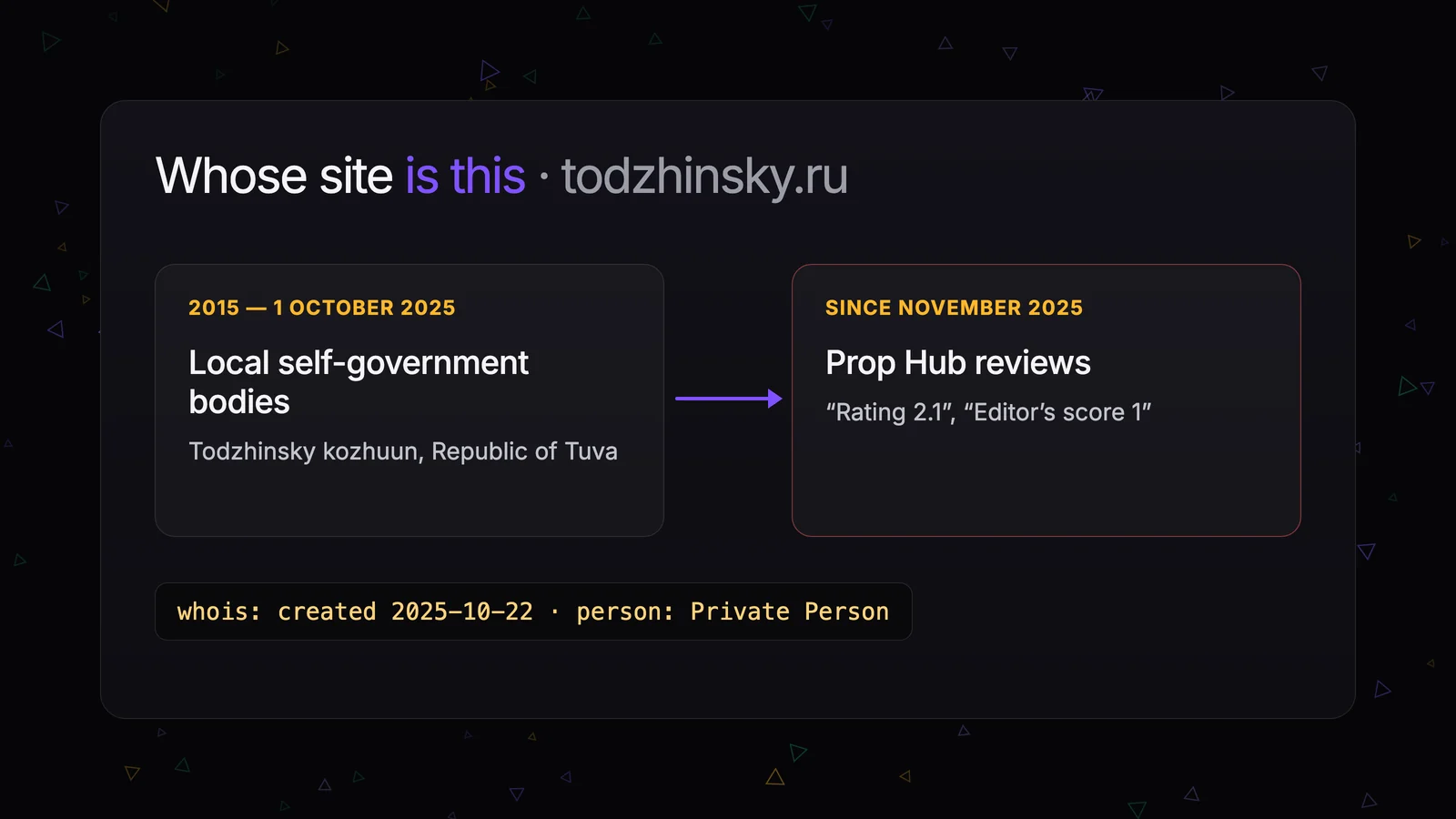
A page at todzhinsky.ru/invest/prop-hub-otzyvy, titled “Prop Hub reviews: terms, accounts and platform risks”, gives us a “Rating 2.1”, an “Editor’s score 1” and seven “reviews”. The site footer reads: “Local government bodies of the Todzhinsky kozhuun municipality, Republic of Tuva”. We looked into whose site this is, where the text came from and who wrote the reviews.
We saved the todzhinsky.ru server response on October 20, 2026, at about 12:31 UTC: page HTML, headers, SHA-256 checksums. We haven’t contacted the site.
Whose site is it?
The header and footer look municipal: “© 2013 - 2025 All rights reserved. Local government bodies…”, “todzhinsky.ru official website”, a postal address in the village of Toora-Khem. The menu puts “Emergencies” and “Local government” next to “Games that pay out to Sberbank”, “Binary options signals on Telegram” and “HYIP monitoring”.
Public records tell a different story.
- Wayback Machine. From 2015 through October 1, 2025, the archive holds copies of the Todzhinsky district administration’s website: citizen requests, “Report corruption”, civil service vacancies. The homepage title on August 1, 2025, is “Local government bodies of the Todzhinsky kozhuun municipality, Republic of Tuva” (archived copy). From November 1, 2025, the archive records a 301 redirect at that address (snapshot list).
- Whois. The .ru registry (whois.tcinet.ru) on October 20, 2026:
created: 2025-10-22T14:02:10Z,person: Private Person, registrar MASTERHOST-RU.
So the domain of a former local government website was registered by a private individual on October 22, 2025, and reviews of financial projects now run under the municipal header. Whether the district administration knows, we can’t say. You can check all of this in a minute; the commands are in our guide to checking reviews with the WordPress API, whois and Wayback.
The same “TOP-3” as bitok.blog
Above the review sits a “TOP-3 best traders” block: Ruflus 4.9 “Reviews (21)”, PRIVATE 4.8 “Reviews (0)”, “Forsirovanny Klyuch” 4.7 “Reviews (27)”. Same three names, same order as on bitok.blog, where our review comes with a “fraudulent project” pop-up (our bitok.blog fact check).
PRIVATE has a 4.8 rating with zero reviews. On bitok.blog we have 1.12 with zero reviews. On these sites, the rating apparently doesn’t depend on how many reviews exist.
The text: a retelling of bitok.blog
The structure and claims match the bitok.blog article of October 2, mistakes included.
| The review says | The facts |
|---|---|
| Payment via TryBit, “after which the funds are credited to an internal USDC balance” | The fee pays for the evaluation and isn’t credited to the trading balance, which is virtual (Terms, §2). As of October 20, payments go through TryBit and Plisio. |
| No links to official social media accounts | Every page footer links to Telegram t.me/prophub_pro and Instagram prophub_pro. |
| “Verification times are not stated” | Help center: the status usually updates within a few minutes. For a welcome-bonus withdrawal you have 7 days to complete KYC. |
| “Strict drawdown limits” | The limits are public: 10% daily, 20% total from the peak (rules). Strict or not is your call, but the “user reviews” saying so aren’t on the page. |
| “On the market for 1–2 years” | The prop-hub.pro domain was registered on July 17, 2026 (RDAP copy). On October 20 the project was three months old. The review itself says it “started in 2026”. |
| “The administration’s right to block accounts” | Terms, §12 do allow us to suspend access for breaching the Terms, suspected fraud or legal reasons. As of October 20, 2026, not a single account has been blocked. |
What the review gets right
The pricing for all four accounts is correct: account size, fee, profit target and daily limit. That includes the $25,000 account, where bankstoday got the target wrong (bankstoday fact check). Current table:
| Account size | Fee | Profit target | Min. equity | Daily limit | Per-outcome limit |
|---|---|---|---|---|---|
| $1,000 | $30 | $1,300 (+30%) | $800 (−20%) | −$100 (−10%) | $50 (5%) |
| $10,000 | $125 | $13,000 (+30%) | $8,000 (−20%) | −$1,000 (−10%) | $500 (5%) |
| $25,000 | $300 | $32,500 (+30%) | $20,000 (−20%) | −$2,500 (−10%) | $1,250 (5%) |
| $50,000 | $500 | $65,000 (+30%) | $40,000 (−20%) | −$5,000 (−10%) | $2,500 (5%) |
The rest is accurate too: the operator is Sharikat al-Marfa Ltd. of the Seychelles; we don’t provide financial services or investment advice; there’s a demo account; you sign up with email or Google; KYC runs through a third-party provider; you must be 18+ and not under sanctions. All of it comes from our Terms and help center.
Seven “reviews”
Three in one minute, none about us
On October 15, 2026, at 15:56, three “reviews” appeared in a row (translated from Russian):
- “Sergey Sorokin”: “they worm their way into your trust… and in the end you get blocked, and there’s no money and no made-up buddy”.
- “Pave”: “Feels like they hire them from the psychology department”.
- “Aleksandr”: “I blew more than a million over the last year because of ‘friends’ like these. With these guys, by the way, I made it back in almost two months”, followed by a link to the Ruflus page on the same site.
None of this is about Prop Hub. It describes people who build personal trust and then pull money out of you. We take no deposits; a challenge fee is a one-off payment through a payment gateway.
We collected another 120 reviews from the site’s “Investments” and “Free crypto signals” sections (URL list) and searched them for these phrases. The same texts, word for word, sit under 23 more reviews. On each page they’re posted within the same minute, and “Aleksandr” always links to Ruflus (pages and timestamps). With ours, that’s at least 24 pages.
Four at night, echoing the article
The other four “reviews” are dated October 5 at 02:34, October 8 at 02:44, October 12 at 03:05 and October 14 at 03:26. All of them repeat the review’s own points: offshore, “no licenses”, “strict drawdown limits”, “the right to block accounts”. One says Prop Hub “will block your account”. Again: as of October 20 we have no blocked accounts.
Why compare text across pages instead of asking the site directly? It runs on WordPress, but its REST API is closed: the comments request returns 401 rest_login_required (response headers). Where the API is open, as on bankstoday, counting is easier. Both methods are in the step-by-step guide.
What to do with this
If you landed on this review while searching for Prop Hub reviews, check the rules rather than the rating. Pricing, limits, payout terms and the legal entity are public: the help center, the Terms, the Privacy Policy. You can also start with the free $100 welcome account and see how trading works for yourself. The common signs of pages like this are in How to spot a paid prop firm review in 5 minutes.