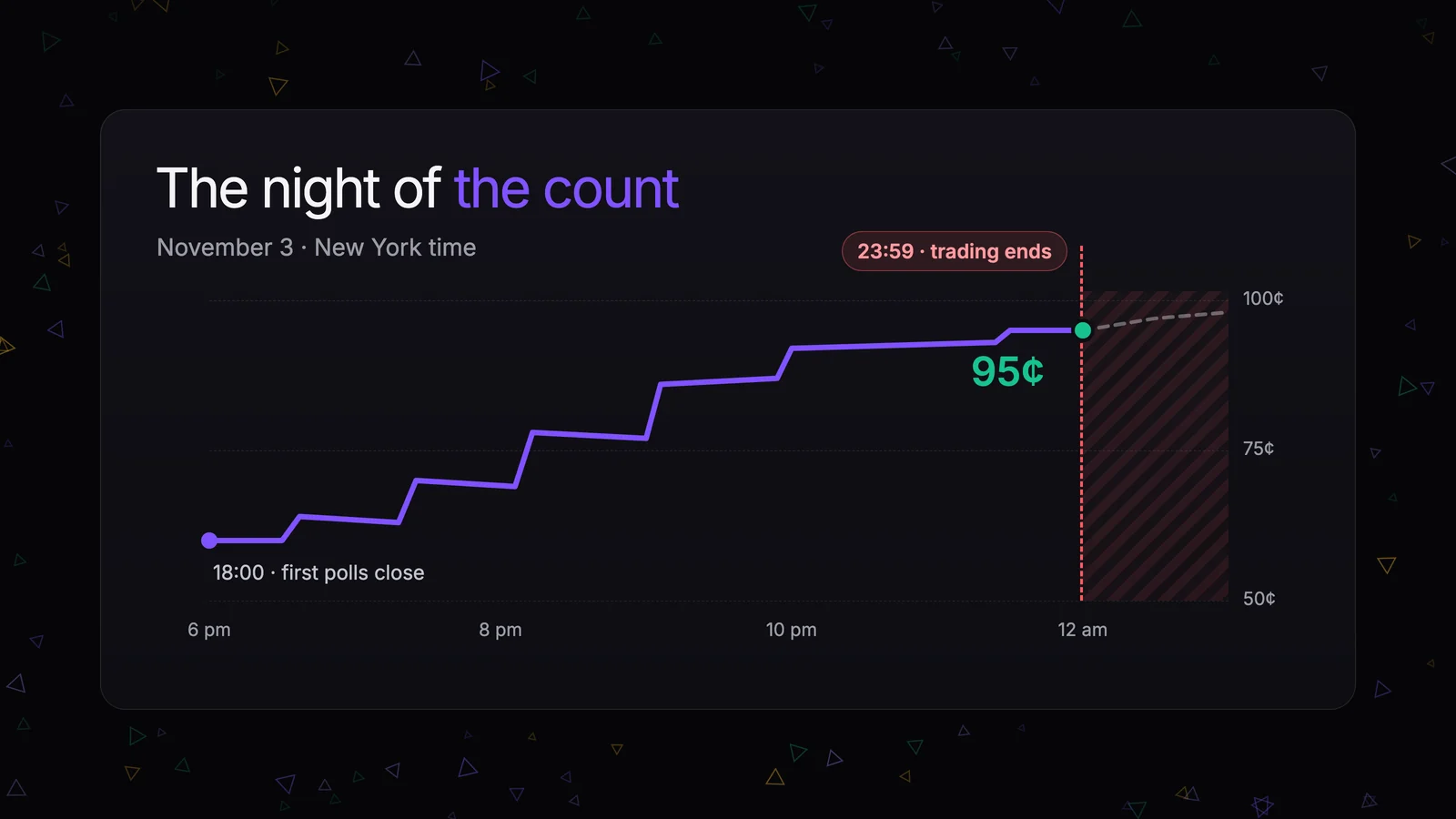
At 6 p.m. Eastern on November 3 the first polls close, and the midterm markets start repricing on live returns. On Prop Hub those markets trade until their Polymarket end date — currently 11:59 p.m. Eastern, or 04:59 UTC on November 4. That gives you a window of about six hours, long enough for a price to travel from 60¢ to 95¢ or back again.
The election itself is covered in US midterm elections explained, and reading chamber and race prices in US midterms on Polymarket. This one is about the counting night.
The night, hour by hour
Times are for November 3–4. Daylight saving time has ended by then, so Eastern time is UTC−5.
| Eastern (ET) | UTC | What happens |
|---|---|---|
| 6:00 p.m. | 23:00 | first polls close: parts of Indiana and Kentucky |
| 7:00 p.m. | 00:00 | Georgia, Virginia, most of Florida |
| 8:00 p.m. | 01:00 | Pennsylvania, Maine, most of Michigan and Texas |
| 9:00–10:00 p.m. | 02:00–03:00 | Arizona, Colorado, Iowa, then Nevada and Montana |
| 11:00 p.m. | 04:00 | California, Oregon, Washington |
| 11:59 p.m. | 04:59 | market end date: trading on Prop Hub stops |
| 12:00–1:00 a.m. | 05:00–06:00 | Hawaii and Alaska |
The last row matters. The Alaska Senate race, where Mary Peltola traded at 73.5¢ on October 20, starts counting after the Prop Hub window has shut. Anything you hold in that market waits for the result.
Why the market runs ahead of the calls
Outlets like the AP call a race only once the trailing candidate can’t catch up with the ballots left. It’s a cautious standard: a wrong call costs them more than a late one.
Traders don’t need certainty, only probability. They compare early county returns with past elections and know the order in which each state counts and which counties usually report last. If a county a Republican won by 10 points in 2022 shows a 4-point margin tonight, the market reprices the whole state without waiting for the count to finish.
The 2024 presidential race is a good example. Around 6 p.m. Eastern, Polymarket had Trump at roughly 58–60%. By 11:43 p.m. the price had reached 95¢. The AP called the race only at around 5:30 a.m. on November 6, and the market itself resolved near 11 a.m., once all three sources named in its rules had called it.
How the price actually moves
Prices rarely glide on election night. The usual pattern:
- Steps. Long flat stretches, then a 10–20¢ jump in minutes when a big batch of ballots lands from a large county.
- False moves. In states that count mail ballots first, early numbers lean one way and Election Day votes pull the other. Traders who don’t know the counting order buy the first wave and sell into the second.
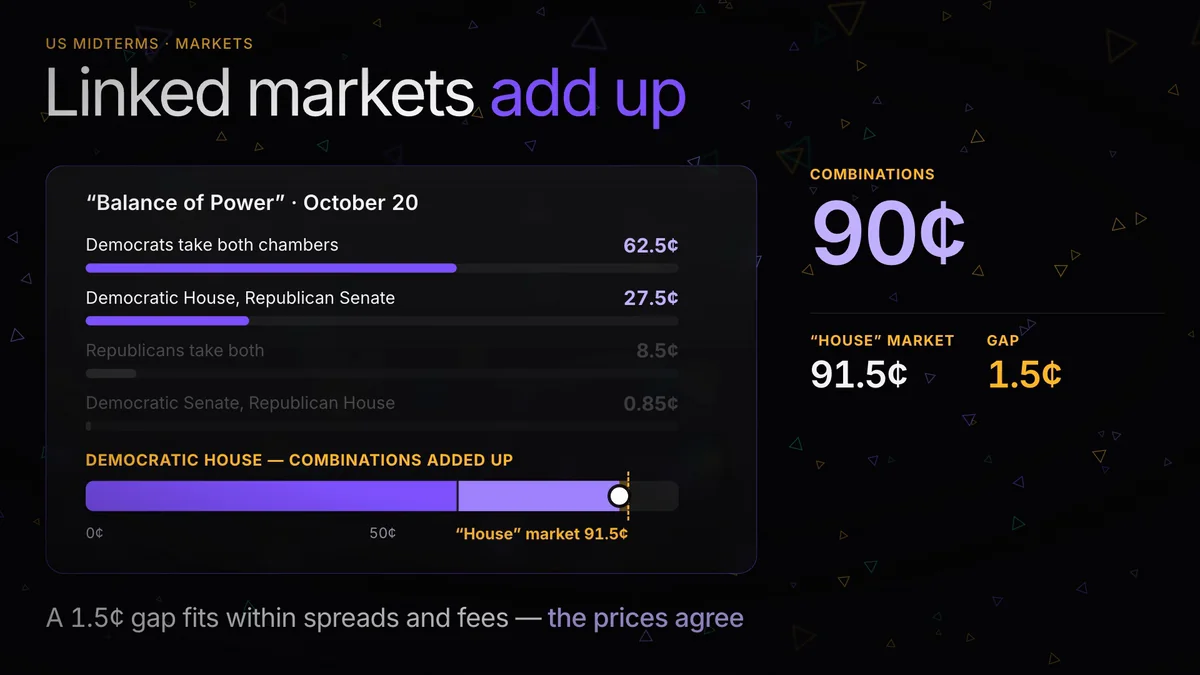
- Contagion. A surprise in one state moves every linked market at once: Senate control, Balance of Power, neighbouring races. The same polling error touches all of a party’s candidates.
The risks of counting night
The book empties
Once an outcome looks settled, sellers pull their offers. A market that was 85¢ a minute ago may have nothing offered below 97¢, and then nothing at all. Buys on Prop Hub walk the order book with no partial fills: if there isn’t enough on offer for the full amount, the order is rejected. Selling works the same way, against the bids.
The window closes before the count does
After the market’s end date you can neither buy nor sell on Prop Hub. A position you’re holding at 11:59 p.m. Eastern stays open until the result, even if the price turns against you an hour later.
Resolution follows the market’s rules, not the first call
Every market names its own resolution sources:
- the Texas Senate race resolves once all three of AP, Fox News and NBC call the same winner; if they don’t agree, official certification decides;
- the chamber control markets rely on state election authorities, Congress and a consensus of credible reporting, count runoffs, and can stay open until January 4, 2027 if it’s unclear which side newly elected independents will caucus with.
In practice that means days or weeks. In 2022 House control was called on November 16. Georgia holds runoffs four weeks after Election Day.
While the position is open, the account waits too
An open position keeps being marked at the market’s midpoint, and account equity moves with it. Until it closes you can’t request a payout or funding, and a challenge can’t reach “Passed”. If you plan to withdraw in November, a House control position could push that back by weeks.
Managing risk on the night
- Decide in advance what you’ll hold past 11:59 p.m. ET. Whatever stays open waits for the result. If you’re not comfortable with that, close before the window ends.
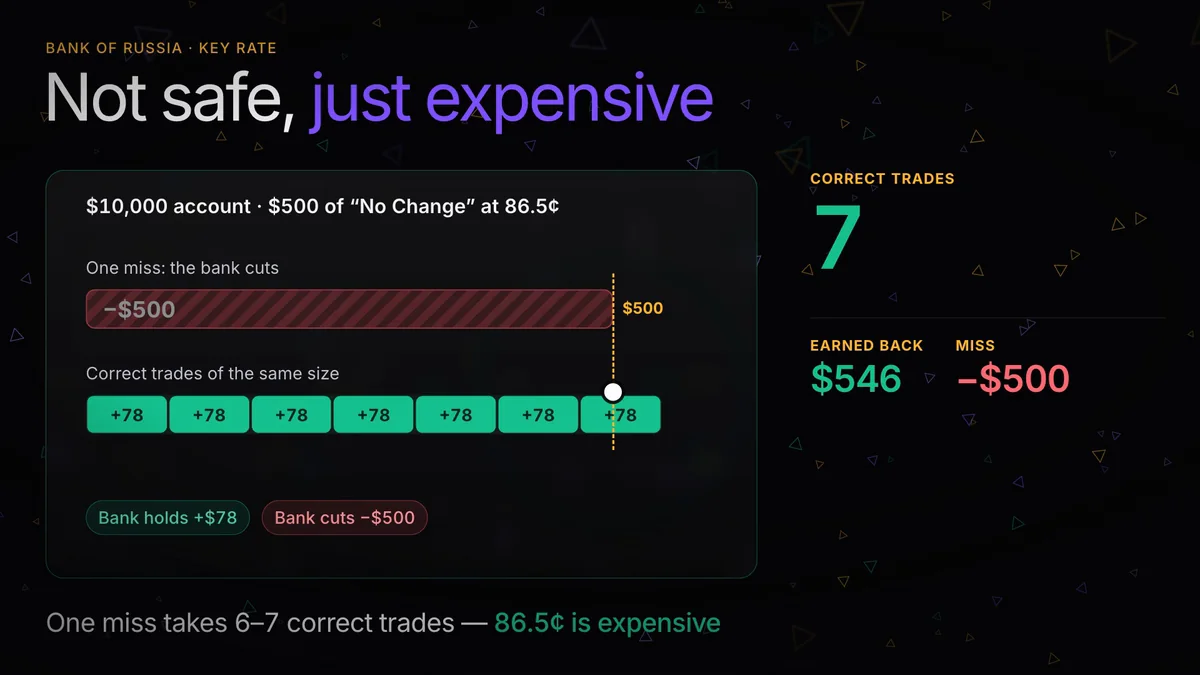
- Size from the worst case. The per-outcome limit is 5% of the starting balance — $500 on a $10,000 account. Before each buy the system checks what happens if every open position loses, and blocks an order that would push the account past a drawdown limit in that scenario. More in risk per trade.
- Remember the daily drawdown. The limit is 10% of equity from closed trades at the start of the UTC day. An open position counts in it at its entry price, so an overnight paper gain doesn’t raise the base. The loss counts on the day the position closes, against that day’s floor.
- One night isn’t the whole challenge. Under the consistency rule, your best day can be at most 30% of total profit. A big election-night gain won’t pass a challenge on its own; it has to be balanced by profit on other days. The rules are in the help center.
- Don’t chase 95¢. Profit on positions bought above 90¢ doesn’t count toward the challenge target or toward withdrawable profit, and the risk is unchanged: a 95¢ position loses almost everything if it’s wrong and can make only 5¢ a share if it’s right.
No paid account? You can watch election night on the $100 welcome account, which runs for 3 days.