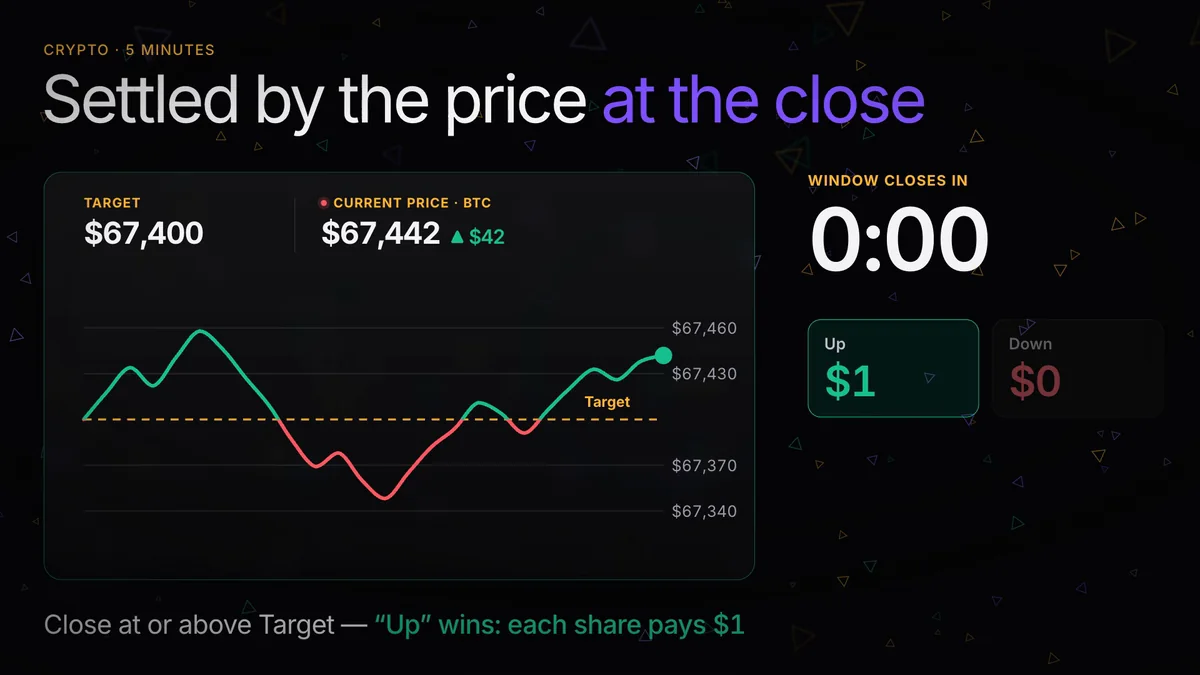
A 15-minute BTC up or down window works exactly like the 5-minute one: the price at the start becomes the Target, and fifteen minutes later the market settles on whether Bitcoin finished at or above it. Tripling the length changes nearly everything around that rule, though — how far the price travels, how many windows you get per hour and how much you pay in fees over a session. Here’s how to put that to use.
The basics of these markets — the Target, the Chainlink price, settling at $1 or $0 — are covered in our piece on Bitcoin 5-minute up or down. This one is only about what’s different at 15 minutes.
The rules of the window
- Target is the Chainlink BTC price at the start of the window. Polymarket uses a 60-second average (TWAP) rather than a single tick, and measures the closing price the same way.
- Up wins if the price at the end is at or above the price at the start. A tie goes to Up.
- Coins: BTC, ETH, SOL, XRP, DOGE, BNB, HYPE and ZEC, with windows running back to back, four an hour.
- Positions close automatically on Polymarket’s result: the winning share is worth $1, the losing one $0.
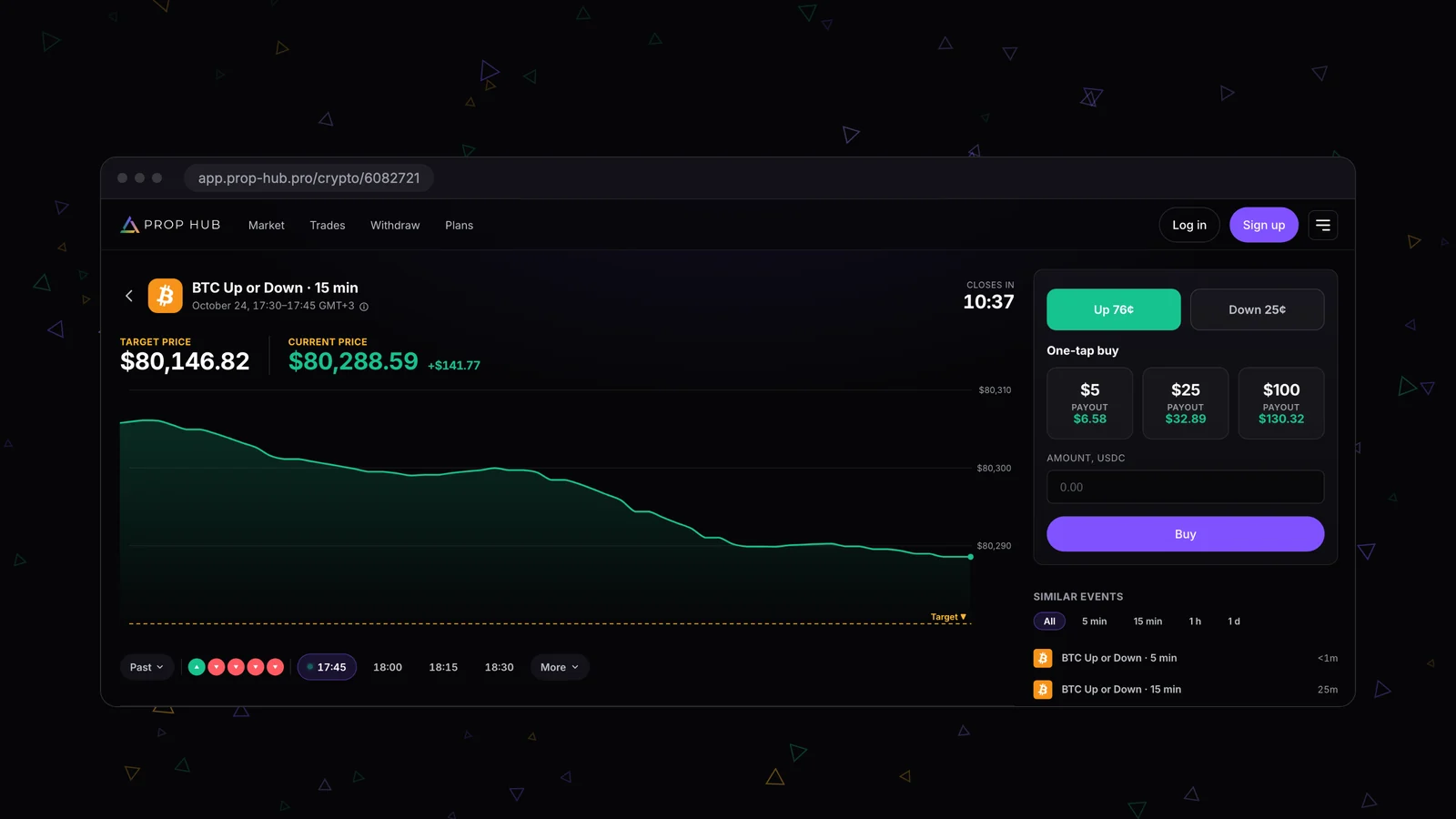
A Prop Hub market page shows the live price chart with the Target line, the time left and the series strip — how recent windows ended, which one is live and which come next.
5 minutes vs 15 minutes
| 5 minutes | 15 minutes | |
|---|---|---|
| Windows per hour | 12 | 4 |
| Typical price move per window | smaller | about 1.7× larger |
| Time to decide | seconds | a few minutes |
| Weight of last-second noise | high | lower |
| Fees per hour, one trade per window | 12 times | 4 times |
The 1.7 is the square root of three. If price behaves roughly like a random walk, its typical move grows with the square root of time, so a window three times longer covers about 1.7 times the distance. For a trader, that means the gap from the Target more often becomes meaningful by the middle of a 15-minute window, and outcome prices leave 50¢ sooner.
How the outcome price moves inside the window
At the open, Up and Down trade near 50¢ because the market knows nothing yet. After that, the price depends on two things: how far BTC has moved from the Target and how much time is left.
Say Bitcoin is $60 above the Target five minutes in. In a 5-minute window, that would be a nearly settled outcome with seconds to go. In a 15-minute window there are still ten minutes left, plenty of time for $60 to come back, so Up might trade at something like 65–70¢ rather than 95¢.
That’s the main edge of the longer window: you have time to watch how price behaves and enter before the move is fully priced in. The catch is symmetrical — a position bought at 70¢ also has ten minutes to go wrong.
Fees: count them per session
Crypto markets carry higher fees than sports or politics, and Prop Hub charges exactly what Polymarket does. As a share of the trade amount, the fee equals the market’s fee rate × (1 − price). Near 50¢, that’s half the market rate: the cheaper the outcome, the larger the fee share, and the pricier, the smaller.
Take a fee rate of 5% as an example (actual rates are in the help center). A $200 buy at 50¢ costs $5 in fees. One trade per window for an hour:
- in 5-minute windows — 12 trades, $60 in fees;
- in 15-minute windows — 4 trades, $20 in fees.
As of November 1, 2026, Polymarket’s rate on crypto windows is 7%. At that rate the same buy costs $7 in fees, and an hour of trading $84 versus $28.
To break even in 5-minute windows you need to be right noticeably more than half the time. The longer window doesn’t make you more accurate, but it tests the same idea at a third of the cost. The formula and current rates are in Fees and execution.
The series strip: what it tells you and what it doesn’t
The strip shows results in a row — say Up, Up, Down, Up. Each window is measured against its own start, so the sequence describes where price has been, not where it’s going.
There’s a useful link between 15-minute and 5-minute windows. The 12:00–12:15 window spans three 5-minute ones: 12:00, 12:05 and 12:10. Its result depends only on the price at 12:15 against the price at 12:00, not on how many of the short windows closed Up. Two Ups of $20 each and one Down of $70 add up to a Down for the 15-minute window. If you trade both, watch the distance to the Target on the chart, not the tally of windows.
What it means for a prop account
A longer window doesn’t change the account rules. The usual Prop Hub limits apply:
- total buys in one outcome — up to 5% of the starting balance, or $500 on a $10,000 account;
- daily drawdown — up to 10% of equity at the start of the UTC day;
- overall drawdown — up to 20% from peak equity.
A quick check: 2 losing windows in a row at the full per-outcome limit take the account to its daily limit. At four windows an hour, that can happen in half an hour. Before each buy, the system checks what happens if every open position loses and won’t let a single trade cross the limit — but it won’t stop a run of small losses. How drawdown is measured is explained in Daily and overall drawdown.
A session plan
- Decide how many windows you’ll trade. Four in an hour, say, and only with a clear reason to enter.
- Enter after the open. The first minutes show direction and speed. Buying at 50¢ in the first second is a trade with no information.
- Don’t pay 90¢+ for an “almost settled” outcome. With three or four minutes left, price can still get back to the Target, and the upside at that price is a few cents. On top of that, profit on buys above 90¢ doesn’t count toward the challenge target or withdrawals.
- Keep the exit in mind. You can sell before the window ends at the current book while the market accepts orders. In the final seconds buyers are thin, and the sale price can differ noticeably from the chart.
- Try it for free. The free $100 account has the same windows at the same prices.
This is not financial or investment advice — just an example of how trading can be organized. Trading decisions are yours alone.