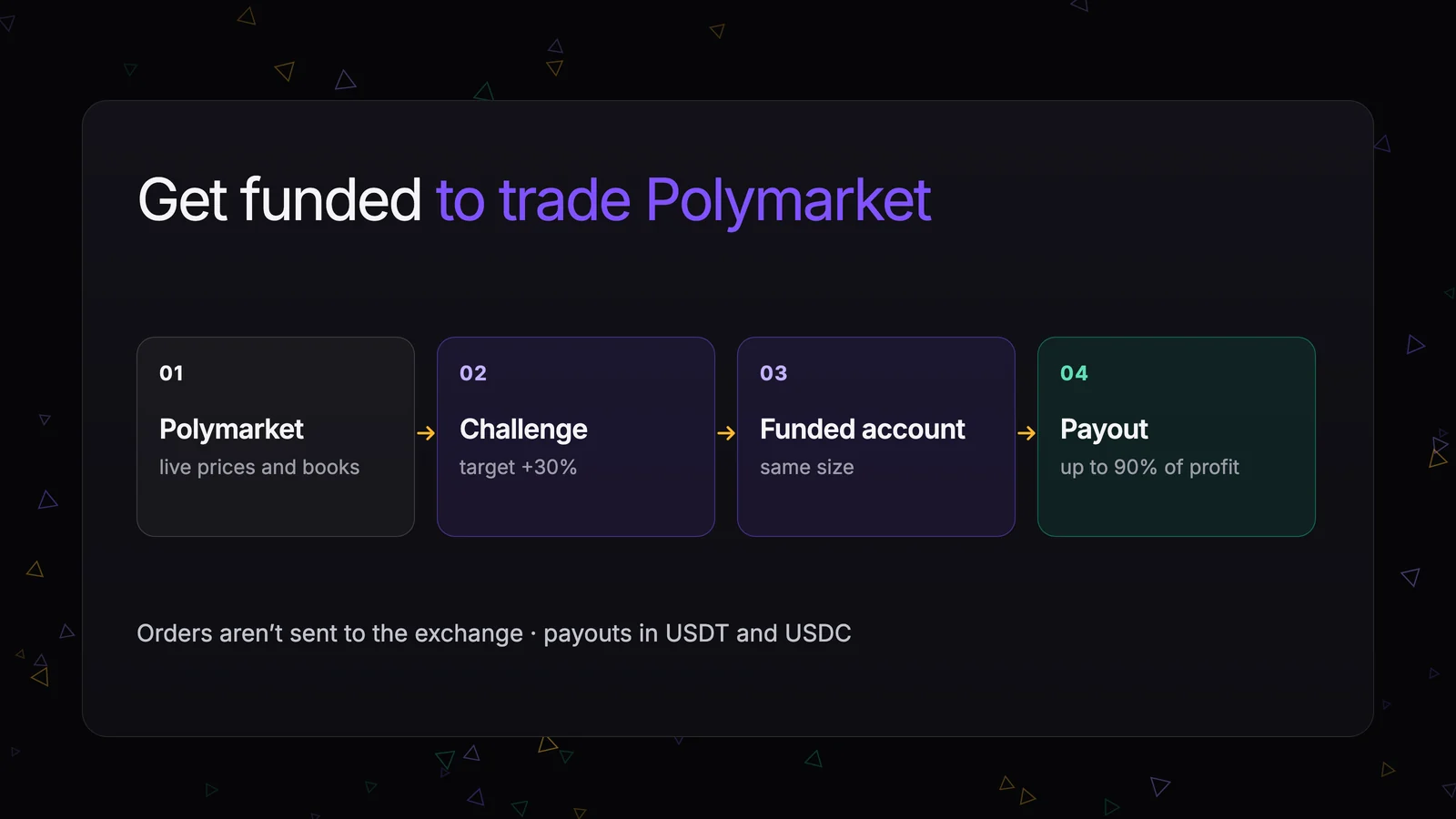
To get funded to trade Polymarket means trading prediction markets with a firm’s capital instead of your own wallet. On Prop Hub you pass an evaluation on live Polymarket prices, get a Polymarket funded account and withdraw up to 90% of the profit in USDT or USDC. The only money you put in is a one-time challenge fee. Below is how that works and why it’s built the way it is; the full walkthrough of every screen is in how Prop Hub works.
The prop model, applied to prediction markets
A prop firm pays traders for results on its capital. You prove you can make money without breaking risk limits, and the firm then lets you trade a larger account and shares the profit. Futures and forex prop firms have run this way for years. Prop Hub applies the same model to Polymarket.
Prediction markets suit it well for two reasons:
- The loss on a position is known before you buy. A share costs between 0 and 1 dollar and settles at $1 or $0. Buy at 52¢ and the most you can lose is the 52¢ plus the fee. There’s no gap through a stop.
- Results come fast. A match is settled the same evening, a five-minute Bitcoin window five minutes after it opens. A firm can judge a trader on dozens of closed positions within weeks rather than months.
Why trades are simulated on live Polymarket prices
Your orders on Prop Hub are not sent to Polymarket. Each buy walks the live Polymarket order book from the best offer upward and fills at the weighted average price, with the same taker fee Polymarket charges on that market, and positions settle on Polymarket’s own result. The market, the price and the outcome are real. The position sits on our books.
Take the NFL game Chiefs vs. Broncos on November 1, 2026. Around noon UTC the Chiefs share was quoted at 51¢ bid and 52¢ ask, with more than 56,000 shares offered at 52¢. A $500 buy fills there in full: 961.5 shares, plus a $7.20 fee at this market’s 3% fee rate. If the Chiefs win, the position pays $961.54, a profit of $454.34 on the account. The same order placed on Polymarket would have filled at the same price.
Why it’s built this way:
- No wallet, no keys, no deposit. You sign up with email or Google. Nothing needs to be bridged, swapped or approved on-chain.
- Reading Polymarket is open; trading on it isn’t open everywhere. Polymarket’s geographic restrictions apply to placing orders, while prices and order books are public. Trading on Prop Hub works from any country. Real-money payouts depend on the country of your KYC document; see Polymarket restricted countries for how the two lists differ.
- The test stays honest. Same book, same fee, same settlement. A strategy that only works on paper because it ignores spreads or depth won’t work here either.
How the funding path works
The route has three parts:
- Challenge. Buy an account on the plans page and reach +30% without breaking the limits below.
- Passed and funding request. Once the target is hit with no open positions and the consistency rule is met, the account turns Passed. You request funding, trading freezes and the team reviews your trades.
- Funded account. If approved, a new account of the same size opens with a fresh balance. There’s no target on it: you trade and withdraw.
Account sizes and one-time fees:
| Account size | Fee | Profit target | Min. equity | Daily limit | Per-outcome limit |
|---|---|---|---|---|---|
| $1,000 | $30 | $1,300 (+30%) | $800 (−20%) | −$100 (−10%) | $50 (5%) |
| $10,000 | $125 | $13,000 (+30%) | $8,000 (−20%) | −$1,000 (−10%) | $500 (5%) |
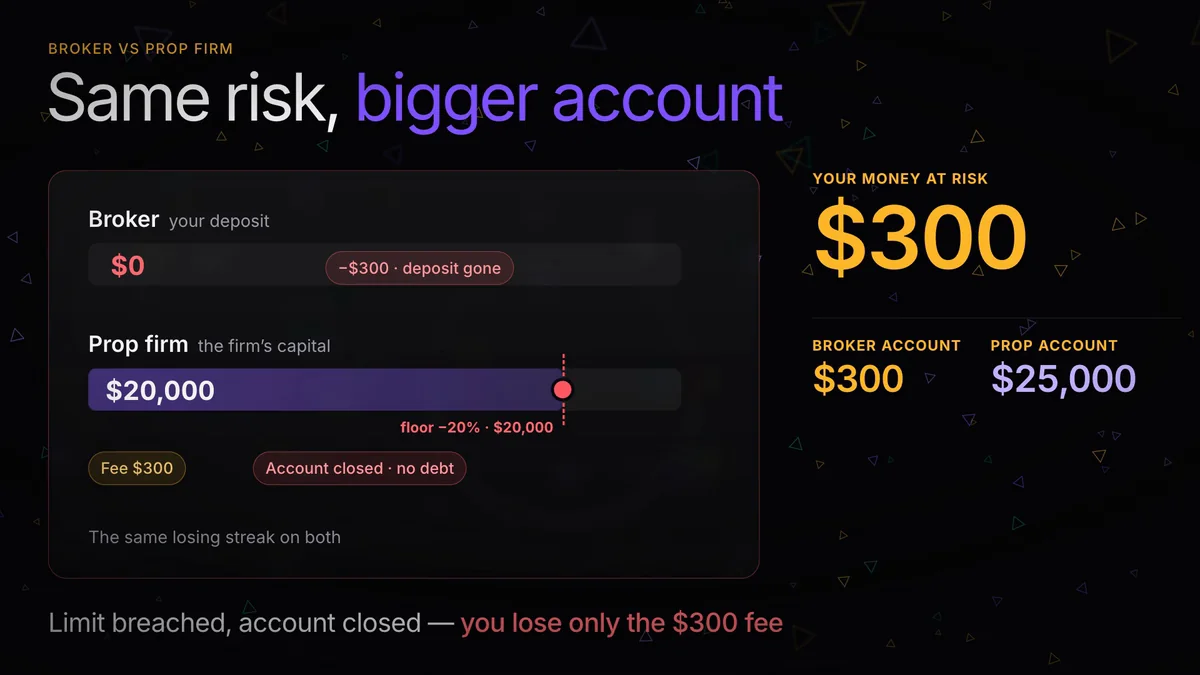
| $25,000 | $300 | $32,500 (+30%) | $20,000 (−20%) | −$2,500 (−10%) | $1,250 (5%) |
| $50,000 | $500 | $65,000 (+30%) | $40,000 (−20%) | −$5,000 (−10%) | $2,500 (5%) |
What changes once you’re funded and how to keep the account is covered in funded trading account.
Which Polymarket markets you can trade
Only markets that resolve within 2 days. A market that ends next month shows up once it’s inside that window. On November 1, 2026, that meant, among others:
- Crypto up or down. Windows of 5 minutes, 15 minutes, 1 hour and 1 day for BTC, ETH, SOL and other coins. The 7:05–7:10 AM ET Bitcoin window traded at 50¢ bid, 51¢ ask.
- Sports, including in-play. Como vs. Venezia in Serie A at minute 32, 0–0: Como to win at 74¢. During a game a buy fills after Polymarket’s execution delay, usually one second, at the book as it stands then.
- Daily price levels and other short events. “Bitcoin above $78,000 on November 2?” traded at 51¢; a range on Elon Musk’s post count for October 31 to November 2 was at 46.5¢.
Fees differ by market: the rate on these crypto markets was 7%, on the NFL game 3%. Prop Hub charges exactly what Polymarket charges on each market and doesn’t earn on fees.
The risk rules
Every challenge and funded account runs on the same limits:
- total drawdown: equity stays above −20% from its peak;
- daily drawdown: no more than −10% from equity at the start of the UTC day;
- per outcome: no more than 5% of the starting balance, summed over all buys;
- activity: at least one trade every 14 days;
- consistency: on the challenge your best day can’t exceed 30% of total profit, on a funded account 40%.
Breaking a drawdown limit or the activity rule closes the account. Consistency never closes it; it only decides when the challenge passes or a payout can be requested. There’s no time limit on the challenge. Every rule with worked numbers is in prop challenge rules.
Trades that count: the price corridor
Profit counts toward the target, consistency and payouts only from closed positions bought between 10¢ and 90¢. Positions outside that corridor are allowed and change the balance, and their losses count toward drawdown as usual, but their profit doesn’t count.
On November 1 “Bitcoin above $74,000 on November 1?” had its Yes share at 99.9¢. Buying it hours before the result means collecting a nearly settled market, with little forecast in it. The opposite end, “Will Bitcoin reach $82,000 October 26–November 1?” at 1¢, is a long shot where one hit outweighs everything else. Neither shows forecasting skill, which is what the evaluation measures. “Bitcoin above $78,000 on November 2?” at 51¢ is inside the corridor and counts.
Payouts: USDT, USDC, KYC
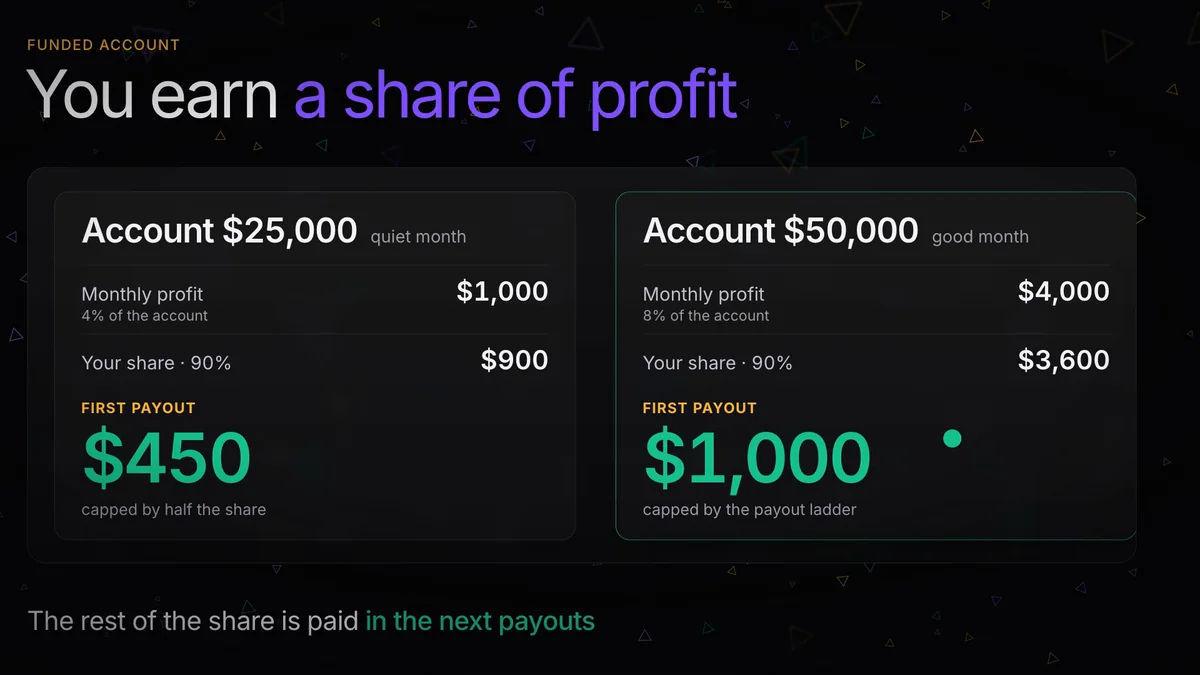
You request a payout on the funded account’s page with no open positions. The amount is the smallest of your share (90% of qualifying profit minus what you’ve already withdrawn), half of that share per payout, and the cap for the payout number: $1,000, then $2,000, then $5,000. Payouts are at least 7 days apart. The math is in funded account payouts.
| Coin | Networks |
|---|---|
| USDT | TRC20, BEP20 |
| USDC | ERC20, Polygon, Solana, BEP20 |
Before the first payout you verify your identity in the dashboard through Didit: an ID document and a short face check, with no VPN. Approval lasts 180 days. If the document was issued in a country on the withdrawal restriction list, the payout can’t be sent; the list is in the help center under country restrictions. Payouts go out manually from the company wallet within 72 hours of the request, or of KYC approval if it was needed, and the funded account keeps trading afterwards.