Polymarket fees aren’t charged on every trade, and they’re never charged on profit. Only the side that takes liquidity from the order book pays, and the amount depends on the market’s fee rate and the outcome’s price. On the same $100 purchase, the gap between markets on November 1, 2026 ran from $0 to $3.45. Below is what Polymarket’s documentation says right now, what the market data actually shows, and how the same fee comes off a Prop Hub account.
What Polymarket trading fees cover
Polymarket charges a taker fee. It’s paid by the side whose order fills immediately against resting orders in the book, as a market buy does. The trader who posted a limit order and waited for someone to take it (the maker) never pays a fee — the documentation says so in as many words.
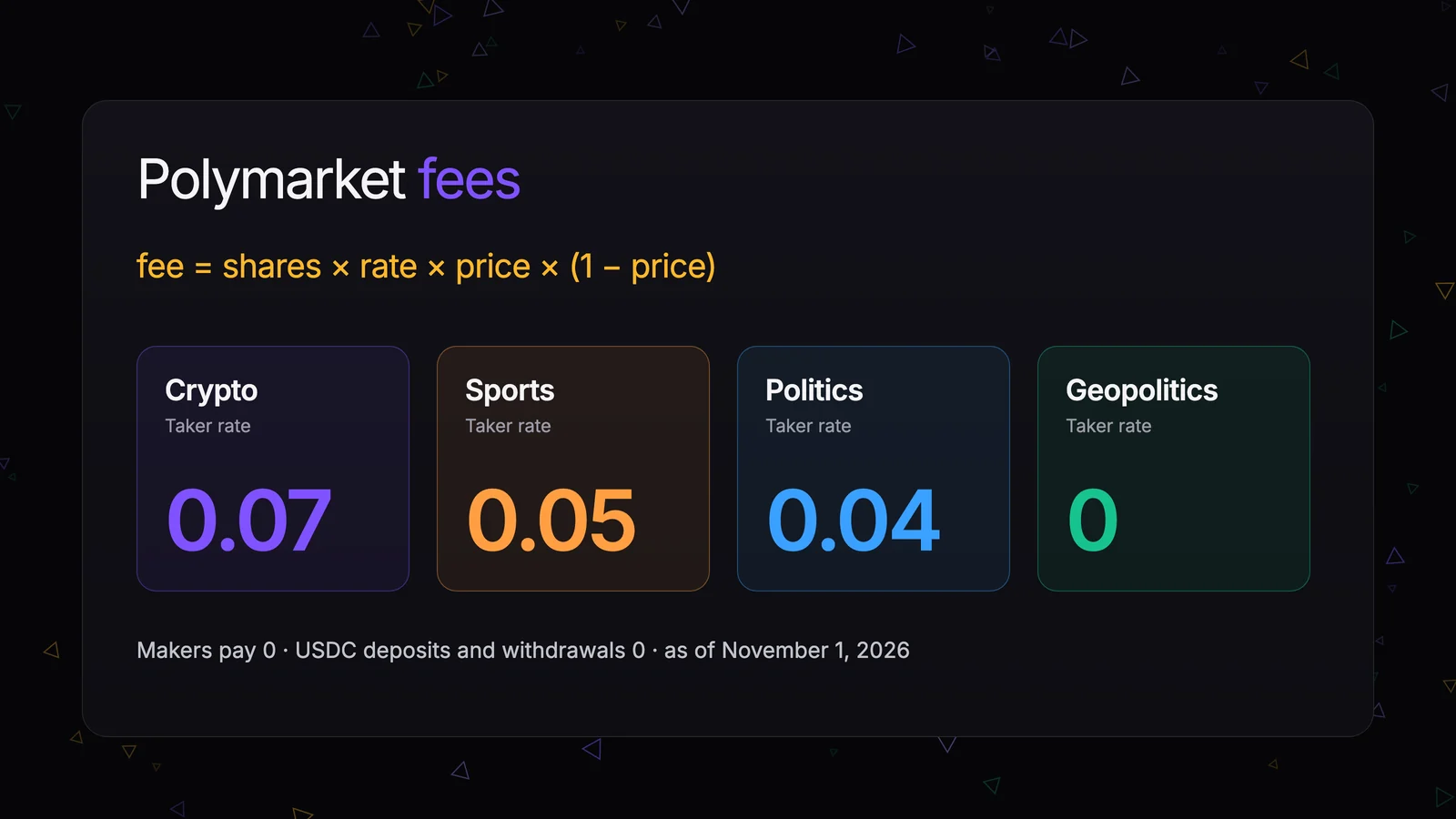
The rate is set by market category. Here’s the table from Polymarket’s docs as of November 1, 2026:
| Category | Taker rate | Maker |
|---|---|---|
| Crypto | 0.07 | 0 |
| Sports | 0.05 | 0 |
| Economics, culture, weather, other | 0.05 | 0 |
| Finance, politics, mentions, tech | 0.04 | 0 |
| Geopolitics and world events | 0 | 0 |
| Combos (several markets in one trade) | 0.05 | 0 |
What’s not on the list: Polymarket doesn’t charge for depositing or withdrawing USDC, though intermediaries such as exchanges or payment services may charge their own. There’s also no fee on payouts. Hold a position to resolution and a winning outcome pays $1 per share, nothing withheld.
Treat the table as a guide, not a rule for every market. NFL games on November 1 carried a 0.03 rate in the market data, even though the docs list 0.05 for sports. What counts is the rate on the specific market, covered below.
The formula: price drives the fee
Polymarket calculates the fee like this:
fee = shares × rate × price × (1 − price)
In dollars it peaks at 50¢ and falls symmetrically toward both ends, so a trade at 30¢ costs the same as one at 70¢. For 100 shares in a crypto market that’s $1.75 at 50¢ and $0.63 at 10¢ or 90¢.
For a trader, a different view is more useful: the fee as a share of the purchase amount. Divide the formula by the amount (shares × price) and you’re left with rate × (1 − price). The cheaper the outcome, the bigger the bite:
| Outcome price | Crypto, 0.07 | Sports, 0.05 | Politics, 0.04 | NFL, 0.03 |
|---|---|---|---|---|
| 10¢ | 6.3% | 4.5% | 3.6% | 2.7% |
| 30¢ | 4.9% | 3.5% | 2.8% | 2.1% |
| 50¢ | 3.5% | 2.5% | 2.0% | 1.5% |
| 70¢ | 2.1% | 1.5% | 1.2% | 0.9% |
| 90¢ | 0.7% | 0.5% | 0.4% | 0.3% |
The practical takeaway: buying a 10–20¢ outcome in a crypto market hands over 5–6% of the amount up front. The price has to move noticeably your way just to earn the fee back.
How to find a market’s fee rate
Every Polymarket market has two fields in the Gamma API data: feesEnabled (whether a fee applies) and feeSchedule, which holds the rate, the exponent (1 on every market we checked), takerOnly (only the taker pays) and rebateRate (the share of the fee returned to makers).
Here’s what three markets showed on November 1, 2026, around 12:10 UTC:
| Market | Rate | Best ask | Fee on a $100 buy |
|---|---|---|---|
| Bitcoin Up or Down, 5-minute window, “Up” | 0.07 | 50¢ | $3.45 |
| NFL, Chiefs vs. Broncos, Chiefs to win | 0.03 | 52¢ | $1.44 |
| US x Iran ceasefire continues through November 2 | fees off | 96.8¢ | $0 |
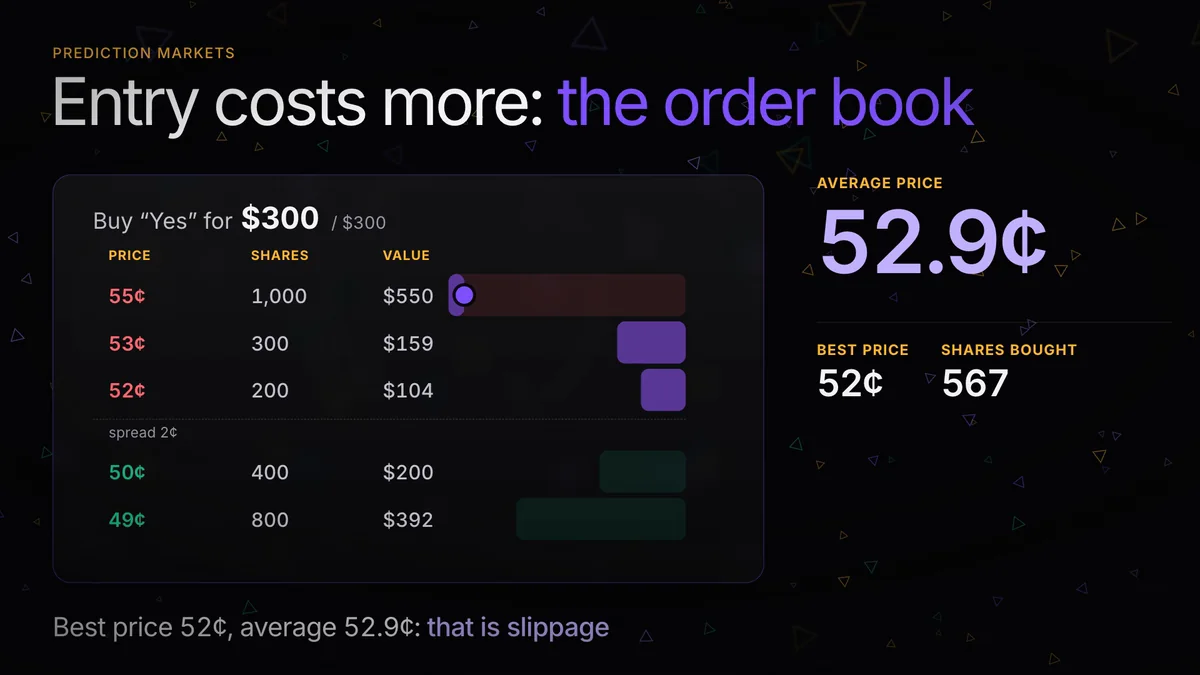
The 5-minute BTC window had only 45.57 shares at the 50¢ best ask, so a $100 buy would have filled at an average of 50.8¢: 196.97 shares and a fee of 196.97 × 0.07 × 0.508 × 0.492 ≈ $3.45. The Chiefs book was much deeper, and the whole amount fit at 52¢: 192.31 shares and a $1.44 fee. The ceasefire market is geopolitics, with feesEnabled: false.
Rebates: who gets part of it back
Polymarket hands part of the collected fees back.
- Makers get a daily rebate in proportion to how much of their resting liquidity was taken. As of November 1 the share of the taker fee is 20% in crypto, 15% in sports, 25% in most other categories and 0% on combos.
- Takers have had a tier program since May 28, 2026. Fee-paying trades build “weighted volume” over 30 days; from $2,000 of it you get 3% of fees back, rising to 50% at the top tier.
For a trader with modest volume, rebates barely move the needle: you pay the taker fee at the full rate.
How fees work on Prop Hub
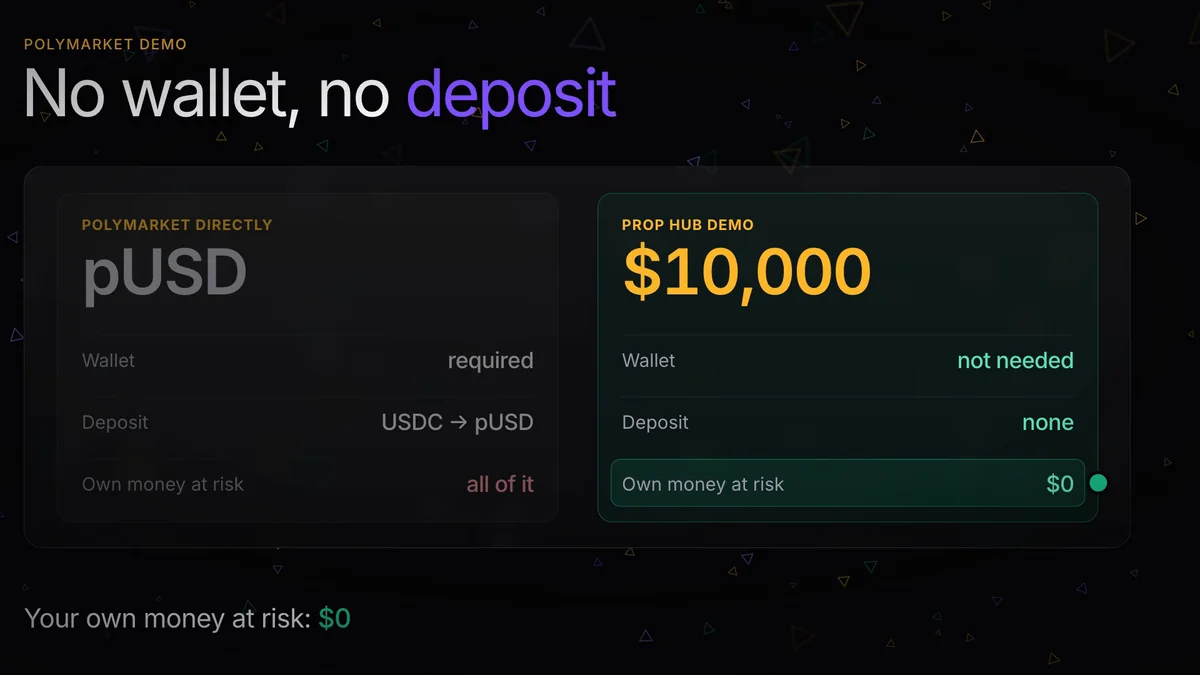
Prop Hub trades on Polymarket quotes and charges the same taker fee, only from the account’s virtual balance. The rules:
- The rate comes from the market at the moment of the trade. We read the market’s
feeSchedulefrom Polymarket on every buy and sale. If the market hasfeesEnabled: false, the fee is zero. If the rate data doesn’t come through, a fallback rate of 0.07 applies, the same as crypto markets. - Same formula: shares × rate × price × (1 − price), where price is the average fill price across the order book.
- Every trade is a taker trade. Buys and sales on Prop Hub fill as market orders; there are no limit orders. So the fee always applies, and there are no rebates.
- Buying: the fee is charged on top of the amount. The account needs enough for both.
- Selling before resolution: the fee is taken from the proceeds.
- Resolution: no fee on the payout.
Prop Hub doesn’t earn anything from this. The money is virtual, and the charge is there so your account result matches what the same trading would produce on Polymarket. Across our trades the average fee is about 2.8% of the amount.
Where to see it: in Trades, every lot has a “Fee” column, and the PnL column is already net of it. In the buy panel, the “how much more you can buy” figure accounts for the market’s fee, which is why it sits a little below your free room. The rate table for the most-traded markets and worked examples are in the help center under execution and fees.
What a round trip costs
Take the same $100 buy in the 5-minute BTC window and run the full loop.
- Buy: 196.97 shares at an average of 50.8¢, fee $3.45. The account pays $103.45.
- Sell straight away into the best bid at 49¢: proceeds $96.52, fee $3.45, so $93.07 comes back.
The round trip cost $10.38, about 10% of the amount: $3.48 of spread and slippage, $6.89 of fees on the two legs. The same loop on Chiefs vs. Broncos would have cost $4.80, with a one-cent spread and a lower rate.
Hold to resolution instead and the second fee never happens. On short markets that’s often the biggest saving available. Why the button price differs from the chart is covered in the articles on the bid-ask spread and the order book and slippage.
How to pay less
- Watch your entry price. At the same rate, a 20¢ outcome pays four times the percentage that an 80¢ outcome does.
- Compare categories. Crypto windows cost more than sports and politics; geopolitics is fee-free.
- Don’t exit without a reason. Every sale before resolution is one more fee and one more spread.
- Count per session. Ten round trips like the one above in BTC windows come to about $104, more than 1% of a $10,000 account in one sitting.