 Emmy
Matchday 5 of the Champions League league phase is played on November 24 and 25, 2026: 18 games over two nights. The headliners include Arsenal vs Borussia Dortmund, Manchester City vs Napoli, PSG vs Roma, Lille vs Bayern and Club Brugge vs Liverpool. After this round only three games are left, and for many clubs November decides where they land: straight into the round of 16, into the knockout playoffs or out.
Here’s how the league phase works, who plays whom and what to watch in the match markets.
No more groups
Since the 2024/25 season the Champions League has had no groups. The league phase replaced them: 36 teams in one table, each playing eight games against eight different opponents, four at home and four away. The 2026/27 season uses the same format.
| League position | What happens next |
|---|---|
| 1–8 | straight to the round of 16 |
| 9–24 | two-legged knockout playoff against another team from this zone |
| 25–36 | out of European competition |
The league phase began on September 8 and ends on January 27, 2027, when all 18 final-round games kick off at the same time. November has two matchdays: Matchday 4 on November 3–4 and Matchday 5 on November 24–25. Matchday 6 follows on December 8–9.
Key Matchday 5 fixtures
Kick-off times in CET, UTC and US Eastern.
Tuesday, November 24
| Match | CET | UTC | ET |
|---|---|---|---|
| Galatasaray vs Aston Villa | 18:45 | 17:45 | 12:45 |
| Arsenal vs Borussia Dortmund | 21:00 | 20:00 | 15:00 |
| Manchester City vs Napoli | 21:00 | 20:00 | 15:00 |
| Real Madrid vs PSV Eindhoven | 21:00 | 20:00 | 15:00 |
Wednesday, November 25
| Match | CET | UTC | ET |
|---|---|---|---|
| Sabah vs Barcelona | 18:45 | 17:45 | 12:45 |
| Paris Saint-Germain vs Roma | 21:00 | 20:00 | 15:00 |
| Lille vs Bayern Munich | 21:00 | 20:00 | 15:00 |
| Inter vs Stuttgart | 21:00 | 20:00 | 15:00 |
| Club Brugge vs Liverpool | 21:00 | 20:00 | 15:00 |
| Sporting CP vs Manchester United | 21:00 | 20:00 | 15:00 |
Home teams are listed first. The rest of the round: Bodø/Glimt vs LASK, Como vs AEK Athens, Feyenoord vs Porto, RB Leipzig vs Lens, Slovan Bratislava vs Real Betis, Slavia Prague vs Villarreal, Atlético Madrid vs Viking and Shakhtar Donetsk vs Fenerbahçe.
What the format changes
Motivation is uneven. In the old group stage, six games against three opponents decided everything, and by Matchday 5 many teams knew their fate. In a 36-team table almost everyone still has something to play for: the gap between eighth and ninth is two extra games in February. A team short on points in November plays to win, not to hold a draw.
Rotation. Matchdays sit between league weekends. A coach with a big league game on Saturday may rest starters. Line-ups come out about an hour before kick-off, and prices move noticeably once they do.
Mismatches. The league phase pairs big clubs with teams from smaller leagues more often, and favorites in those games can trade at 75–85¢. An expensive outcome earns little per share and loses a lot when it misses. On a funded account, profit from positions bought above 90¢ doesn’t count toward withdrawals.
Markets on a match
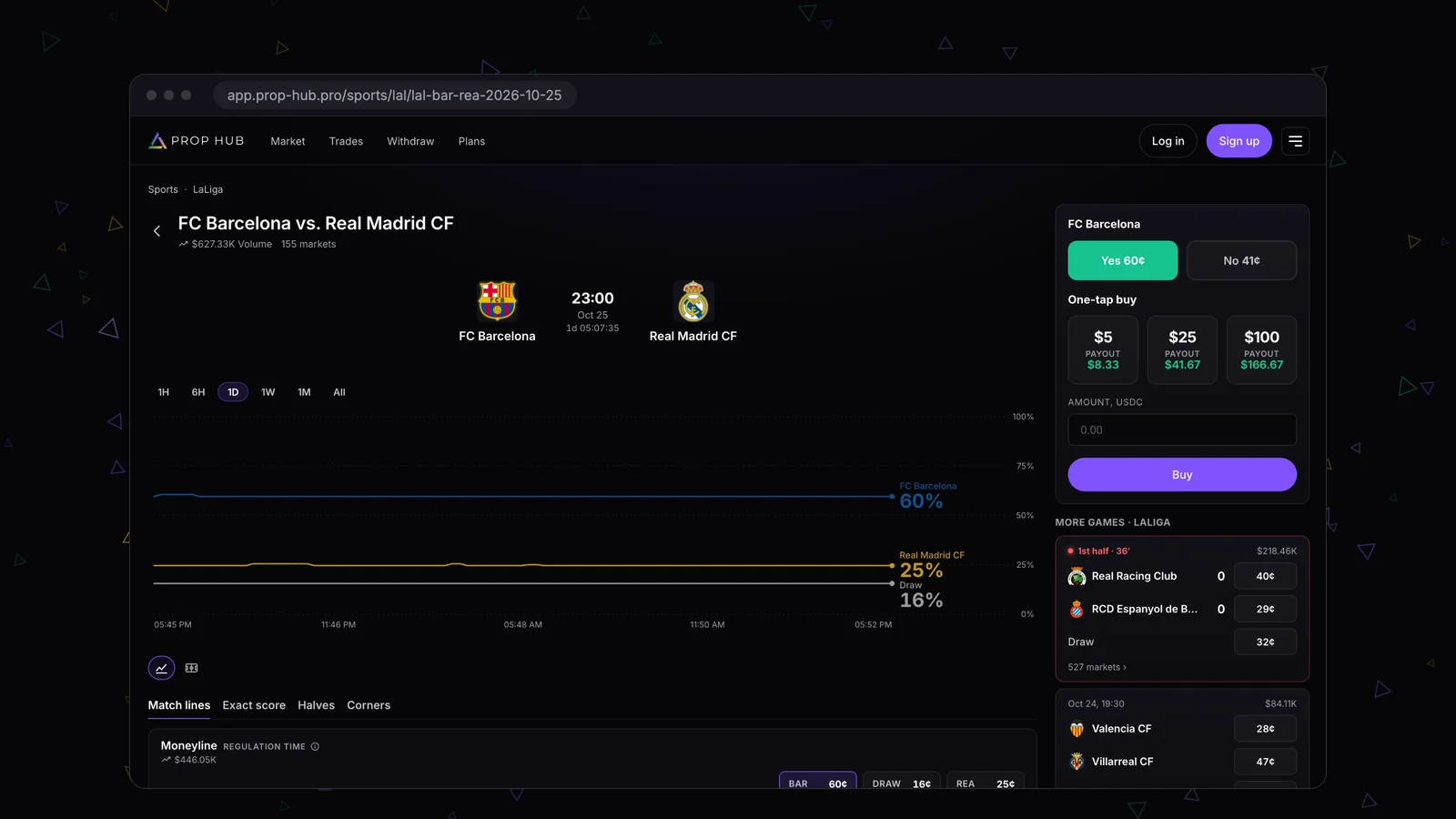
For each game Polymarket opens three Yes/No markets: home win, draw, away win. All three cover regulation time plus stoppage time only. Alongside them come total goals and both-teams-to-score markets. How those prices relate is covered in reading a football match market, and the draw gets its own piece in the three-outcome soccer market.
There are tournament-long markets too: the winner, top-eight finish, reaching the round of 16. On October 20 the Champions League winner market had Barcelona at 23.5¢, PSG at 15.5¢, Arsenal at 13.5¢ and Real Madrid at 9.5¢. Those markets close at the end of the league phase on January 27, 2027, or later, so Prop Hub doesn’t list them.
How it works on Prop Hub
On Prop Hub, a match market appears once kick-off is no more than 2 days away. Tuesday’s and Wednesday’s games are available from the evenings of November 22 and 23 respectively, and trade until the final whistle.
- Orders fill against the Polymarket book at the volume-weighted average price. If the book can’t fill the full amount, the order is rejected.
- During the match there’s an execution delay set by Polymarket; after it the market and book are fetched again, so an order doesn’t fill at a price that vanished after a goal. More in live sports markets.
- Positions settle on the Polymarket result after the match.
A nine-game night and your account limits
On Wednesday seven games kick off together at 21:00 CET. That’s handy if you have views on several of them, and risky for your daily limit.
Take a $10,000 account. The per-outcome cap is $500, and the daily drawdown limit is 10%, or $1,000 from the day’s opening equity. Three $400 positions on three different games cost $1,200 in the worst case, more than the daily limit. The system won’t accept a buy if equity would cross the limit with every open position at zero, so of five planned $400 positions only two will open; the third one is already rejected. Decide in advance which two or three games you actually understand.
Before the round
- The day before, check the league table: who needs points for the top eight or for 24th place.
- Look at the weekend league schedule: which favorites might rotate.
- An hour before kick-off, compare the line-ups with the price. If a surprising line-up didn’t move it, find out why.
- Pick two or three games and size to the order book, not to the limit.
You can try it without a fee on the $100 welcome account; account sizes are on the plans page.