 Emmy
Position size ends more accounts than bad market picks do. Two traders with identical forecasts can finish the month in profit and with a closed account respectively, just because one put 1% of capital into each trade and the other put 10%. Here are four ways to size a position and how each holds up in prediction markets, where an outcome can drop to zero within a minute.
Why size matters more than accuracy
Buying an outcome on Polymarket is a binary position: a share trades between $0 and $1, pays $1 if the outcome happens and nothing if it doesn’t. Buy $300 at 60¢ and you hold 500 shares. Worst case, you lose $300 plus the fee. Best case, you make $200.
Even a good system loses in streaks. At 60% accuracy, a run of five losses in a row over 300 trades is more likely than not. What matters is how many such runs the account can take. Here’s a $10,000 account where every losing position goes to zero and the size stays fixed:
| Share of capital per trade | Losses in a row to the total drawdown limit | Losses in a row to the daily limit |
|---|---|---|
| 1% | 20 | 10 |
| 2% | 10 | 5 |
| 5% | 4 | 2 |
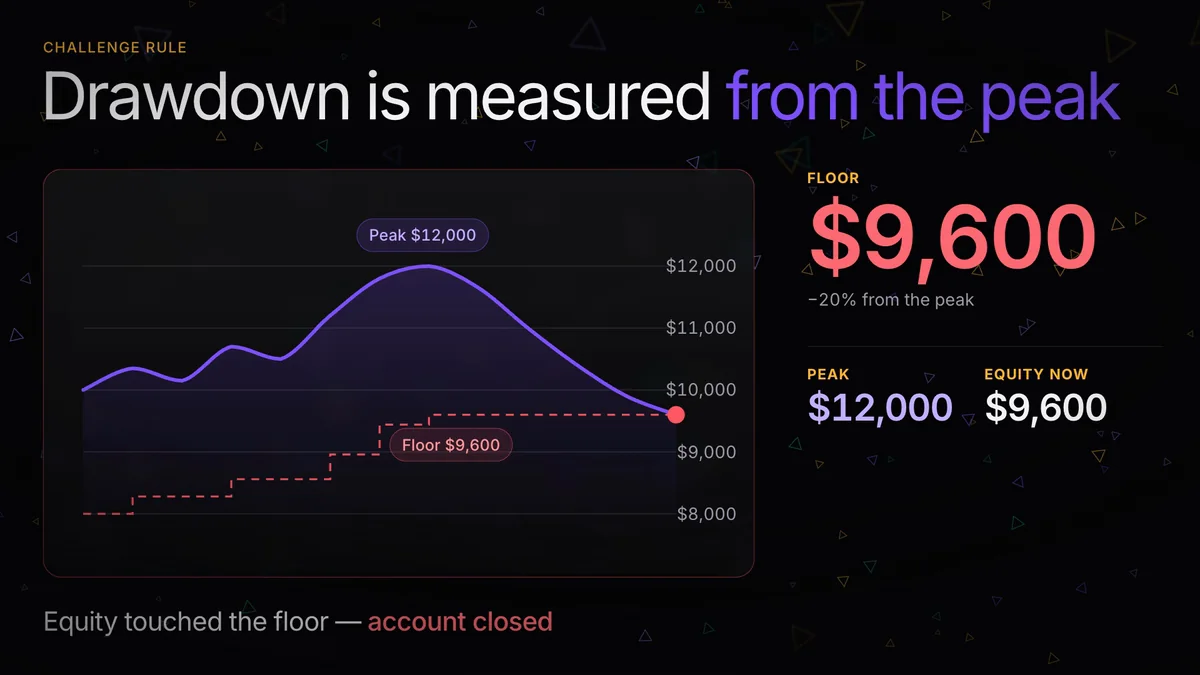
The limits are those of a Prop Hub account: 20% total drawdown from the peak and 10% daily drawdown from the start-of-day equity. The gap between the rows is the gap between a bad week and a bad evening.
Fixed dollar amount
The simplest approach: every trade is the same size, say $150 on a $10,000 account. It’s easy to stick to and works well for your first weeks, while you build up a track record.
The catch is that the amount ignores your equity. After a losing streak, $150 is a bigger slice of what’s left, so risk goes up exactly when it should go down.
Fixed fractional
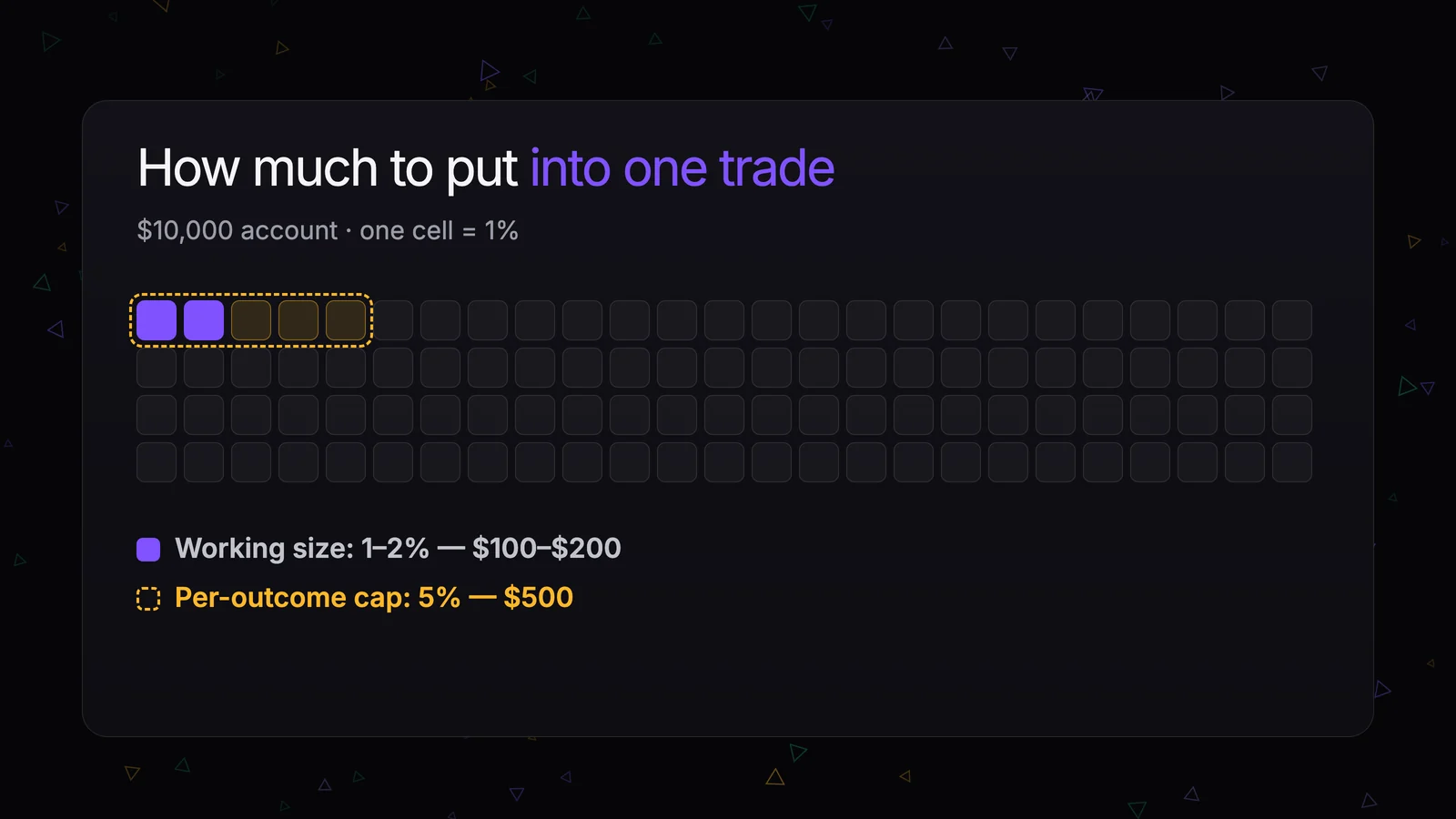
Each trade is a fixed share of current equity, usually 0.5–2%. With $10,000 and 1%, the position is $100. Equity drops to $9,200 — the position becomes $92. Equity grows to $11,000 — $110.
The method slows you down in a drawdown and speeds you up a little on the way up. It’s the default for traders who take many small positions, including short crypto windows, where the result of any single trade is largely noise.
On a prop account there’s a wrinkle. Total drawdown trails the peak, not the starting balance: the minimum rises with the peak and never comes back down. A percentage of current equity doesn’t see that. A $10,000 account grows to $12,000, and the minimum becomes $9,600. Equity slips back to $10,500: 1% of it is still $105, but the cushion above the minimum is now $900, down from $2,000 at the start. That’s why many prop traders size from the starting balance, or from the distance to the minimum, rather than from current equity. The article on daily and total drawdown shows how the minimum moves.
Risk to zero vs risk to exit
A fixed percentage tells you how much you’re willing to lose, not how much to buy. In prediction markets those two numbers can be far apart.
Risk to zero
The honest calculation assumes the whole position can go to zero. Willing to lose $100? Buy $100, fee included. Use this for anything you hold through the result: a match, a central bank decision, the close of a five-minute bitcoin window. The result arrives as a jump, and there may be no price in between to get out at.
Risk to exit
If you’ve decided in advance to sell at a certain price, your risk is the distance to that price. Buy at 40¢ and plan to exit at 28¢: that’s 12¢ out of 40¢, or 30% of the position. A $100 risk budget then allows a position of about $333.
Two caveats. Prop Hub has no stop orders that trigger on their own: you sell manually into the best bids in the order book, and on a thin book the actual exit price will be lower (see order book and slippage). More importantly, news doesn’t care where your exit is. A goal, a surprise data print or a statement from a candidate can take the price from 40¢ straight to 5¢. Sizing to exit works for positions you close before the key moment of the event. If you hold through it, size to zero.
The Kelly criterion
Kelly answers one question: what share of capital maximizes long-run growth, assuming you know your edge exactly. For an outcome priced at p that you think happens with probability q:
share of capital = (q − p) / (1 − p)
Example. On October 20, “No change” in the “Fed Decision in October?” market traded at 85.5¢. Say your estimate is 92%. Kelly gives (0.92 − 0.855) / 0.145 ≈ 45% of capital — about $4,480 on a $10,000 account, in a single outcome.
A second example: an outcome at 30¢ that you put at 40%. That’s 0.10 / 0.70 ≈ 14% of capital, around $1,430.
These numbers look aggressive for a reason. Kelly is right only if your probability is right. Misjudge the first example by six and a half points and your real edge is zero; the fee (about 3.2% of the amount on average across our trades) pushes it below zero. Full Kelly with an overestimated edge produces drawdowns of tens of percent.
So in practice traders use fractional Kelly — half or a quarter of the formula. Quarter Kelly in the second example is about 3.6% of capital, roughly $357, which looks like a workable size. Quarter Kelly in the Fed example is still about $1,120, above the per-outcome cap.
Kelly is most useful as a sanity check. If the formula gives less than 1% at your estimate, there’s hardly any edge and you can skip the trade. If it gives 40%, you’re probably more confident than you should be.
How each method fits a prop account
| Method | Strength | Weak spot |
|---|---|---|
| Fixed amount | Simple, clean statistics | Doesn’t react to drawdown |
| Fixed fractional | Cuts size in a drawdown | On a prop account, size from peak or start |
| Risk to exit | Larger size with a clear exit | No protection against news gaps |
| Fractional Kelly | Uses price and your estimate | Only as good as your estimate |
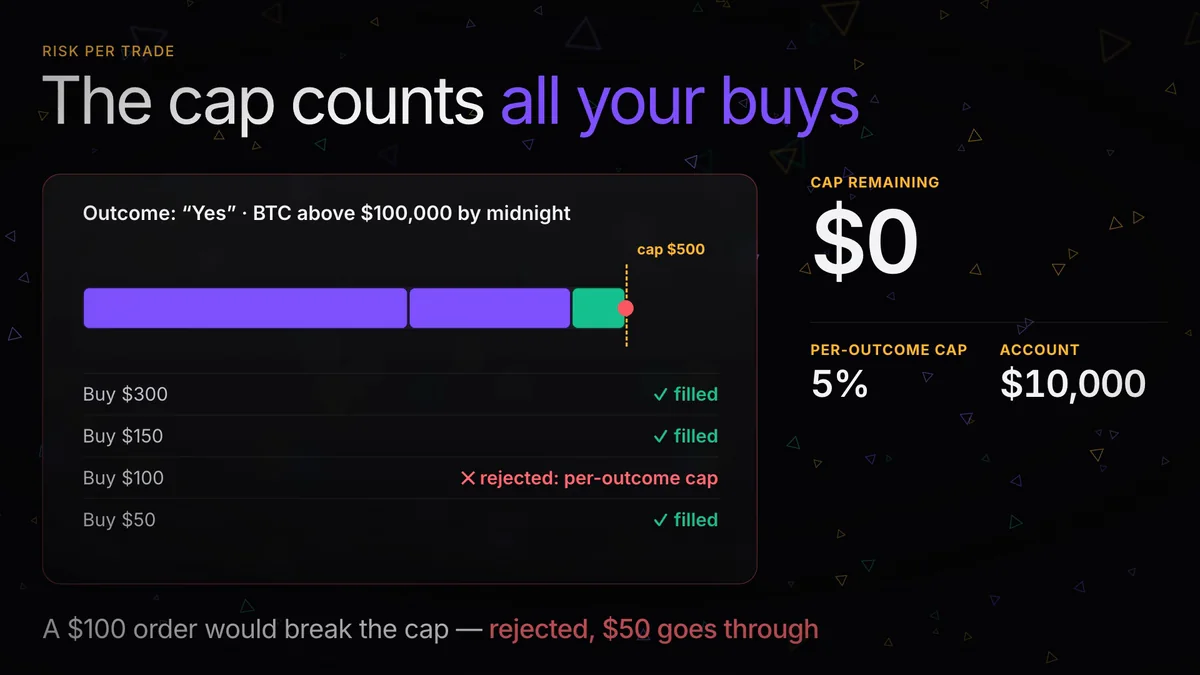
Every method sits under the account’s own limits. On Prop Hub, all buys in one outcome together can’t exceed 5% of the starting balance — $500 on a $10,000 account. Before each buy, the system also checks whether losing every open position would take equity past a drawdown limit. The article on the risk-per-trade limit covers how that ceiling works. A sizing method is for choosing a size under the ceiling, not for hitting it every time.
What to do on your account
- Pick a risk budget per idea: 0.5–2% of the starting balance.
- Size positions held to the result to zero. Size short positions you’ll exit before the news to the exit point, with room for the order book.
- Before a large buy, run your estimate through Kelly and take a quarter. If that’s above your budget, use the budget.
- Treat correlated positions as one: “up” on BTC and “up” on ETH in the same window usually move together.
You can try these methods at no cost on the free account, and account sizes and fees are on the plans page.