 Emmy
You don’t need a tipster to get a forecast for tonight’s football. The prices on a Polymarket match market already are one, set by people who back their view with money. A share at 64¢ means the market puts that outcome at about 64%. The skill is reading all of a match’s markets together and spotting where they disagree with you.
We’ll use a real example: Liverpool vs Villarreal in the Champions League on October 20, 2026, priced a few hours before kick-off. Liverpool won 4–3, coming back from 2–0 down to win by a single goal.
Three markets for the result
A football match on Polymarket is a bundle of markets. The core is the result, which is split into three separate Yes/No markets:
| Market | Yes price |
|---|---|
| Liverpool win | 64.5¢ |
| Draw | 20.5¢ |
| Villarreal win | 14.5¢ |
They add up to 99.5¢, almost exactly $1. That’s what you’d expect: exactly one of the three will happen. If the sum drifts well away from $1, one of the books is thin or a price hasn’t caught up with the news yet.
All three cover regulation time only: 90 minutes plus stoppage time. Extra time and penalties in a cup tie don’t count. The draw has enough quirks of its own to deserve a separate article.
Goal markets
The second block is about how many goals get scored.
- Totals. Over 2.5 goals traded at 66.5¢, over 3.5 at 43.5¢. The line priced near 50¢ shows how many goals the market expects; here it sits between 2.5 and 3.5.
- Both teams to score. Yes at 60.5¢. It’s a different question from the total: a 3–0 is over 2.5 but a No on both teams to score.
- First team to score. Liverpool 66¢, Villarreal 28.5¢, neither 3.5¢.
- Correct score. One market per scoreline: 1–1 at 9¢, 2–0 at 8.5¢, 1–0 at 7.5¢, 0–0 at 3.6¢.
There’s also a spread (Liverpool −1.5 at 42.5¢), first- and second-half results, corners and team totals.
The markets have to agree
The most useful habit is checking markets against each other. They describe the same game, so the prices should line up.
From this match: “neither team to score first” was 3.5¢, the 0–0 correct score 3.6¢, under 0.5 goals 3.5¢. Three different markets on one event, priced within a tenth of a cent of each other.
A harder one. Liverpool to win was 64.5¢, and Liverpool −1.5, a win by two or more, was 42.5¢. That leaves roughly 22¢ for a one-goal Liverpool win. If you think Liverpool win but don’t run away with it, that’s a specific view, and there’s a market that matches it.
When neighbouring markets disagree noticeably, find out why. Usually a side market has a thin book: the midpoint looks attractive, but there’s nothing to buy at that price.
What moves the price
Before kick-off, prices move on news: injuries, rotation ahead of a bigger game, weather. The biggest moment is the team sheet, about an hour before the start. If a key player is missing, the result and totals markets reprice within minutes.
During the game, events on the pitch move it: a goal, a red card, a penalty. The market reacts in seconds; live sports markets covers that in detail.
The clock moves prices too. At 0–0 in the 70th minute the draw gets more expensive and over 2.5 gets cheaper, even if nothing is happening on the pitch.
How it works on Prop Hub
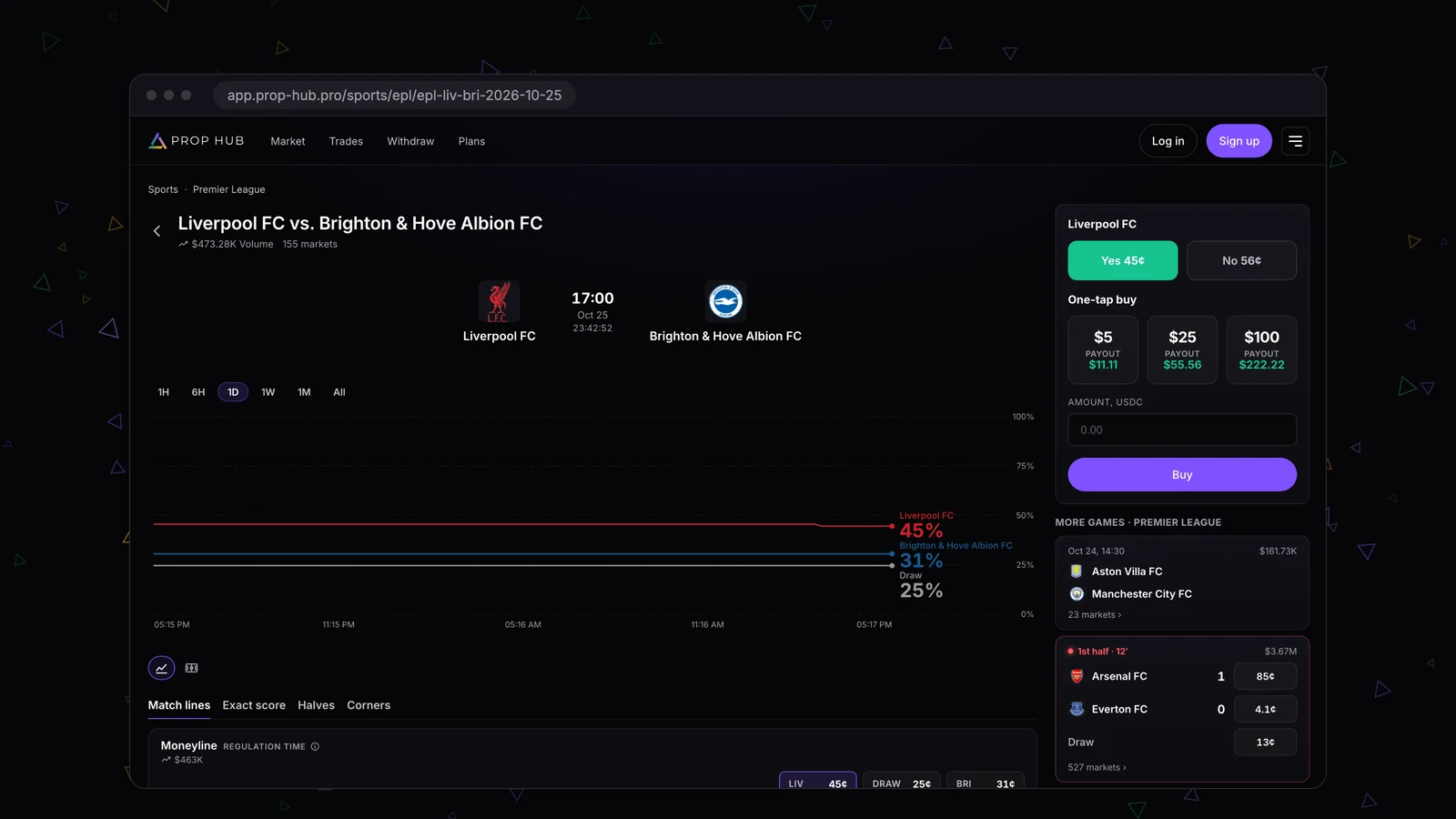
A football match appears under Sports once it starts within 2 days. You can trade before kick-off and in play for as long as Polymarket accepts orders. Season-long markets and tournament winners aren’t on the account; they close beyond that horizon.
Execution rules:
- buys fill against the Polymarket order book at the average of every level they take. If there isn’t enough on offer for the full amount, the order is rejected. See order book and slippage;
- the fee is whatever Polymarket charges on that market, about 3.2% of the trade on average. The calculation is in the help center;
- most football markets have an execution delay of about a second: the order waits it out and fills against the fresh book;
- once Polymarket settles the result, winning shares close at $1 and losing ones at $0;
- only trades entered between 10¢ and 90¢ count toward the challenge target. You can trade a correct score at 3–9¢, but its profit won’t count toward the target.
Checklist before you buy
- Put your view in one sentence. “Liverpool by one goal” or “a low-scoring game”. That decides which market you buy.
- Pick the market that matches the view most closely. “Few goals” is under 2.5, not the draw.
- Compare the price with neighbouring markets. If an outcome looks cheaper than the spread and total imply, check the book; there may be nothing to buy.
- Work out the worst case. What you pay is what you can lose. On a $10,000 account one outcome takes at most $500, or 5% of the starting balance.
- Check what else is open. Positions in three matches on the same evening can all lose together. Daily drawdown is capped at 10%.
This is not financial or investment advice — just an example of how trading can be organized. Trading decisions are yours alone.
You can run this routine risk-free on the free welcome account. Why a price is a probability and how to turn it into a profit figure is covered in prices are probabilities.