 Emmy
People searching for a Polymarket broker usually expect a middleman like the ones in stocks or forex: a company that holds your money and sends your orders to the market. On Polymarket’s international platform that middleman doesn’t exist. You trade directly against the order book from a wallet you control. There are, however, three kinds of intermediaries that sit near the book, and each changes what you pay and who holds your funds. Below is what they are, as of November 2026, and where a prop firm such as Prop Hub fits in.
What a broker does, and why Polymarket works differently
A classic broker does three jobs. It holds your deposit, it routes your orders to an exchange or fills them itself, and it charges for the service through commission, spread or both. Some forex and CFD brokers also take the other side of your trade, so your loss is their income.
Polymarket is built the other way round. Its documentation describes a central limit order book where buyers and sellers are matched with each other, and every account is a smart wallet controlled by its own signer. The collateral is pUSD, Polymarket’s dollar token. The exchange doesn’t trade against you, and nobody in the middle holds your balance. What Polymarket charges is a taker fee on the specific market: only the order that takes liquidity pays, makers pay nothing. The formula from the docs is:
fee = shares × rate × price × (1 − price)
The rate depends on the category: 0.07 on crypto, 0.05 on sports, 0.04 on politics, 0 on geopolitics. How it plays out on real trades is in our breakdown of Polymarket fees.
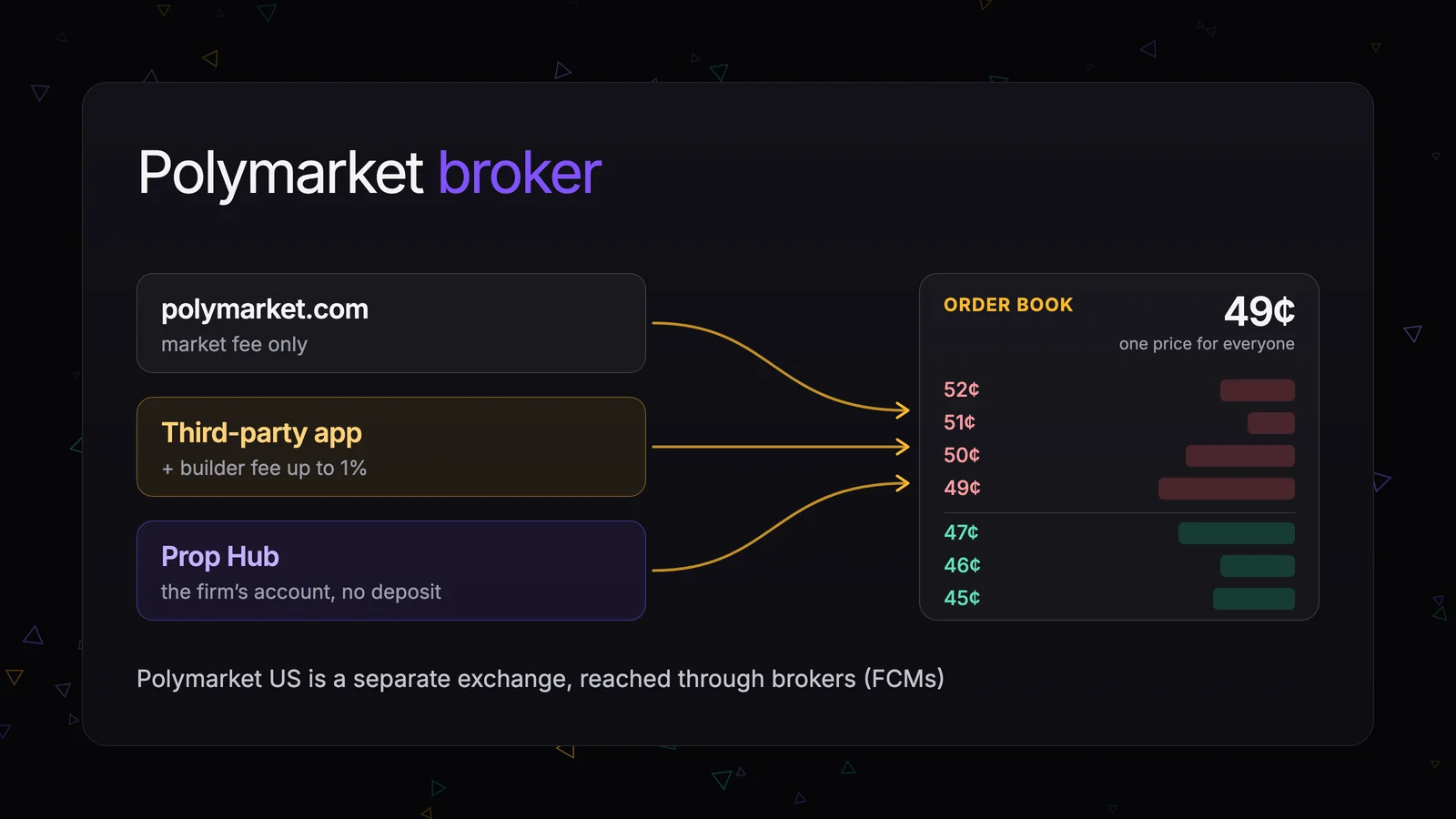
Route 1: directly on polymarket.com
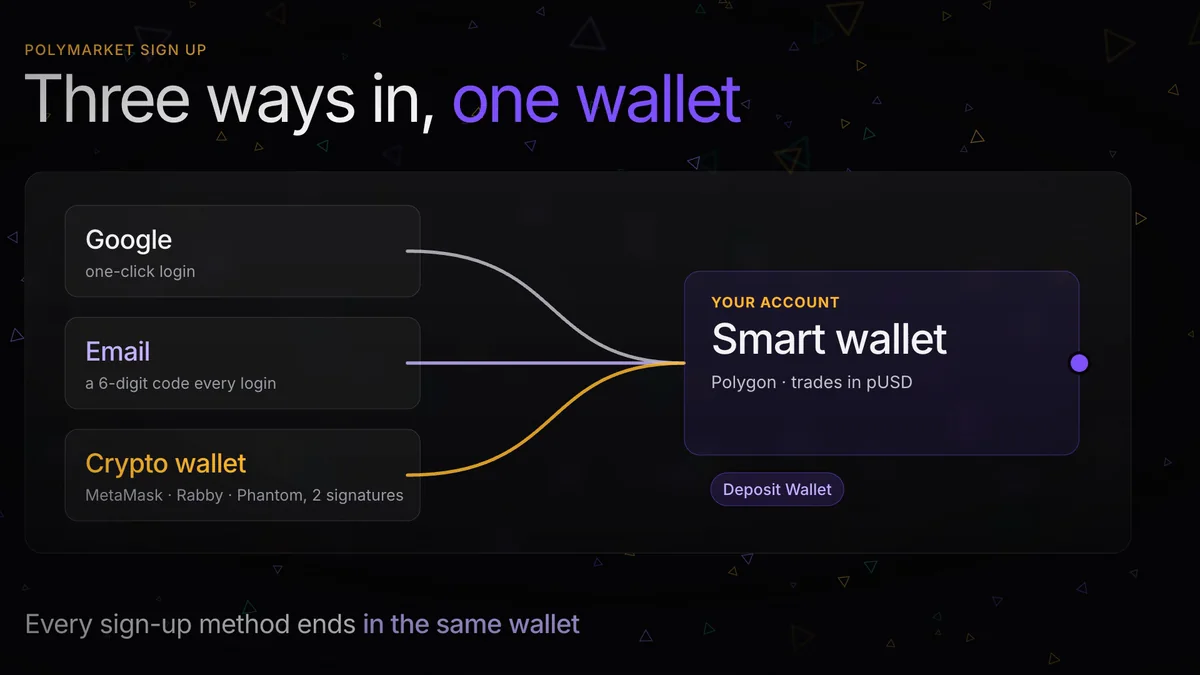
Most people trade through Polymarket’s own site or app. You sign in with email, Google or an external wallet such as MetaMask, deposit, and your orders go straight into the book. There’s no broker fee, only the market’s taker fee. Polymarket doesn’t charge to deposit or withdraw USDC, though an exchange or card service you use on the way can charge its own.
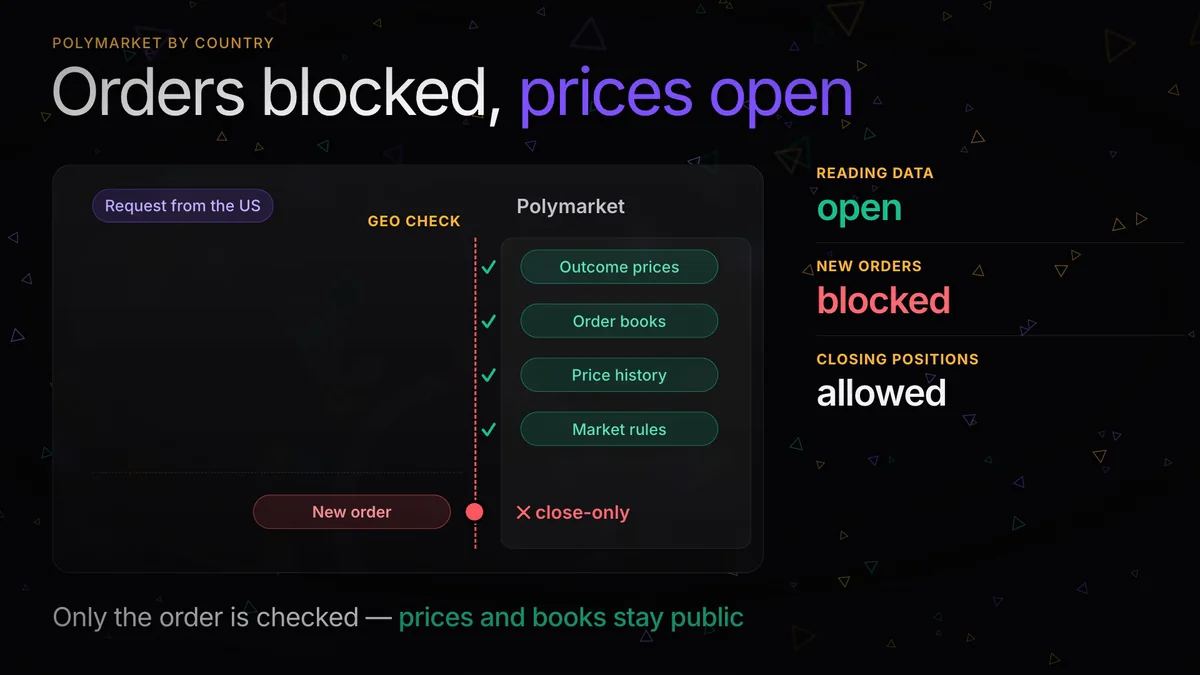
The catch is geography. Polymarket blocks order placement from a number of countries, while prices and order books stay publicly readable. The details are in Polymarket restricted countries.
Route 2: third-party apps built on Polymarket
The closest thing to a broker on the international platform is a third-party app. Polymarket calls these companies builders: “a person, group, or organization that routes orders from users to Polymarket.” Trading bots, wallets and alternative interfaces fall into this group. Each attaches its builder code to the orders it sends, so Polymarket can credit it with the volume.
A builder can also charge its own fee, and it’s added on top of Polymarket’s fee, never instead of it. According to Polymarket’s builder documentation:
- the taker builder fee is 0 by default and capped at 100 basis points (1%) of the trade amount;
- the maker builder fee is capped at 50 basis points (0.5%);
- the rate can change at most once every 7 days, and Polymarket can revoke a builder’s right to charge it.
Here’s what that means on a live book. On November 13, 2026, around 18:40 UTC, Over 218.5 points in the NBA game Warriors vs. Spurs was offered at 48¢ for 10 shares and at 49¢ for more than 10,700 shares. A $1,000 buy fills at about 49¢ for roughly 2,041 shares. Polymarket’s fee at this market’s 0.05 rate comes to about $25.50. Through an app charging the maximum builder fee, another $10 is added: $35.50 in total, or 3.55% of the amount instead of 2.55%.
Before trading through any third-party app, check three things:
- The fee. It should be stated in the app. The same order on polymarket.com costs only the market fee.
- Who controls the wallet. A legitimate app never asks for your seed phrase or private key.
- The address. Phishing copies of trading sites are common. Bookmark the real one.
Route 3: Polymarket US and its brokers
In the United States the picture is different. In July 2025 Polymarket bought QCEX, a CFTC-licensed exchange and clearinghouse. On November 25, 2025 the CFTC approved an amended order of designation that lets Polymarket US operate as an intermediated venue: American users reach its markets through futures commission merchants (FCMs) and brokerages, under the same rules as other regulated US exchanges.
On November 3, 2026 the National Futures Association approved Polymarket’s own FCM, PM Derivatives, LLC, on a fully collateralized basis, so there’s no margin trading. Polymarket said it would keep working with its existing FCM and brokerage partners. So in the US a Polymarket broker really exists: it’s a regulated futures intermediary, and access goes through it rather than through a self-controlled wallet. This applies to US residents only. Polymarket US is a separate exchange with its own order books, so its prices aren’t the ones on the international platform described above.
Where a prop firm fits
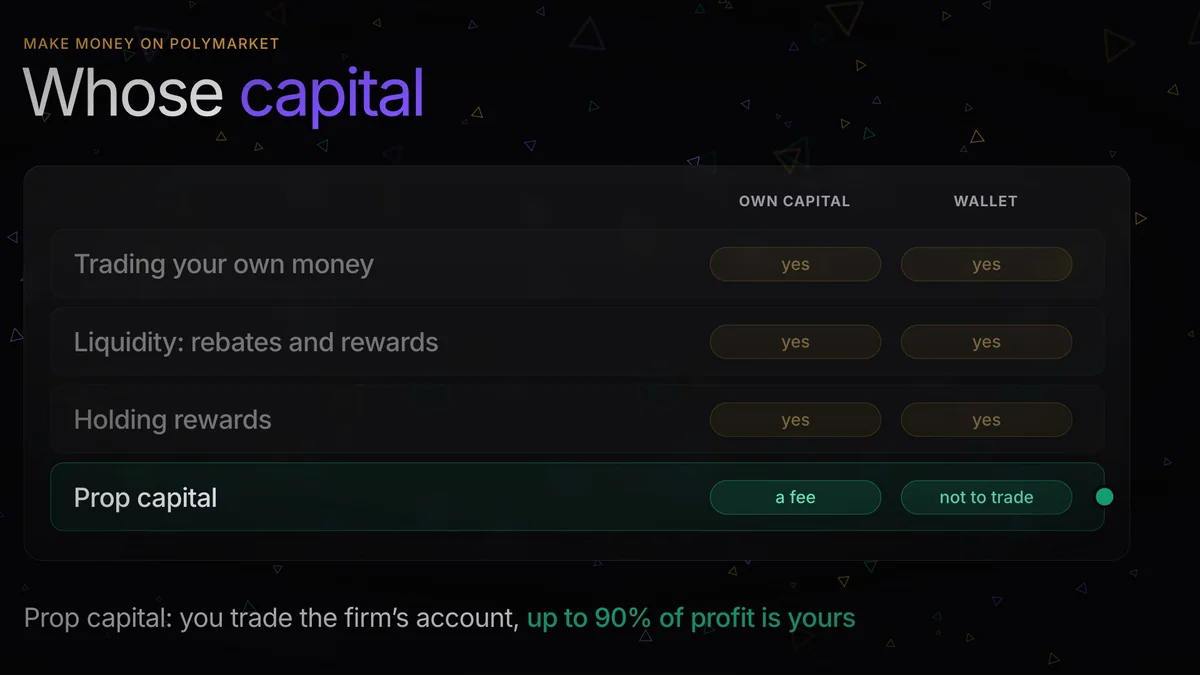
A prop firm isn’t a broker either, and the difference matters for your money. A broker takes your deposit and you trade it. A prop firm sells you a one-time challenge, then lets you trade its capital and pays you a share of the profit. The full comparison is in prop firm vs broker.
Prop Hub is a prop firm for Polymarket. You sign up with email or Google, with no wallet and no deposit. Each buy walks the live Polymarket order book and fills at the weighted average price, with the same taker fee Polymarket charges on that market, and positions settle on Polymarket’s own result. Challenge orders aren’t sent to the exchange, and Prop Hub adds no fee of its own on trades.
What you put at risk is the challenge fee. The account sizes and fees:
| Account size | Fee | Profit target | Min. equity | Daily limit | Per-outcome limit |
|---|---|---|---|---|---|
| $1,000 | $30 | $1,300 (+30%) | $800 (−20%) | −$100 (−10%) | $50 (5%) |
| $10,000 | $125 | $13,000 (+30%) | $8,000 (−20%) | −$1,000 (−10%) | $500 (5%) |
| $25,000 | $300 | $32,500 (+30%) | $20,000 (−20%) | −$2,500 (−10%) | $1,250 (5%) |
| $50,000 | $500 | $65,000 (+30%) | $40,000 (−20%) | −$5,000 (−10%) | $2,500 (5%) |
To pass, you reach +30% without breaking the limits: total drawdown −20% from the peak, daily drawdown −10%, no more than 5% of the starting balance in one outcome. Only markets that resolve within 2 days are available. On a funded account you keep up to 90% of the profit, paid in USDT or USDC after KYC. The full path is in how Prop Hub works, and the list of markets in the help center under markets.