 Emmy
Prop markets are bets on something inside a game other than the final winner: how many points a player scores, whether a running back finds the end zone, which team scores first, by how much the game is won. In sportsbooks they’re called props, short for proposition bets. Polymarket lists the same kind of questions as ordinary Yes/No markets with a price between 0 and 100¢, so a prop reads as a probability like any other market. Below: which props Polymarket has, how to read a ladder of prop lines, why their order books are thinner than the game line, and how to trade them on Prop Hub without a wallet.
One note on the word. In “prop firm”, prop means proprietary: trading a firm’s capital. Prop markets have nothing to do with that, though on Prop Hub the two meet: you trade Polymarket props on a funded-style account.
What counts as a prop market
On Polymarket a game is a group of markets. The main one is the moneyline (who wins), next to it spreads and totals; how those work is covered in spread and total markets. Everything else is a prop. There are two families.
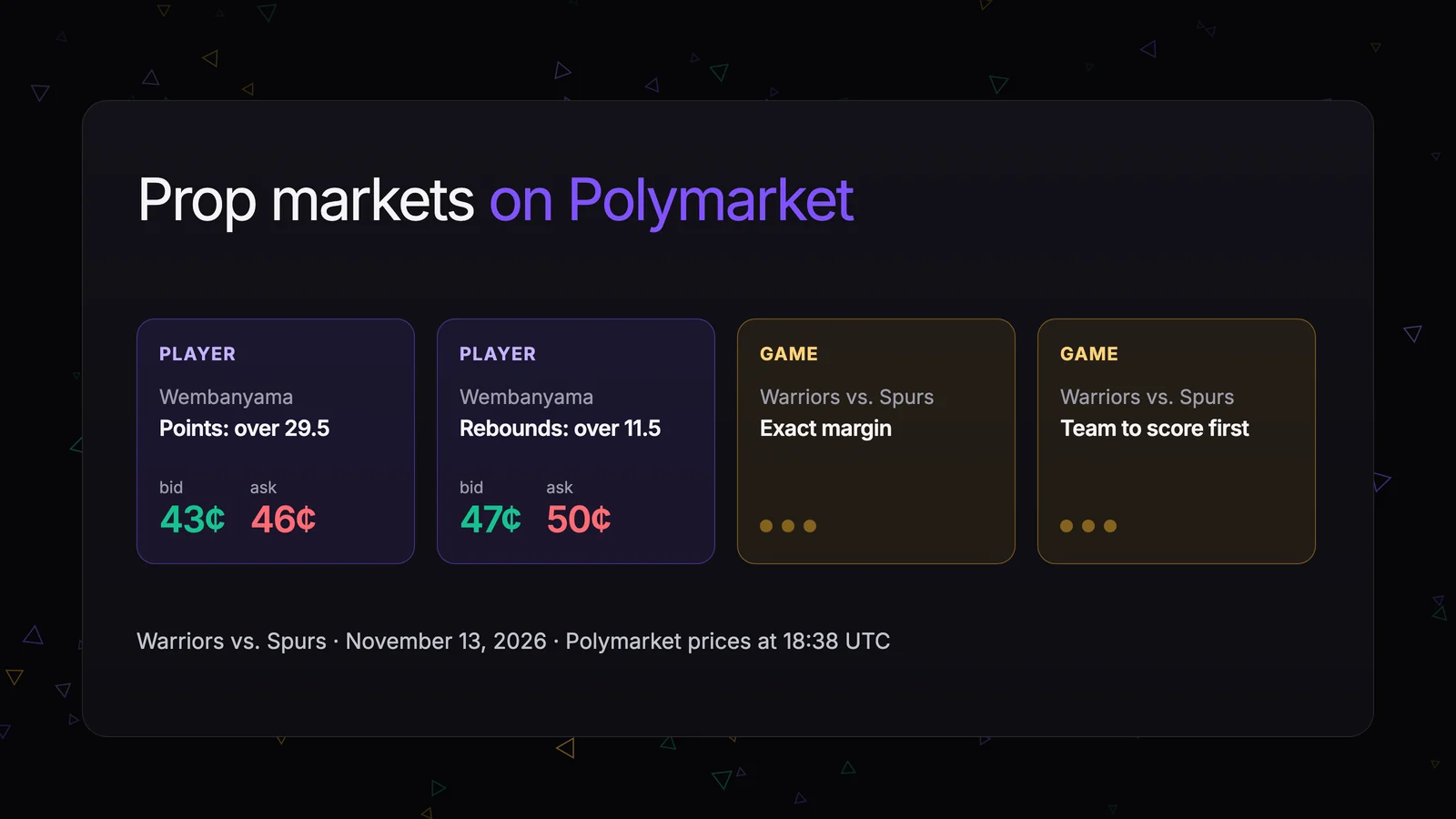
Player props are about one player’s stat line. Warriors vs. Spurs on November 13, 2026 had, among others:
- Points, rebounds, assists over/under: “Victor Wembanyama: Rebounds O/U 11.5”, “Brandin Podziemski: Points O/U 19.5”;
- 3-pointers made, steals, blocks: “Victor Wembanyama: Blocks O/U 4.5”;
- in the NFL, anytime touchdown scorers (“Will Travis Kelce score a touchdown?”), in football (soccer), goalscorers and similar player markets.
Game props are about the course of the game rather than one player:
- exact margin (“Exact Margin: Packers by 25+”) and exact score in football;
- first to score, both teams to score, team totals, quarter and half lines, corners in football.
Each line is a separate market. “Wembanyama: Points O/U 29.5” resolves Yes if he scores more than 29.5 points, that is 30 or more, counting overtime. The source is the official box score, for the NBA the one published on NBA.com.
One rule matters more for props than for anything else: if the player doesn’t take the court, the market resolves No. That’s written in the rules of every NBA player market we checked. A Yes on a player who sits out is a loss, not a refund. Before buying, check the injury report; how to read it is in NBA injury report markets.
How to read a ladder of props
A single prop is one probability. A ladder of lines for the same player is a whole forecast of his stat line. Here’s Wembanyama’s points on Polymarket at 18:38 UTC on November 13, 2026, about eight hours before tip-off (midpoint of the best bid and ask):
| Line | Bid / Ask | Chance of “more” |
|---|---|---|
| over 19.5 (20+) | 82¢ / 86¢ | 84% |
| over 24.5 (25+) | 66¢ / 69¢ | 67.5% |
| over 29.5 (30+) | 43¢ / 46¢ | 44.5% |
| over 34.5 (35+) | 22¢ / 28¢ | 25% |
| over 39.5 (40+) | 1¢ / 17¢ | 9% |
The difference between two neighbouring lines is the chance of the range between them. 25+ at 67.5% minus 30+ at 44.5% gives 23% for 25 to 29 points. That’s the most likely five-point range, and still less than one in four. The market doesn’t say “he’ll score 27”, it says “probably 20 to 35, with a long tail either way”.
Two practical takeaways:
- Compare a line with its neighbours. On the same ladder “Points O/U 28.5” stood at 5¢ bid and 49¢ ask. Its midpoint, 27¢, is meaningless: with 29.5 at 43–46¢, the real price of 28.5 is somewhere near 46–49¢. A wide book gives you a price range, not a price; the ladder tells you where in that range the market actually is.
- A prop is a forecast of a number, not of a result. On the moneyline the Spurs were at 85¢. That says nothing about whether Wembanyama goes over 11.5 rebounds; the answer there was 47¢ / 50¢, a coin flip. More on reading prices as chances in prices are probabilities.
Why prop order books are thinner
The main difference between props and the game line isn’t the question, it’s the money behind the price. At the same moment, Polymarket’s data showed about $197,000 of liquidity on the Warriors vs. Spurs moneyline and about $1,800 on Wembanyama rebounds over 11.5. Some point props had a few dozen dollars.
You see it the moment you buy. A $200 buy on each, against the live order books:
- Spurs to win. 9,734 shares offered at 85¢, the best ask. The whole $200 fills there: 235.3 shares, no slippage.
- Wembanyama rebounds over 11.5. Only 5 shares at 50¢, then 167 at 51¢, 15 at 52¢, 80 at 54¢ and the rest at 55¢. The order walks five price levels: 378.5 shares at an average of 52.8¢. At the best ask, $200 would have bought 400 shares.
That’s 2.8¢ a share on top of the quoted price before the game even starts. If the prop wins, those 21.5 missing shares are $21.50 less payout. How a buy walks the book is covered in order book and slippage.
The fee works the same as on any Polymarket sports market: the taker pays shares × rate × price × (1 − price). This game had a 0.05 rate on all markets, so the rebounds buy carried about $4.71 in fees, the moneyline buy $1.50. Details are in Polymarket fees.
What follows for trading props:
- Size to the book, not to the account. On a thin prop the right amount is what the first two or three levels can take.
- Look at the spread before the price. A 1–3¢ spread means people actually trade the line. 5¢ to 49¢ means nobody does.
- Props move on news. A lineup change can shift a player’s whole ladder in seconds, and the few offers in the book vanish first.
Trading props on Prop Hub
On Prop Hub, props sit on the game page: open a game in the Sports section of the market and switch to the Players tab; exact score, halves and other game props have their own tabs. Orders fill against Polymarket’s live order book at the same price and fee as on Polymarket, so everything above applies one to one. If the book can’t take the whole order, it’s rejected rather than partially filled.
The account rules that matter most for props:
- Horizon. A game’s markets are open if it starts within the next 2 days. Season-long props like “top goalscorer of the season” don’t fit.
- Per outcome. All buys in one outcome together can’t exceed 5% of the starting balance.
- Price corridor. Profit counts toward the challenge target and payouts only from positions bought between 10¢ and 90¢. Many props live at the edges of the ladder, like 40+ points at 1–17¢; those trades are allowed but their profit doesn’t count. The corridor is explained in the help center under challenge rules.
- In-play. Props keep trading after tip-off while Polymarket accepts orders, with the same execution delay; see live sports markets.
You can try props for free on the $100 welcome account or the $10,000 demo, then move to a challenge on the plans page:
| Account size | Fee | Profit target | Min. equity | Daily limit | Per-outcome limit |
|---|---|---|---|---|---|
| $1,000 | $30 | $1,300 (+30%) | $800 (−20%) | −$100 (−10%) | $50 (5%) |
| $10,000 | $125 | $13,000 (+30%) | $8,000 (−20%) | −$1,000 (−10%) | $500 (5%) |
| $25,000 | $300 | $32,500 (+30%) | $20,000 (−20%) | −$2,500 (−10%) | $1,250 (5%) |
| $50,000 | $500 | $65,000 (+30%) | $40,000 (−20%) | −$5,000 (−10%) | $2,500 (5%) |
Which markets are available and how they’re grouped is in the help center under markets.