 Emmy
Instant funding means you buy a funded account outright. There’s no evaluation: you pay, the account opens, and profit from the first trade counts toward a payout. It sounds like the obvious choice, and for some traders it is. But the firm still has to protect itself from traders who would fail a test, so the checks the challenge used to do move into the rules of the account itself. Here’s where they usually end up.
What instant funding sells
At a typical prop firm you pay for an evaluation: one or two phases with a profit target and loss limits, then a funded account. With instant funding the evaluation is gone. You’re trading for a profit split from day one, and the fee is the price of the account, not of an attempt.
For the firm that’s a bigger risk. A challenge filters traders before the firm pays out anything, and its fees fund the payouts of those who pass. Instant funding has no such filter, so firms compensate in three ways: a higher price for the same capital, stricter loss limits and a smaller share or slower access to payouts.
How the rules usually differ
FundedNext publishes both models side by side, which makes it a good example. Here’s their Stellar Instant account next to their Stellar 2-Step challenge, as listed on November 1, 2026:
| Stellar 2-Step | Stellar Instant | |
|---|---|---|
| Profit target | 8%, then 5% | none |
| Daily loss limit | 5% | none |
| Maximum loss | 10%, static | 6%, trailing |
| Profit share | 80%, 90% with on-demand payouts | 70%, 80% from tier 3 |
| Leverage | up to 1:100 | forex 1:30, crypto 1:1 |
| Entry price | $6,000 account for $59.99 | $2,000 account for $59.99 |
The same $59.99 buys three times the capital in the challenge. The instant account has no target and no daily limit, but its maximum loss is smaller and it trails: the floor rises with your best equity and stops trailing once it reaches the starting balance.
HyroTrader, a crypto prop, follows the same pattern, except that its fast lane is the shortest possible evaluation rather than no evaluation at all. Zero-Step is a single 10% target with a one-day trading minimum, while the Two-Step needs two targets, 10% and 5%, with at least 5 days per phase. Zero-Step has a 3% daily limit and a 5% maximum loss against 5% and 10%, an 80% split against 80% rising to 90%, and a fee that isn’t refunded, while the Two-Step deposit comes back with the first payout. (Terms from their homepage, checked November 1, 2026.)
These are examples, not a ranking. Other firms combine the same levers differently. The direction is almost always the same, though: the shorter the road to funding, the tighter the account.
A trailing limit on a small account
The tightest of these levers is the trailing maximum loss. Take a hypothetical $5,000 instant account with a 6% trailing limit: the floor starts at $4,700. Make $200, and the floor climbs to $4,900. Give it back to $5,000, and you have $100 of room instead of $300, though you’re back where you started.
Once the floor reaches the starting balance it stops, and from then on the account behaves like one with a fixed floor. Until then a normal pullback after a good run can close the account even though it never went below its start. That’s why instant accounts often reward slow, steady growth rather than a fast start. More on this type of limit in daily and total drawdown.
Instant, one-step and two-step compared
| Two-step challenge | One-step challenge | Instant funding | |
|---|---|---|---|
| Before payouts | two targets | one target | none |
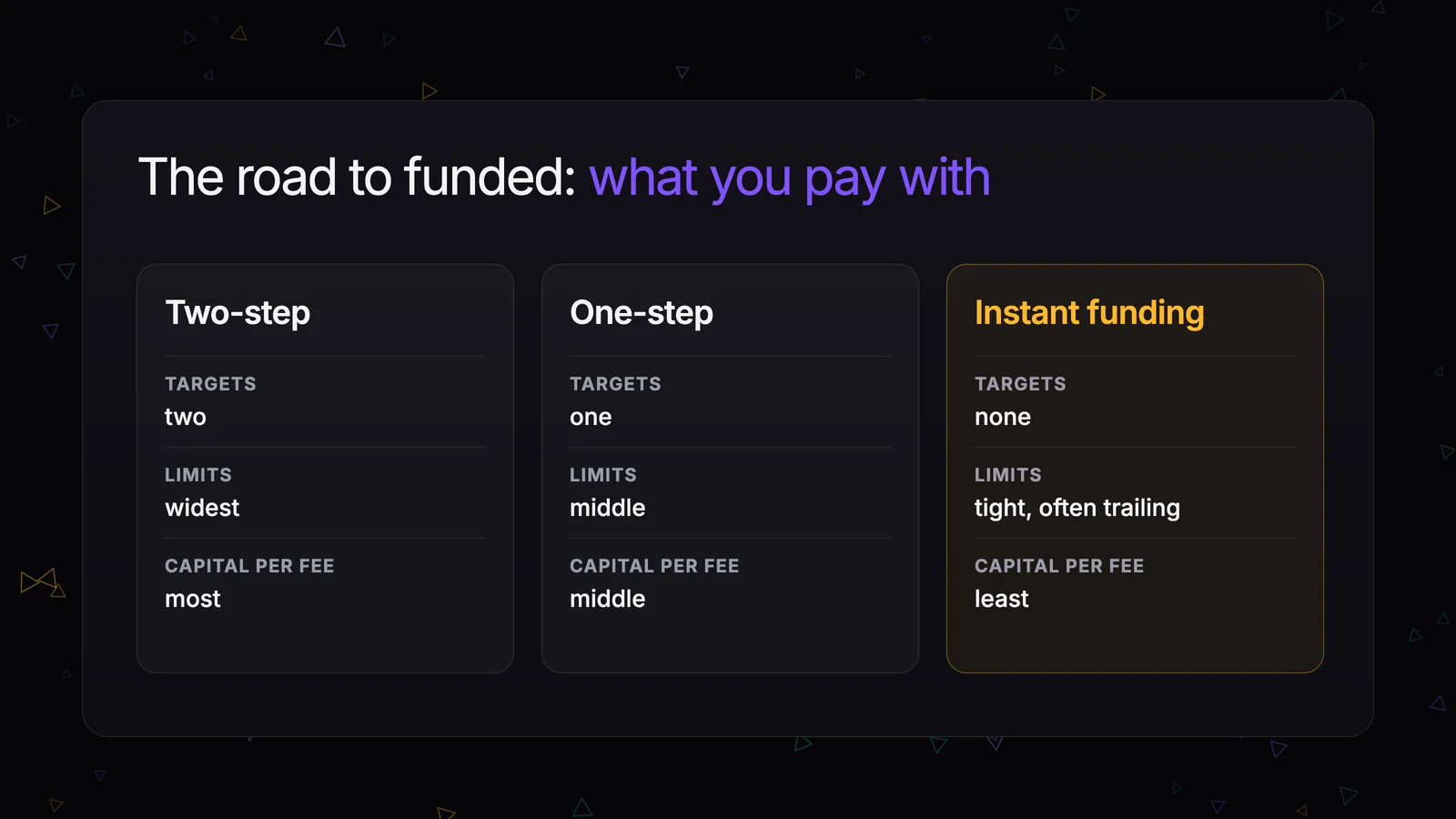
| Typical limits | widest | middle | tightest, often trailing |
| Capital for the fee | most | middle | least |
| Fee | price of an attempt | price of an attempt | price of the account |
| Main risk | time and two chances to fail | one target to reach | a small floor from day one |
A two-step challenge is the longest road but gives you the most room. Instant funding is the shortest, but you start on a small account with almost no buffer. Which one fits depends less on skill than on how you trade: a scalper with tight stops copes with a small floor, while a trader who holds through swings needs room.
Why Prop Hub uses a challenge
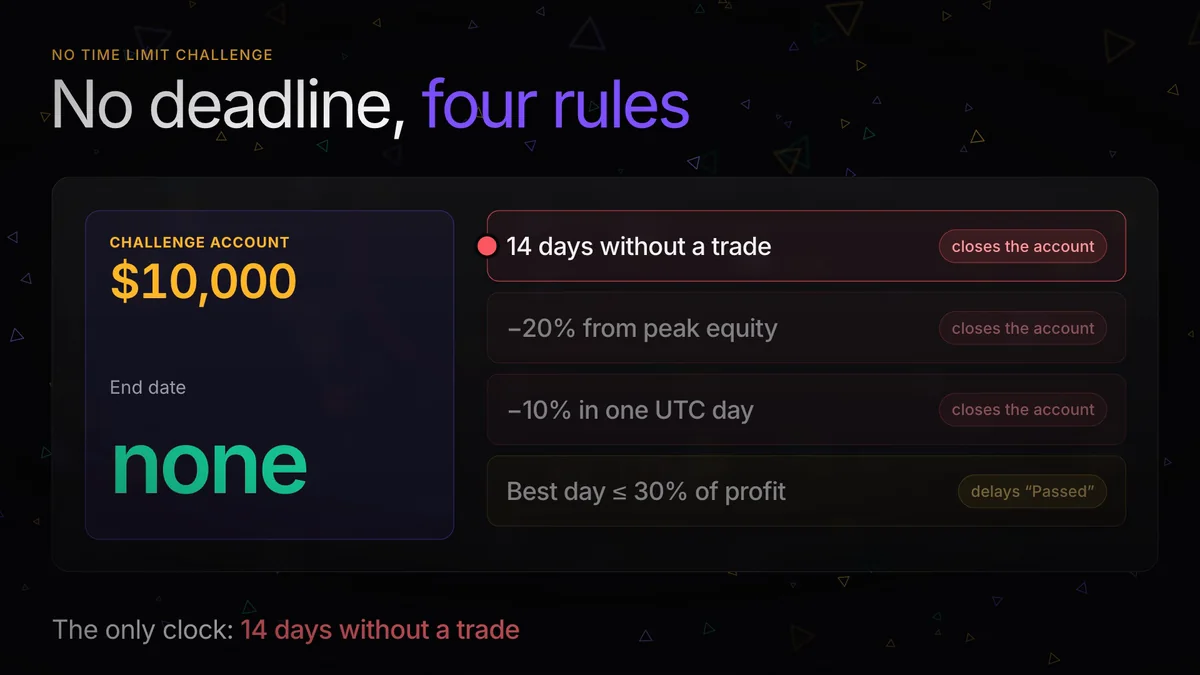
Prop Hub, a Polymarket prop firm, has no instant accounts. You buy a one-phase challenge: reach +30% with total drawdown no more than 20% from the peak and daily drawdown no more than 10%. There’s no time limit, only an activity rule: at least one trade every 14 days. Once you pass and close your positions, you request funding, the team reviews your trades and opens a funded account of the same size, with up to 90% of the profit going to you. The whole path is in get funded to trade Polymarket.
The reason is the instrument. On prediction markets an outcome can go from 60¢ to zero in one evening. With a 6% maximum loss, one position at the 5% per-outcome cap going to zero would use up almost all of it. So Prop Hub sets wider limits and checks the trader first. The terms of your account are fixed when you buy the challenge and carry over to the funded account unchanged. Why the fee exists at all is covered in why prop firms charge a fee.
| Account size | Fee | Profit target | Min. equity | Daily limit | Per-outcome limit |
|---|---|---|---|---|---|
| $1,000 | $30 | $1,300 (+30%) | $800 (−20%) | −$100 (−10%) | $50 (5%) |
| $10,000 | $125 | $13,000 (+30%) | $8,000 (−20%) | −$1,000 (−10%) | $500 (5%) |
| $25,000 | $300 | $32,500 (+30%) | $20,000 (−20%) | −$2,500 (−10%) | $1,250 (5%) |
| $50,000 | $500 | $65,000 (+30%) | $40,000 (−20%) | −$5,000 (−10%) | $2,500 (5%) |
What you get instead: a free account with a real payout
The usual argument for instant funding is that you don’t want to pay for a test you might fail. Prop Hub answers that differently. When you sign up you get a $100 welcome account for 3 days, with no fee and no deposit. It trades the same Polymarket markets as the challenges, and profit on it can be withdrawn once in real money: from $5 up to $100.
The conditions are short. Equity can’t fall below $50, you need trades on at least 2 different days, and no single event can bring more than 30% of the profit. After the trade review you have 7 days to pass identity verification. Depending on the terms in effect on the day you sign up, the withdrawal is open right away or after buying any challenge; the account page shows which version you have, and the Help Center explains both.
The welcome account doesn’t turn into a funded account. It does let you see, at no cost, how the markets and limits behave before you pay for anything. There’s also a $10,000 Polymarket demo account with challenge rules and no time limit, without a payout.
Questions to ask before buying instant funding
- Is the maximum loss trailing, and when does it stop? On a small account this decides more than the profit split.
- How much capital does the same fee buy in the firm’s challenge? If it’s two or three times more, you’re paying for speed.
- When can you withdraw, and how much? Look for minimum days, payout caps and consistency rules on the funded account.
- Is the fee refunded? Challenge deposits are sometimes returned with the first payout; instant fees usually aren’t.
- Which instruments and leverage? Instant accounts often get lower leverage than the same firm’s challenges.
The full checklist is in how to choose a prop firm.