 Emmy
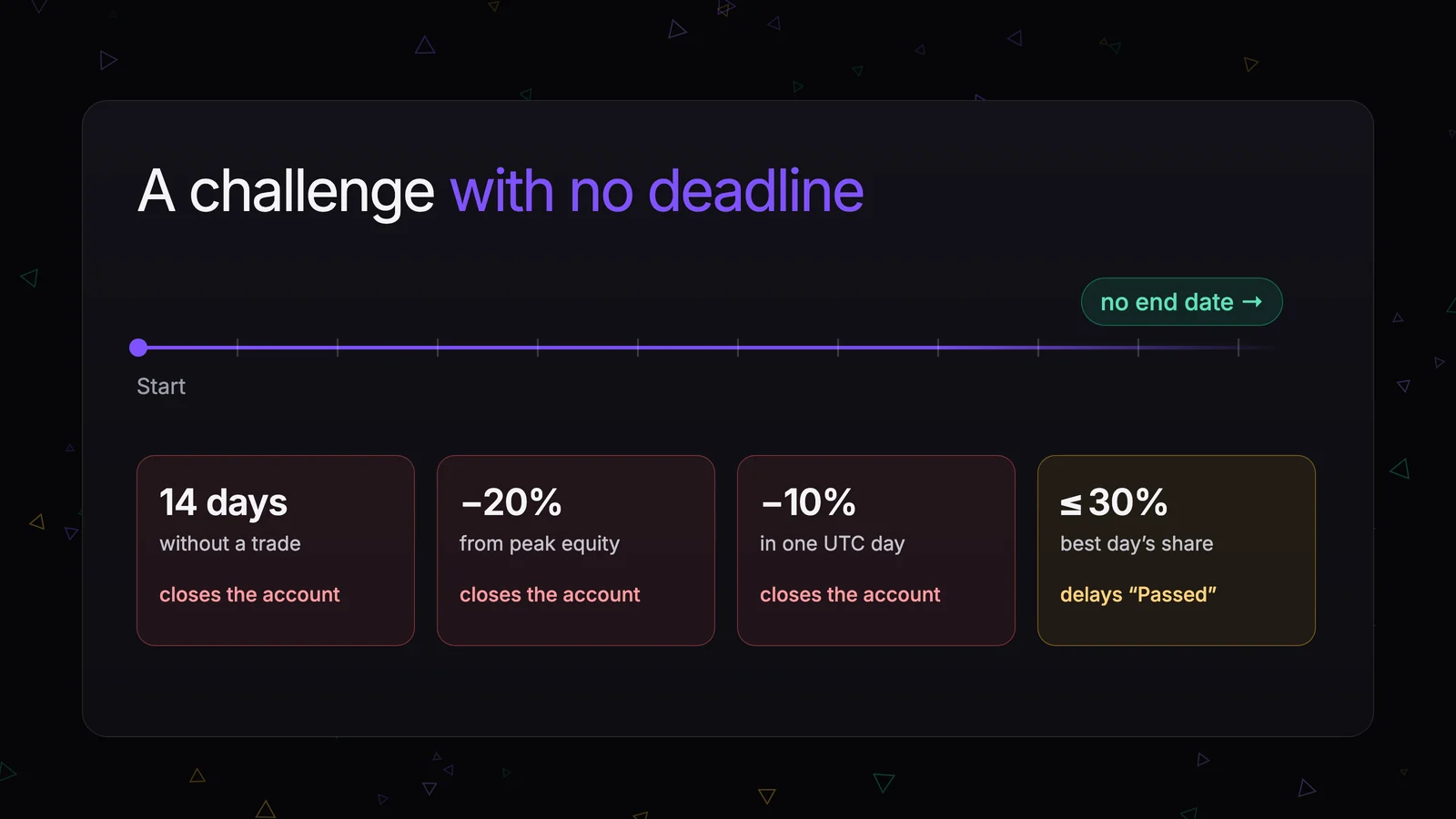
A no time limit challenge has no date by which the profit target must be reached. On Prop Hub the challenge account opens without an end date, and the funded account that follows has none either. That doesn’t mean nothing can close it: an activity rule, two drawdown limits and a consistency condition still apply. Here’s what the missing deadline changes, what still limits you and how to plan the path. The rules themselves, with worked numbers, are in prop challenge rules.
What a deadline does to a trader
Big prop firms such as FTMO, FundedNext and Funding Pips have dropped the deadline on their two-step challenges, but some firms and programs still give you 30 or 60 days. The number of days matters less than what happens to position size once the schedule slips.
Take a $10,000 account. The target is +30%, which is $3,000 of profit. With a 30-day deadline the even pace is $100 a day. Now say that after 20 days you’re up $1,000, a normal result with a couple of losing days in it. To finish you now need $2,000 in 10 days, or $200 a day. The required pace has doubled, while the market hasn’t changed at all.
The usual answer is bigger positions, and bigger positions are exactly what the drawdown limits catch. A deadline turns a decent trader behind schedule into a trader taking risk they wouldn’t take otherwise.
Without a deadline, falling behind costs you nothing except time. If you’re making $150 a day instead of $300, the path is twice as long and the risk is the same.
How it’s set up on Prop Hub
- The challenge has no end date. A paid account opens without an expiry, and its Passed status depends on the target, closed positions and consistency, not on the number of days.
- The funded account has none either. You trade and request payouts for as long as the account stays within the limits.
- Terms are fixed at purchase. The rules in your account’s snapshot don’t change later, even if the plan does.
For comparison, the free accounts work differently: the $100 welcome account lasts 3 days, while the $10,000 demo has no time limit and no activity rule at all.
What still limits you
Activity
The account closes if there are no trades for 14 days in a row. Here’s how it’s counted, straight from the code:
- A trade is a buy or a sale. Both reset the clock.
- Settlement isn’t a trade. When Polymarket resolves a market and your position closes at $1 or $0, the clock keeps running from your last buy or sale.
- No trades yet? Then the clock runs from the moment the account opened.
- The countdown is visible. The account page shows how many days are left before the activity limit.
The settlement rule is where traders slip. You buy on Monday into a game that settles on Tuesday, the position closes on its own, and you take a break. The 14 days are counted from Monday’s buy, not from Tuesday’s result.
In two situations the account can’t close for inactivity. While a funding or payout request is under review, trading is frozen and the rule doesn’t fire, though the countdown is still measured from your last trade, so trade soon after the freeze lifts. And once a challenge is Passed, the activity rule no longer applies to it: you can prepare the funding request without watching the clock.
Drawdowns
The limits don’t care about the calendar. Equity must stay above −20% from its peak, and a single UTC day can’t take more than −10% from that day’s opening equity. Both are measured on equity including open positions. Having no deadline gives you time; it doesn’t widen your cushion. The details are in daily and total drawdown.
Consistency
Your best day can’t be more than 30% of total profit. It never closes the account, but it means the target can’t be reached in one go: on a $10,000 account a single day can bring at most $900 of the $3,000 you need. The path takes several profitable days whatever you do, which fits well with having no deadline.
How to plan without a deadline
No date to aim at means you set the pace yourself. A plan that works with Prop Hub’s rules:
- Size the day by the limits, not the calendar. Pick a loss for a bad day well below the daily limit of $1,000 on a $10,000 account, and a realistic profit for a good one. Bad days should cost less than good days earn.
- Count days, not dates. Divide the target by a good day: at $300 a day, $3,000 is 10 profitable days, plus losing days and days off. An honest estimate for that plan is three to four weeks, and stretching it costs nothing.
- Trade when there’s a setup. Crypto windows run around the clock and there are games every day, so the market always has something. You can afford to be picky and skip days with nothing worth trading.
- Watch only one clock. The activity countdown is the only time limit. If you’re going away for longer than 14 days, one small trade before you leave restarts it.
- Review once a week. Average good day, average bad day, which markets made money. If good days come in smaller than planned, extend the timeline; don’t raise position size.
The day-by-day breakdown of the target is in profit target plan.