 Emmy
On November 28, 2026, Montevideo’s Estadio Centenario hosts the Copa Libertadores final, the biggest prize in South American club football. Think of it as the continent’s Champions League: clubs build entire eras around winning it, and the final stops the region for an evening.
Here’s how the tournament came about, how it works today, who made the 2026 final, and what the markets on it look like on Polymarket and on Prop Hub.
Where the tournament came from
The first edition was played in 1960. CONMEBOL, South America’s football confederation, set it up as a competition for the continent’s national champions, with the winner going on to face the European Cup holder in the Intercontinental Cup. The name honours the leaders of the wars of independence, such as Simón Bolívar and José de San Martín — the “Libertadores”.
Uruguay’s Peñarol won the first two editions. In the very first final they beat Olimpia of Paraguay, 1–0 at home and 1–1 in Asunción.
Record holders and eras
The competition has gone through distinct eras since. Argentina’s Estudiantes won three in a row from 1968 to 1970. Independiente dominated the 1970s and hold the record with seven titles, ahead of Boca Juniors with six and Peñarol with five.
| Club | Country | Titles |
|---|---|---|
| Independiente | Argentina | 7 |
| Boca Juniors | Argentina | 6 |
| Peñarol | Uruguay | 5 |
| River Plate | Argentina | 4 |
| Estudiantes | Argentina | 4 |
| Flamengo | Brazil | 4 |
| Palmeiras | Brazil | 3 |
By country, Argentina and Brazil are level on 25 titles each, with Uruguay on eight. Recent history belongs to Brazil, though: every final from 2019 to 2025 was won by a Brazilian club, and five of those seven finals were all-Brazilian.
From two legs to a single final
Until 2018 the final was played over two legs, home and away. The last two-legged final is also the most famous: River Plate against Boca Juniors. After Boca’s team bus was attacked on the way to the second leg, the match was moved to Madrid’s Santiago Bernabéu, where River won.
Since 2019 the final has been a single match at a venue chosen in advance. A draw after 90 minutes goes to extra time and then penalties. The one-match finals so far:
| Year | City | Winner | Score | Runner-up |
|---|---|---|---|---|
| 2019 | Lima | Flamengo | 2–1 | River Plate |
| 2020 | Rio de Janeiro | Palmeiras | 1–0 | Santos |
| 2021 | Montevideo | Palmeiras | 2–1 (a.e.t.) | Flamengo |
| 2022 | Guayaquil | Flamengo | 1–0 | Athletico Paranaense |
| 2023 | Rio de Janeiro | Fluminense | 2–1 (a.e.t.) | Boca Juniors |
| 2024 | Buenos Aires | Botafogo | 3–1 | Atlético Mineiro |
| 2025 | Lima | Flamengo | 1–0 | Palmeiras |
The 2019 final is remembered for its ending: River led into the closing minutes before Gabriel Barbosa scored twice late on to win it for Flamengo.
The 2026 final
The Centenario was built for the first World Cup in 1930 and hosted its final. This will be its second one-match Libertadores final, after 2021, when Palmeiras beat Flamengo in extra time.
The road to Montevideo runs through qualifying rounds, a group stage of eight groups of four, and then two-legged knockout ties from the round of 16. The 2026 semi-finals:
- Estudiantes vs Flamengo: 0–0 in La Plata and 0–0 again in the second leg at the Maracanã on October 22. Estudiantes won the shootout 3–2 and knocked out the defending champions.
- Fluminense vs Palmeiras: Palmeiras won the first leg 2–1 at the Maracanã, Fluminense won 1–0 in São Paulo on October 21, and Palmeiras went through 5–3 on penalties.
So the final is Palmeiras vs Estudiantes, kicking off at 17:00 Montevideo time (20:00 UTC). The two clubs have met in a final once before, in 1968: Estudiantes won their first title in a playoff, 2–0, at this same Centenario.
Which markets Polymarket lists
Polymarket runs a “Copa Libertadores: Winner” market on who lifts the trophy. On October 20, before the second legs of the semi-finals, shares were priced at 48.5¢ for Flamengo, 42¢ for Palmeiras and 10.05¢ for Estudiantes. The price reflects the market’s view of probability: 48.5¢ means roughly a 48% chance that Flamengo win the cup. If they do, each share settles at $1. Two days later Flamengo went out on penalties, and their shares were left heading for zero: a price is a probability, not a promise. More on reading prices this way in prices are probabilities.
Closer to the final, match markets usually appear too: a win for either side or a draw, and total goals. Note the difference between the two kinds. Match markets typically count regulation time only, while the tournament winner can be decided by extra time and penalties. A draw after 90 minutes in the match market and a trophy for one of the teams can happen at the same time, so read the settlement rules on the specific market.
How it works on Prop Hub
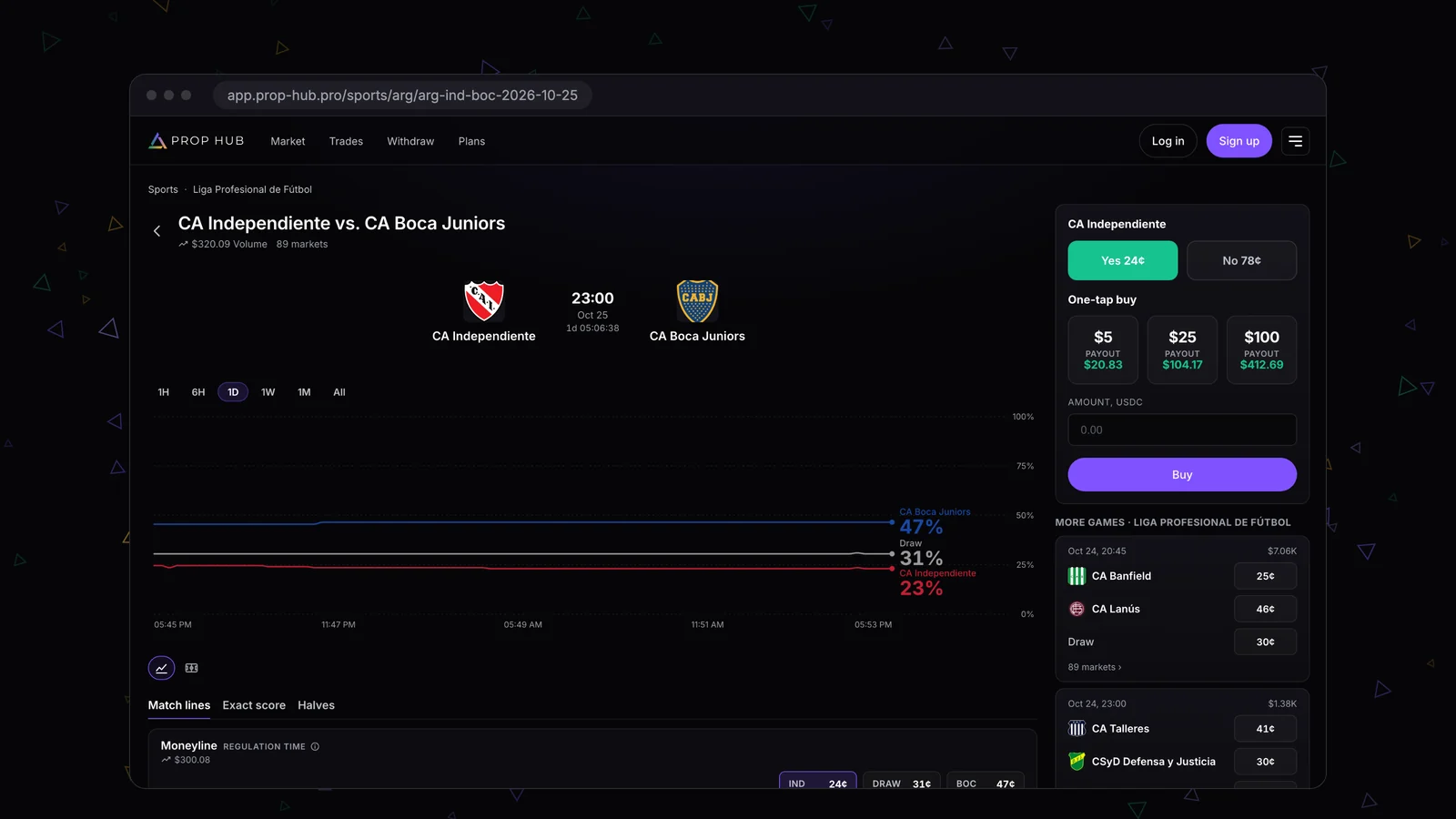
Prop Hub lists markets that resolve within 2 days. A tournament-winner market that closes on the day of the final becomes tradable only in the last 2 days before its end date on Polymarket. Markets on the final itself appear in the same window, since for sports the clock runs from kickoff.
You can trade the match before kickoff and while it’s being played. Sports trades carry Polymarket’s execution delay, usually about a second, so you can’t buy at the old price right after a goal. The live mechanics are covered in live sports markets.
A few things to keep in mind on the account:
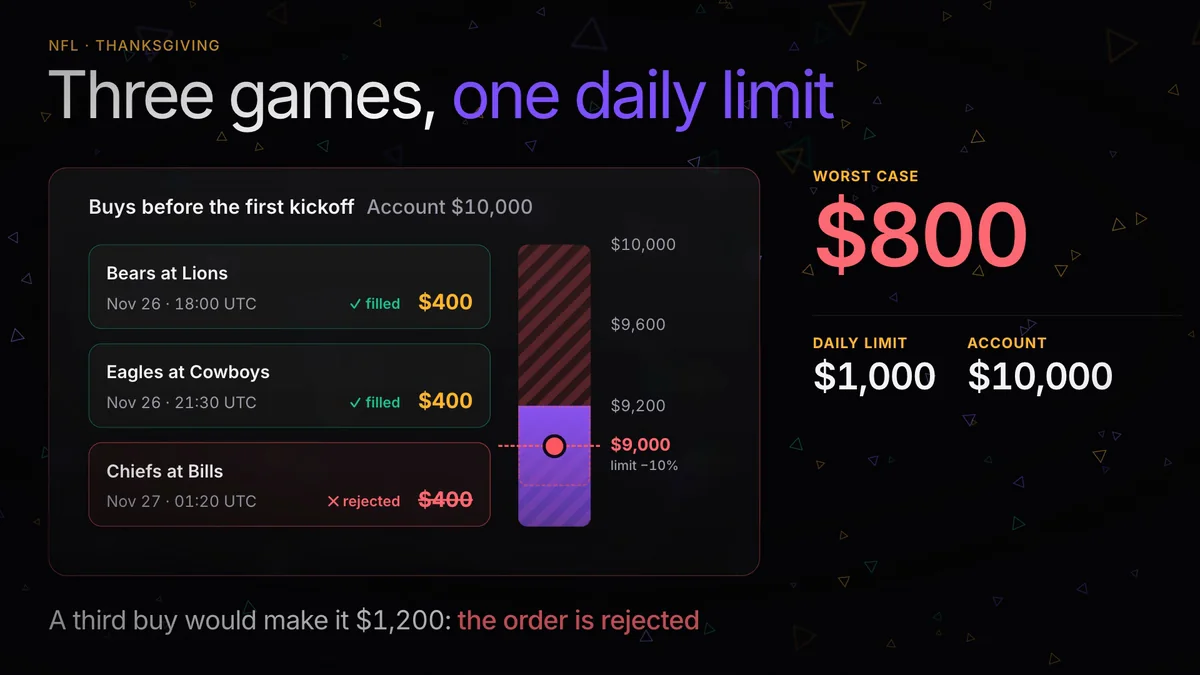
- One view, two markets. “Palmeiras win the cup” and “Palmeiras win the match” are separate outcomes, and the 5%-of-starting-balance cap applies to each on its own. They almost always lose together, though, and drawdown protection adds up their worst case.
- The final can run long. If it goes to extra time and penalties, a tournament-winner position stays open longer and swings harder as the match unfolds.
- Order book depth. Big finals usually have deeper books than ordinary games, but compare the price on the buy button with the chart before you commit. Spread and slippage are explained in the order book article.