

 Emmy
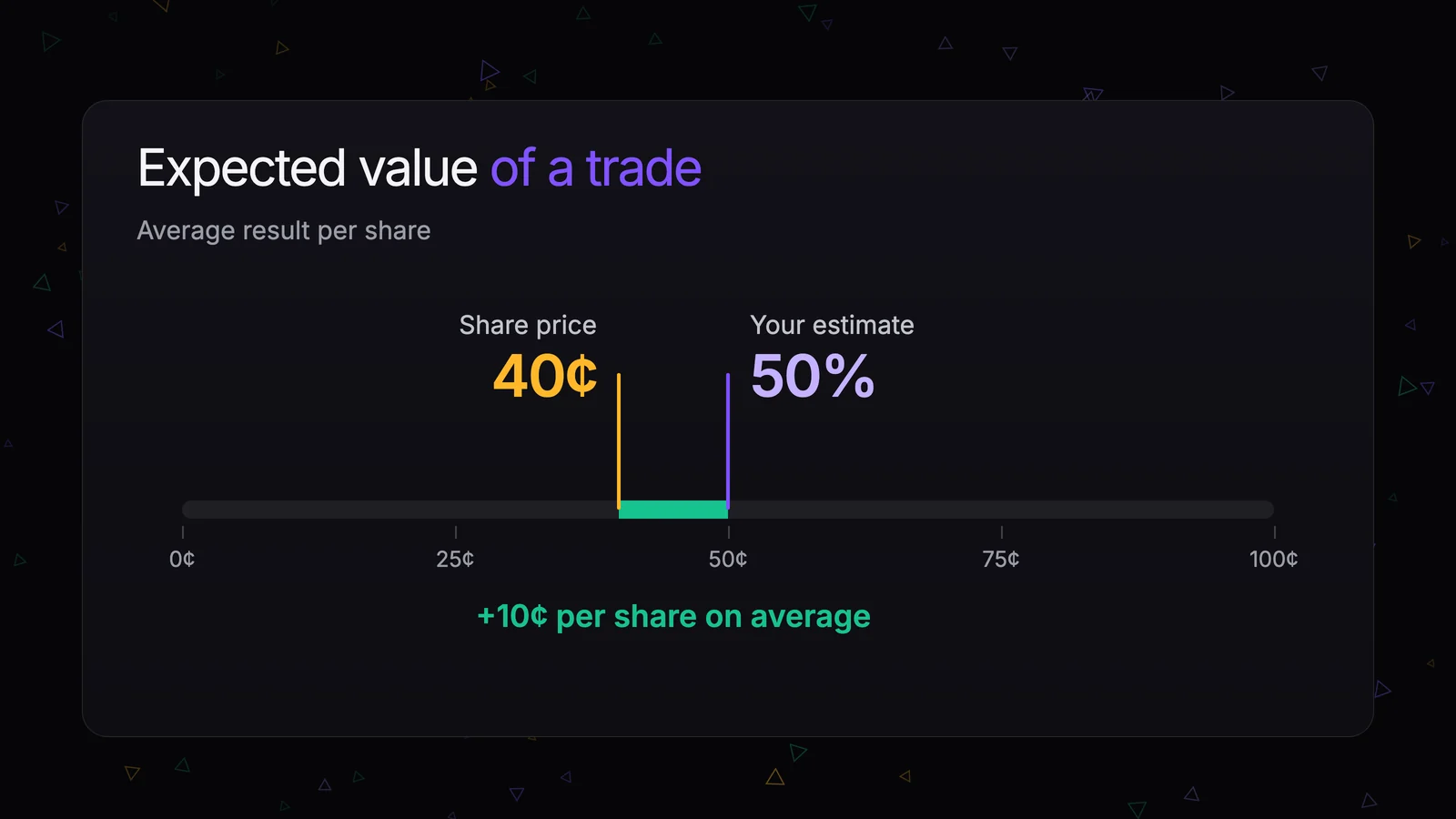
Expected value is the average result of a trade if you could repeat it many times under the same conditions. On a prediction market it’s unusually easy to calculate: a share costs a known price and ends up worth $1 or $0. The only input you supply is your own estimate of how likely the outcome is. If EV after fees is negative, no amount of conviction turns it into a good trade.
The formula for one share
Say an outcome share costs c (price in dollars) and you think the outcome has probability p.
- It happens (probability p): the share pays $1, a profit of 1 − c.
- It doesn’t (probability 1 − p): the share goes to zero, a loss of c.
EV per share: p × (1 − c) − (1 − p) × c = p − c.
That’s the whole thing. Per share, expected value is the gap between your probability and the price. Buy at 40¢ an outcome that happens half the time and you make 10¢ per share on average.
Per dollar invested it’s p / c − 1. Same example: 0.50 / 0.40 − 1 = +25% of the amount, before fees.
A $100 example
The market prices an outcome at 40¢. You put it at 50%. You buy $100 worth, which is 250 shares.
| What happens | Probability | Result |
|---|---|---|
| Outcome happens | 50% | 250 × $1 − $100 = +$150 |
| It doesn’t | 50% | −$100 |
| On average | 0.5 × 150 − 0.5 × 100 = +$25 |
The formula gives the same $25: 250 shares × (0.50 − 0.40).
Fees change the answer
Many Polymarket markets charge a taker fee, and Prop Hub deducts exactly the same. As a share of the amount you buy, it’s the market’s fee rate × (1 − price). EV after fees, per dollar bought:
p / c − 1 − fee rate × (1 − c)
Assume a 5% fee rate (an example: every market has its own, and some charge nothing). On a $100 buy:
| Price | Your estimate | Before fees | Fee | After fees |
|---|---|---|---|---|
| 40¢ | 50% | +$25.00 | $3.00 | +$22.00 |
| 40¢ | 45% | +$12.50 | $3.00 | +$9.50 |
| 60¢ | 65% | +$8.33 | $2.00 | +$6.33 |
| 85¢ | 87% | +$2.35 | $0.75 | +$1.60 |
| 50¢ | 50% | $0 | $2.50 | −$2.50 |
Two things stand out. When your estimate matches the market, EV after fees is negative — you pay to get in and get nothing for it. And with expensive favorites, a two-point edge shrinks to pocket change per $100. Current rates and the formula are in Fees and execution.
The spread is part of the price
Plug in the price you actually pay, not the one on the chart. The chart shows the midpoint between the best bid and ask; a buy fills against sellers’ offers, and a large one walks several levels of the book. If a 40¢ outcome costs you 41–42¢, EV drops by 3–6% of the amount. More on that in the order book and slippage.
Where p comes from
The market price is already someone’s probability estimate — that’s the idea behind prices as probabilities. You only have positive EV where your estimate differs from the market’s and you can say why.
Good reasons are concrete: news from five minutes ago the price hasn’t caught up with; a lineup change before kickoff that didn’t move the line; a crypto window with little time left and a wide gap from the Target. Bad reasons sound like “I have a feeling”, “it’s due” and “everyone’s buying it”.
A habit worth building: write down your p before you buy. After fifty trades you’ll see whether your 60% behaves like a real 60%. If outcomes you gave 70% happen half the time, your “edge” is overconfidence.
Positive on average, negative today
EV describes the average over many trades, not the next one. The +$25 trade above still loses half the time. Five losses in a row at 50% has about a 3% chance, yet over a hundred trades a run like that shows up at least once roughly 80% of the time.
That’s why position size matters more than precision. If each trade is a big slice of the account, a losing run ends the account before the average has a chance to show. Prop Hub caps this with rules: total buys in one outcome can’t exceed 5% of the starting balance, and daily drawdown is limited to 10%. Within those limits the size is your call, and sitting well under the maximum is sensible. How the per-outcome cap works is in risk per trade.
EV and the prop challenge
The challenge target is +30% on the starting balance — $3,000 on a $10,000 account. If your typical trade is $200 with +5% EV after fees, it earns $10 on average, so you need around 300 such trades to get there. That’s honest arithmetic: with a small edge, a challenge is passed through volume and discipline, not one big position.
It also shows why outcomes at 90¢ and above add so little. EV there is cents per hundred dollars, while one surprise result wipes out the profit from dozens of those trades. There’s a formal limit too: only profit from positions bought between 10¢ and 90¢ counts toward the challenge target and the withdrawable amount.
A pre-trade check
- Write down your p and one reason it differs from the price.
- Take the buy price from the button, not the chart.
- Work out p / c − 1 and subtract the fee rate × (1 − c).
- If what’s left is under a couple of percent, skip it: your estimate can easily be off by more.
- Pick a size where five losses in a row don’t bring the account near its daily limit.