 Emmy
Funding Pips, FundedNext and FTMO are three of the prop firms traders run into most. This prop firm rules comparison has no scores and no ranking. It only lays out the rules as each firm’s official pages state them on November 1, 2026, with a link to every page, and what those rules teach: what a limit is measured from, where a deadline hides, and when profit doesn’t count.
Each firm runs several programs. For a like-for-like view, we took the classic two-step ones: Funding Pips 2 Step Standard, FundedNext Stellar 2-Step and the FTMO 2-Step. Rules change, so check the source before you buy.
The rules side by side
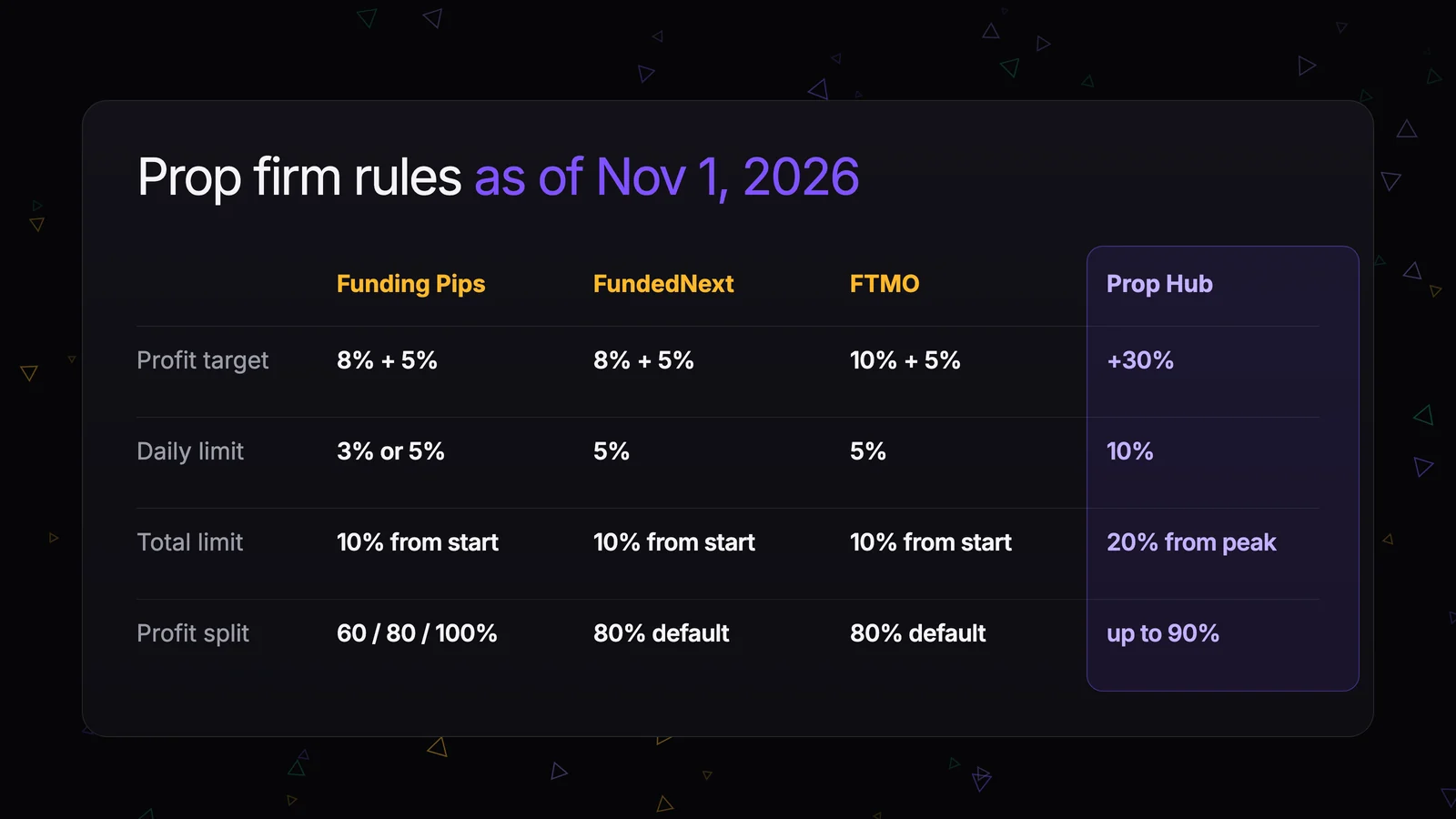
| Funding Pips 2 Step Standard | FundedNext Stellar 2-Step | FTMO 2-Step | Prop Hub | |
|---|---|---|---|---|
| Phases | 2 | 2 | 2 | 1 |
| Profit target | 8% + 5% | 8% + 5% | 10% + 5% | +30% |
| Daily limit | 3% or 5% | 5% | 5% | 10% |
| Total limit | 10% from start | 10% from start | 10% from start | 20% from peak |
| Minimum trading days | 3 per phase | 5 per phase | 4 | none |
| Time limit | none; a trade every 30 days | none | none | none; a trade every 14 days |
| Profit split | 60%, 80% or 100% by payout cycle | 80% by default | 80% by default | up to 90% |
Sources: Funding Pips 2 Step Standard help article, FundedNext Stellar 2-Step help article, FTMO Trading Objectives and the FTMO 2-Step page.
Profit target: two phases or one
All three firms use two phases: 8% or 10% first, then 5%. Since July 24, 2026, Funding Pips no longer offers a 10% first-phase target on this program; 8% remains.
The lesson. The target gets checked twice to filter out a lucky streak. The smaller second-phase target is the same discipline test, just shorter. Prop Hub has one phase with a +30% target, and the second check comes from the consistency rule and from passing only with no open positions. The target is higher because the instrument is different: a Polymarket outcome share trades between $0 and $1 and can move tens of percent in a day.
Daily limit: 5% of what?
The headline number is nearly the same everywhere. The base it’s measured from isn’t.
- FTMO: the limit is reset at 00:00 Central European time as the midnight balance minus 5% of the initial capital (Trading Objectives).
- Funding Pips: 3% or 5%, depending on what you bought, of the higher of the day’s opening balance or opening equity. It resets at 00:00 platform time (UTC+3), and floating losses count (help article).
- FundedNext: 5% of the initial balance per trading day, reset at 00:00 server time, with open trades counted (daily vs. maximum loss article).
The difference shows when a winning position is open at midnight. Take a $10,000 account that starts the day with a $10,000 balance and $10,400 of equity including that position. At FTMO the base is the balance, so the day’s floor is $9,500, which leaves $900 of room from $10,400. At Funding Pips (5%) the base is the higher figure, equity: $10,400 − $520 = $9,880, leaving $520.
At Prop Hub the daily limit is 10% of equity from closed trades at the start of the UTC day, and an open position counts at its entry price. So the open profit isn’t in the base: the floor is $9,000, which is $1,400 below the current $10,400.
The lesson. A position carried past midnight with an open profit can shrink the next day’s room. Before holding through the day change, check what your firm uses as the base.
Total limit: from the start or from the peak
On these programs, all three firms set the total limit at 10% of starting capital, and it doesn’t move. Funding Pips calls it a static floor that never moves. FTMO calls it a static limit. FundedNext says balance or equity must not drop below 90% of the initial balance at any point.
Prop Hub’s total limit is 20% from peak equity: the peak only moves up, and the floor rises with it. On a $10,000 account that has grown to $12,000, the floor is $9,600.
The lesson. Percentages mean little without the base. A static 10% gives you more and more room as the account grows; a limit from the peak doesn’t. The charts are in daily and total drawdown.
Time limits and inactivity
None of the three sets a deadline to pass. Funding Pips, however, closes the account if no trade is completed for 30 calendar days in a row. Minimum trading days: 3 per phase at Funding Pips (none with the 3% daily-loss option), 5 per phase at FundedNext, 4 at FTMO.
Prop Hub has no deadline either; its activity rule is at least one trade every 14 days. There’s no minimum number of trading days, and the consistency rule does that job.
The lesson. “No time limit” doesn’t mean you can forget the account. Search the rules for “inactivity”.
Consistency and trade speed
- Funding Pips: on the funded (Master) account with on-demand rewards, the best day can be at most 35% of profit, plus at least 7 profitable days of 0.5% or more of the account size.
- FundedNext: with on-demand rewards, the best day can be at most 40% of profit. Its Quick Strike rule keeps the share of profit from trades closed within 30 seconds of opening below 30%. On the funded account, risk at any time is capped at 3%.
- FTMO: the 2-Step section has no consistency rule; the “best day at most 50%” rule belongs to the 1-Step program (for accounts bought from October 12, 2026, 50% of total profit; before that, 50% of the profit of positive days).
At Prop Hub the best day can be at most 30% of profit on the challenge and 40% on the funded account. It’s a condition, not a breach: while one day outweighs the rest, you keep trading. Exposure to a single outcome is capped at 5% of the starting balance.
The lesson. Firms pay for results that repeat. The faster and more concentrated the profit, the more conditions come with withdrawing it.
Payouts: split, first payout, fee refund
- Funding Pips: you pick the cycle on the funded account: weekly at a 60% split, every 14 days at 80%, or on demand at 100% with the conditions above. The minimum payout is 1% of the account size.
- FundedNext: you pick the payout option at checkout. By default it’s 80%, a first cycle of 21 days, then every 14 days; on-demand rewards pay 90% with the conditions above, and the three-profitable-days option pays 60%. The fee is refunded with the first reward (help article).
- FTMO: 80% by default, 90% once the Scaling Plan or Premium Programme conditions are met. The first reward can be requested on day 14 after the first trade (withdrawal FAQ). The 2-Step fee is refunded with the first reward (fee FAQ).
At Prop Hub the split is up to 90% from the first payout, and the fee isn’t refunded. You can request the first payout once positions are closed and the consistency rule is met, and it’s sent after your identity check; after that, at most once every 7 days. Caps by payout number are $1,000, $2,000, then $5,000, and no more than half of your available share at a time.
The lesson. The split percentage isn’t the whole price. Look at when the first payout comes, how often the next ones can, and what happens to the fee.
News rules and restrictions
- FTMO: on a Standard funded account, orders can’t be executed from 2 minutes before to 2 minutes after selected news on affected instruments, and breaking this may end the account. There’s no restriction during the evaluation or on Swing accounts (news FAQ).
- Funding Pips: no restriction during the evaluation. On the Master account, profit from trades opened or closed within 5 minutes before or after high-impact news may be deducted; trades opened 5 hours or more before are exempt. Deliberately trading news is prohibited at every stage.
- FundedNext: on the funded account, trades within 5 minutes before or after high-impact news on a correlated pair count only 40% of their profit, while losses count in full.
Prop Hub has no news window. What it has instead is what Polymarket itself has: an order on a sports market waits out the market’s execution delay (usually a second) and fills against the updated order book, and on short crypto markets the taker delay is 150 ms. Multiple accounts, hedging between accounts and bots are prohibited, and profit from trades entered below 10¢ or above 90¢ doesn’t count.
The lesson. News rules protect a firm from fills at prices the real market no longer offered. Where there’s no such rule, there’s usually a delay or some other mechanism, so find out which.
What to check at any firm
- Is the daily limit measured from balance or equity, and when does it reset?
- Is the total limit static or from the peak?
- Is there an inactivity rule?
- What consistency conditions stand before a payout?
- When is the first payout, which split comes with which cycle, and is the fee refunded?
- What’s restricted around news and on trade speed?
More questions, including checking the legal entity and payout countries, are in how to choose a prop firm. Prop Hub’s rules are walked through step by step in prop challenge rules.