 Emmy
Today, Thanksgiving, November 26, the NFL plays three games back to back: Bears at Lions, Eagles at Cowboys and Chiefs at Bills. Polymarket doesn’t have one market per game open but several hundred: the winner, spreads, totals, team totals, halves and quarters. The holiday’s history and the full schedule are in Thanksgiving football history. This piece is about reading a game’s markets once “who wins?” isn’t enough.
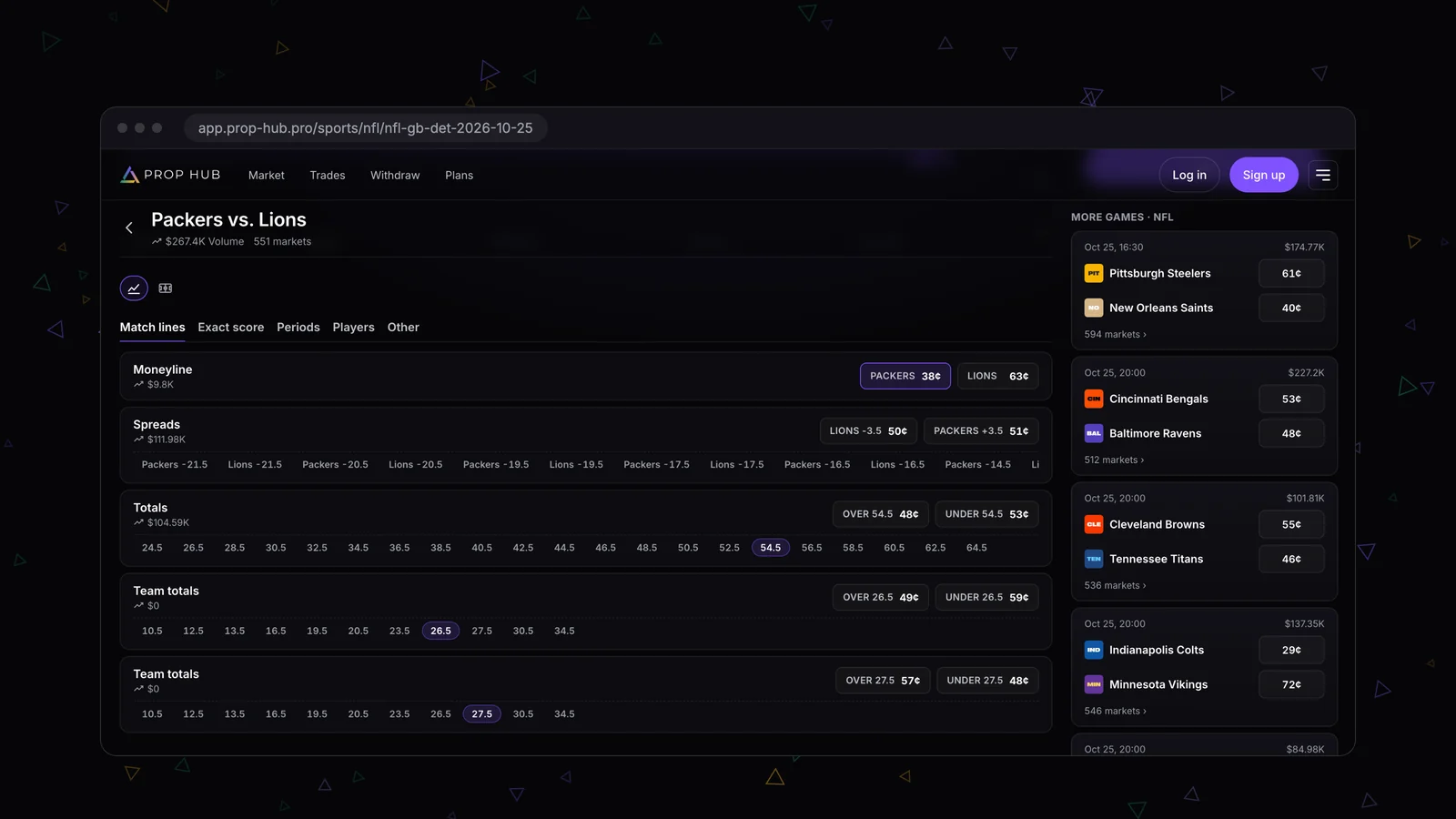
We’ll use real prices from Packers at Lions on October 25, 2026. Detroit won 20–17 on a field goal as time expired: a win by exactly 3, so Lions −3.5 lost, and the 37 combined points fell short of even the 38.5 line. Holiday games are set up the same way.
The winner
The simplest market is who wins the game. On October 20 the Lions traded at 61.5¢ and the Packers at 38.5¢. Overtime counts. Regular-season NFL games can end tied, rarely, and the market rules then settle both sides at 50¢.
This market has the deepest book, about $58,000 of liquidity with a 1¢ spread. But NFL favorites often sit around 60–75¢, and “who wins” isn’t always the most interesting question.
The spread: by how many points
A spread market asks whether a team wins by more than the line. “Spread: Lions (−3.5)” settles for Detroit if the Lions win by 4 or more. If they win by 1–3 or lose, the Green Bay side wins. The half point is there so the line can never land exactly.
One game has dozens of these markets at different lines. Prices on October 20:
| Market | Price of the named side |
|---|---|
| Lions to win | 61.5¢ |
| Lions −3.5 | 47.5¢ |
| Lions −5.5 | 41.5¢ |
| Packers −1.5 | 36¢ |
| Packers to win | 38.5¢ |
What the ladder tells you
A ladder of spreads is a distribution of the final margin. Subtract neighboring rows and you get the probability of a specific range:
- Lions win by 1–3: 61.5 − 47.5 = 14%
- Lions win by 4–5: 47.5 − 41.5 = 6%
- Packers win by exactly 1: 38.5 − 36 = 2.5%
A three-point range carries 14%, while the next two-point range carries only 6%. That’s the scoring at work: points come in chunks of 3 (field goals) and 7 (touchdown plus extra point), so margins of 3 and 7 come up far more often than others. A −3.5 or −2.5 line sits right on top of the most common result, and half a point either way moves the price more than you’d expect.
If neighboring rows look wrong, say −5.5 priced above −3.5, you haven’t found an edge. One of the books is empty or stale.
The total: how many points in all
A total market asks whether both teams combined score more than the line. “O/U 58.5” settles Over if the game has 59 or more points.
| Line | “Over” price |
|---|---|
| 38.5 | 87¢ |
| 58.5 | 36.5¢ |
| 60.5 | 30.5¢ |
| 64.5 | 21¢ |
Same logic: the chance the total lands on exactly 59 or 60 is about 36.5 − 30.5 = 6%. Totals depend on different things than the winner: pace of both offenses, defense, weather. On Thanksgiving the short week matters too: teams that played on Sunday get three days to prepare.
Team totals, halves and quarters
Then come narrower markets: one team’s points, who wins the first half or a quarter, the second-quarter total, whether there’s a safety. Here you need to look at the book, not the price.
For the same game on October 20, most quarter markets showed bids at 1¢ and asks at 99¢, with 50¢ displayed on the page. That isn’t a probability, it’s the midpoint of an empty book. Team totals were a bit more alive, but still had quotes as wide as 11¢ against 97¢.
On Prop Hub orders fill against the Polymarket book at the volume-weighted average price, with no partial fills. In an empty market the order won’t go through; in a thin one it fills well below what you expected. Details in the order book and slippage.
Halves and quarters have their own rules: overtime isn’t included, and if the period ends level, the “who wins the period” market settles at 50¢ for both sides.
How it works on Prop Hub
Sports markets appear on Prop Hub once kick-off is no more than 2 days away. Thursday’s first game kicks off on November 26 at 1:00 pm ET (18:00 UTC), so its markets have been on Prop Hub since the evening of November 24, and by this morning all three games are open. You can keep trading during the game.
In-play there’s an execution delay set by Polymarket, usually one second. After it the market and book are fetched again and the order fills at the new prices, which protects you from buying on a quote that was pulled after an interception or touchdown. More in live sports markets.
Three games in one evening and your limits
The holiday games run back to back from 18:00 UTC until around 04:30 UTC the next day. Prop Hub counts the trading day in UTC from 00:00, so the first two games fall on one trading day and the late Chiefs at Bills game starts on the next.
On a $10,000 account you can put up to $500 into one outcome, and the daily drawdown limit is 10%. A few notes:
- Lions to win, Lions −3.5 and Lions first half are one idea. The limit treats them as separate outcomes, but they’ll most likely lose together.
- A game’s spread and total are only loosely linked. If you expect a high-scoring home win, that’s two positions with two different risks.
- On a funded account, profit from positions bought above 90¢ or below 10¢ doesn’t count toward withdrawals. Alternate lines at 5–8¢ fall into that; the 38.5 Over at 87¢ doesn’t yet, but it sits right at the edge.
Before kickoff
- Find the main spread line: the one priced closest to 50¢ with the deepest book.
- Compare it with the winner market to see how much weight sits on the favorite winning by three or fewer.
- Check player status before the game: the NFL posts inactive lists about 90 minutes before kickoff, and on a short week Sunday knocks often don’t heal in time.
- Size to the order book, not to the limit, and decide in advance how many of the three games you’ll trade.
Account sizes and fees are on the plans page.