 Emmy
Every December TIME names its Person of the Year: whoever, in the editors’ view, did the most to shape the year’s events, for better or for worse. In nearly a century the title has gone to presidents, dictators, scientists, a computer and once to “You”. On Polymarket the 2026 pick has its own market with dozens of candidates.
Here’s where the tradition came from, how the choice is made, the strangest picks so far and how to read the market on TIME’s decision.
How it started
The first honoree was aviator Charles Lindbergh. In May 1927 he flew solo across the Atlantic, and TIME never put him on the cover. To make up for it, the editors named him Man of the Year, on the cover of the January 2, 1928 issue. Lindbergh was 25, and he stayed the youngest pick until 2019, when 16-year-old Greta Thunberg was chosen.
The first woman was Wallis Simpson in 1936; Edward VIII gave up the British throne to marry her. Until 1999 the title was “Man of the Year” or “Woman of the Year”, and then it became the neutral Person of the Year.
Influence, not an award
TIME’s rule is to pick whoever, for better or for worse, did the most to influence the events of the year. It’s not a prize. Adolf Hitler was Man of the Year for 1938, Joseph Stalin for 1939 and 1942, and Ayatollah Khomeini for 1979, a choice that TIME itself says many readers couldn’t accept.
Franklin D. Roosevelt holds the record with three titles: 1932, 1934 and 1941. Donald Trump has two, for 2016 and 2024.
The editors decide. TIME runs a reader poll, but it doesn’t bind the magazine.
Not always a person
Sometimes the pick is a group, an idea or an object:
| Year | TIME’s choice |
|---|---|
| 1982 | The Computer, “Machine of the Year” |
| 1988 | Endangered Earth, “Planet of the Year” |
| 2006 | You: people creating content online |
| 2011 | The Protester |
| 2017 | The Silence Breakers: people who spoke up about harassment |
| 2025 | The Architects of AI |
For the market this matters a lot: the answer may be a concept rather than any person on the list.
When it’s announced
TIME announces in the first half of December. Donald Trump was named on December 12, 2024, and the Architects of AI on December 11, 2025. The magazine doesn’t always confirm the date in advance, so watch TIME’s own announcements.
The Polymarket market on 2026
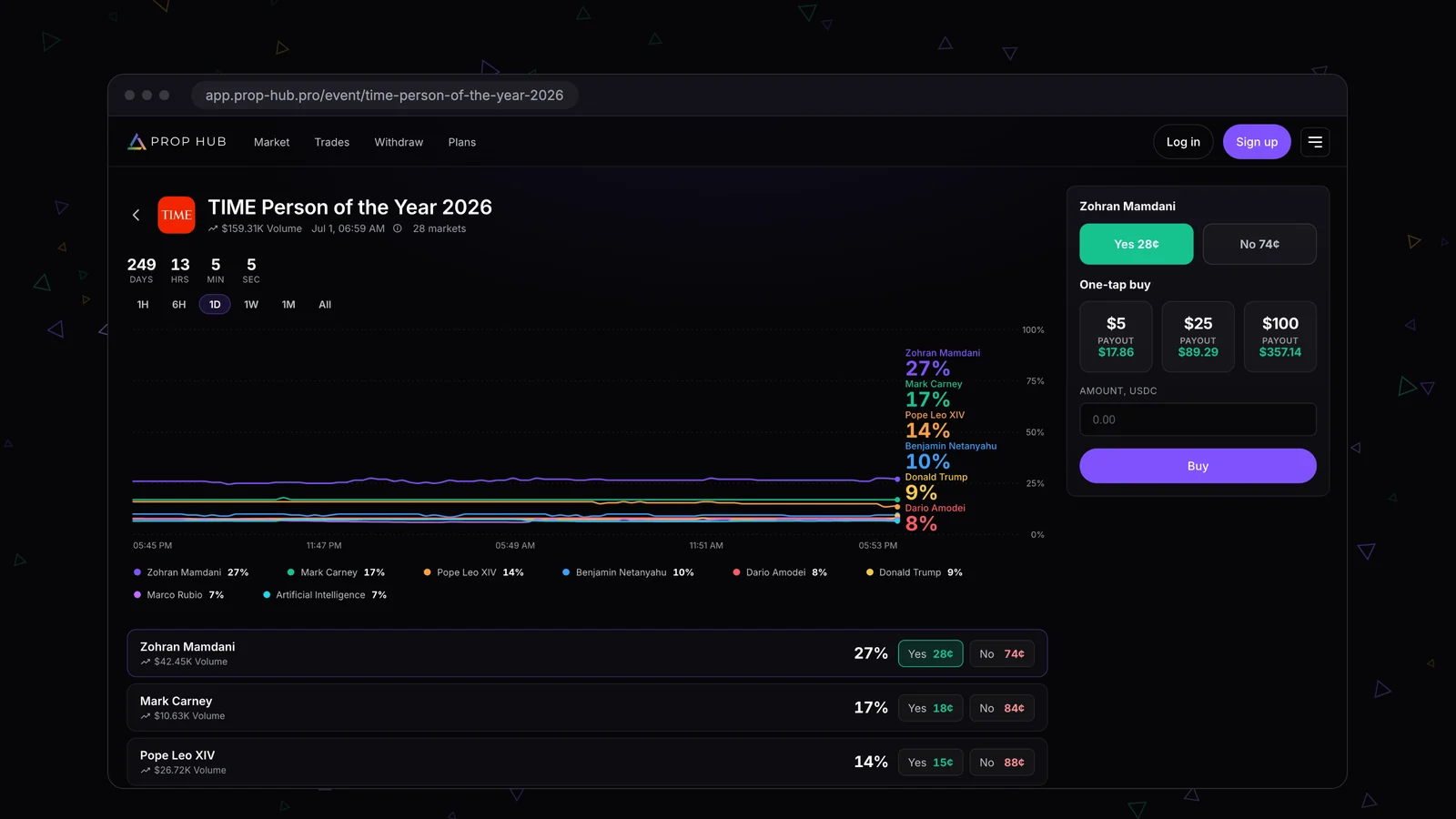
Polymarket’s “TIME Person of the Year 2026” is a set of separate Yes/No markets, one per candidate, with 28 of them on October 20. The leaders by “Yes” price that day:
| Candidate | “Yes” price |
|---|---|
| Zohran Mamdani, mayor of New York City | 28.5¢ |
| Mark Carney, prime minister of Canada | 16¢ |
| Pope Leo XIV | 15.5¢ |
| Benjamin Netanyahu | 8¢ |
| Donald Trump | 6.5¢ |
| Dario Amodei | 6.3¢ |
| Marco Rubio, Elon Musk | 6¢ |
| “Artificial Intelligence” | 5.9¢ |
At 28.5¢ the favorite gets roughly a one-in-three-and-a-half chance. More than two-thirds of the probability is spread across everyone else, so this is a market without a clear favorite.
How the outcomes resolve
The rules are worth reading in full, because they deal with exactly the awkward cases:
- if TIME names several people, each named person resolves “Yes”;
- if the pick is a concept or group, a specific person resolves “Yes” only if they’re directly associated with it and pictured on an official cover. The rules’ own example: with the Architects of AI in 2025, “Sam Altman” would have resolved “Yes”;
- a listed concept counts only if it’s synonymous with the pick. If ChatGPT were chosen, “AI” would resolve “No”: related, not the same thing.
That’s also why the “Yes” prices across all candidates can add up to more than 100¢: several outcomes can resolve “Yes” at once.
How to read a market like this
TIME’s pick is one editorial team’s decision, not a vote or a game. The price reflects traders’ guesses about the magazine’s logic: who dominated the news all year, what the year’s main story was, and whether the editors will pick a person or a phenomenon.
A few things to keep in mind:
- The year isn’t over. A major event in November or early December can flip the market in a day.
- Concepts beat people more often than you’d expect. Since 2006 the editors have repeatedly chosen a group or idea. If the year was defined by one theme rather than one person, the individual names may be overpriced.
- A few cents isn’t free money. An outcome at 6¢ loses almost everything if it misses, and on this market most outcomes will.
- Liquidity is modest. About $140,000 had traded by October 20, and the books on minor candidates are thin.
Why Prop Hub doesn’t list it
Prop Hub only lists markets that close within 2 days, based on the market’s end date on Polymarket. Most outcomes in “TIME Person of the Year 2026” end on December 31, 2026, and some on July 1, 2027. They’d only enter the window at the very end of December, after the announcement, when the market is effectively decided.
The same goes for any long-dated market: season winners, year-end results. A Prop Hub account trades events of the next few days: matches, central bank decisions, crypto windows, election-day results. The principle is explained in how Prop Hub works, and the list of available markets is in the help center.
Watching the TIME market is still good practice in turning prices into probabilities. If the favorite trades at 28.5¢, ask yourself whether you agree their chance is about one in three and a half. That’s the question you’ll ask of every market on your account. The basics are in prices are probabilities.