 Emmy
The Davis Cup is men’s tennis’s main team event: national sides play ties in which every match a player wins earns his team a point. The 2026 finals, the Final 8, run November 24–29 in Bologna. Eight nations, six days, straight knockout.
For a trader, team tennis behaves differently from a regular tournament. A tie’s result is built from several matches, and the last one may never be played. Here’s the history, the format and what that means for the markets.
What the Davis Cup is
The first tie was played in 1900 at the Longwood Cricket Club in Boston, with the United States taking on the British Isles. The silver trophy was donated by American player Dwight Davis, and the competition carries his name.
The United States have the most titles with 32, Australia 28, France and Great Britain 10 each. Italy won the last three editions, in 2023, 2024 and 2025, beating Spain 2–0 in the 2025 final in Bologna. That makes four Davis Cups for Italy, the first in 1976.
How the format changed
For more than a century the Davis Cup kept one shape. A tie was played at one nation’s home over three days and had five matches: two singles on day one, doubles on day two, two reverse singles on day three. Matches were best of five sets, and the first team to three points won.
In 2019 the competition was rebuilt. The finals moved to a single city in a single week, and ties shrank to three matches: two singles and a doubles, all best of three sets. The finals first had a group stage; today it’s eight teams and a knockout bracket.
The 2026 format
The road to Bologna has two qualifying rounds:
| Stage | When | At stake |
|---|---|---|
| Qualifiers, first round | February 5–8 | 26 teams, 13 places in round two |
| Qualifiers, second round | September 18–20 | 14 teams, 7 places in the finals |
| Final 8, Bologna | November 24–29 | host Italy plus the seven qualifiers |
The Bologna field: Austria, Canada, Czech Republic, Germany, Great Britain, Italy, South Korea and Spain. Quarterfinals: Italy vs South Korea, Czech Republic vs Canada, Great Britain vs Germany, Austria vs Spain. The first semifinal brings together the winners of the first two ties, the second the winners of the last two. The final is on Sunday, November 29.
Every finals tie is completed in one day:
- First singles match.
- Second singles match.
- Doubles, only if the singles end 1–1.
All matches are best of three sets. If one nation wins both singles, the tie ends 2–0 and the doubles pair never goes on court. That’s exactly what happened in the 2025 final.
Why team tennis trades differently
The tie depends on two or three matches. A team’s best player can win his singles and the team can still lose if the number two and the doubles pair both go down. So “nation wins the tie” and “its top player wins his match” are separate prices, and they can be far apart.
The doubles may not happen. It’s only played at 1–1. If you hold a position on a match that might not take place, read the market’s rules beforehand to see how it settles in that case.
The captain picks the team. Who plays singles and doubles is the captain’s call, and until line-ups are announced there may be no market on a specific player’s match at all.
Home crowd. Italy play at home in Bologna. The market usually prices crowd support in already, so on its own it’s not a reason to buy.
Polymarket markets and how they look on Prop Hub
As of October 20, Polymarket had no dedicated Davis Cup markets. Polymarket typically lists tennis matches close to play with its usual set: match winner, set winner, total sets and games, set handicap. We don’t know in advance which markets will appear for the Bologna ties.
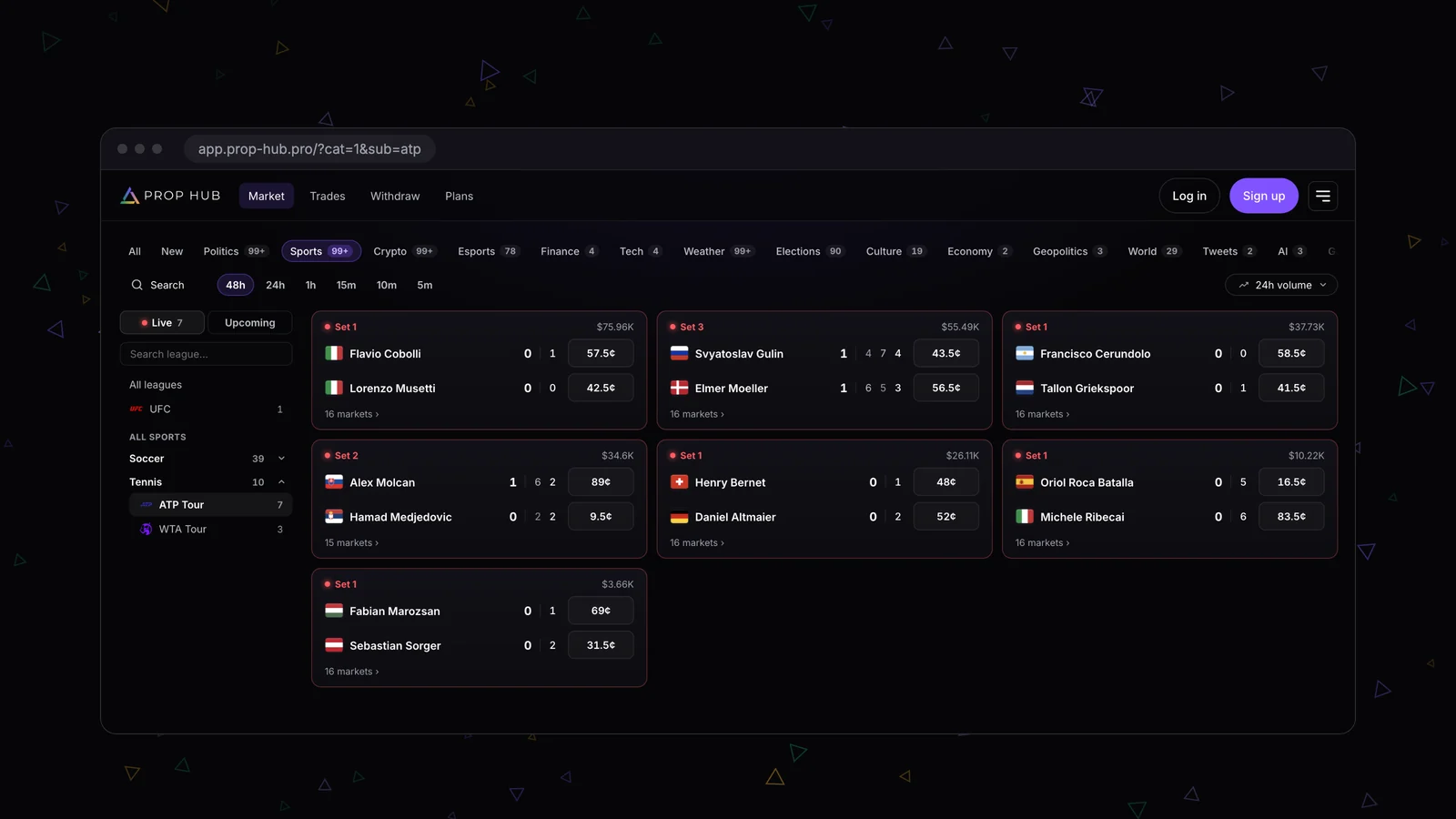
If they do appear, they follow the general Prop Hub rule. A match becomes available once it starts within 2 days and stays available during play while Polymarket accepts orders. A tournament-winner market that closes beyond that horizon won’t reach the account.
Trading terms match any other sports market:
- buys and sells fill against the Polymarket order book, with no partial fills;
- the fee is whatever Polymarket charges on that market, about 3.2% of the trade on average;
- if the market has an execution delay, the order waits it out and fills against fresh quotes;
- positions settle on Polymarket’s result.
More on in-play trading in live sports markets. If you traded the ATP Finals the week before, much will feel familiar: best of three sets, indoor hard court. That tournament’s format is covered in ATP Finals explained.
Managing risk on tie day
A tie is two or three matches in a row between the same two nations. Positions on them are linked: if a team is off form, they can all lose together.
- The per-outcome cap is 5% of the starting balance, $500 on a $10,000 account. It’s counted per outcome, but losses on linked positions add up.
- Daily drawdown is capped at 10% of equity at the start of the UTC day. All matches in one tie almost always fall on the same day.
- On a funded account, profit from positions opened above 90¢ or below 10¢ doesn’t count toward the withdrawable amount. Buying a heavy favourite at 92¢ does nothing for your payout.
Try the approach on the free welcome account; the help center explains how to find tennis on the Market page.