 Emmy
A crypto prop firm sells you an evaluation, gives you a simulated account and pays out a share of the profit once you prove you can trade without breaking its loss limits. The model is the same as at forex and futures props. The instrument is not: most crypto props run on perpetual futures with leverage, in a market that never closes. That combination sets the rules, and it sets how quickly an account can end.
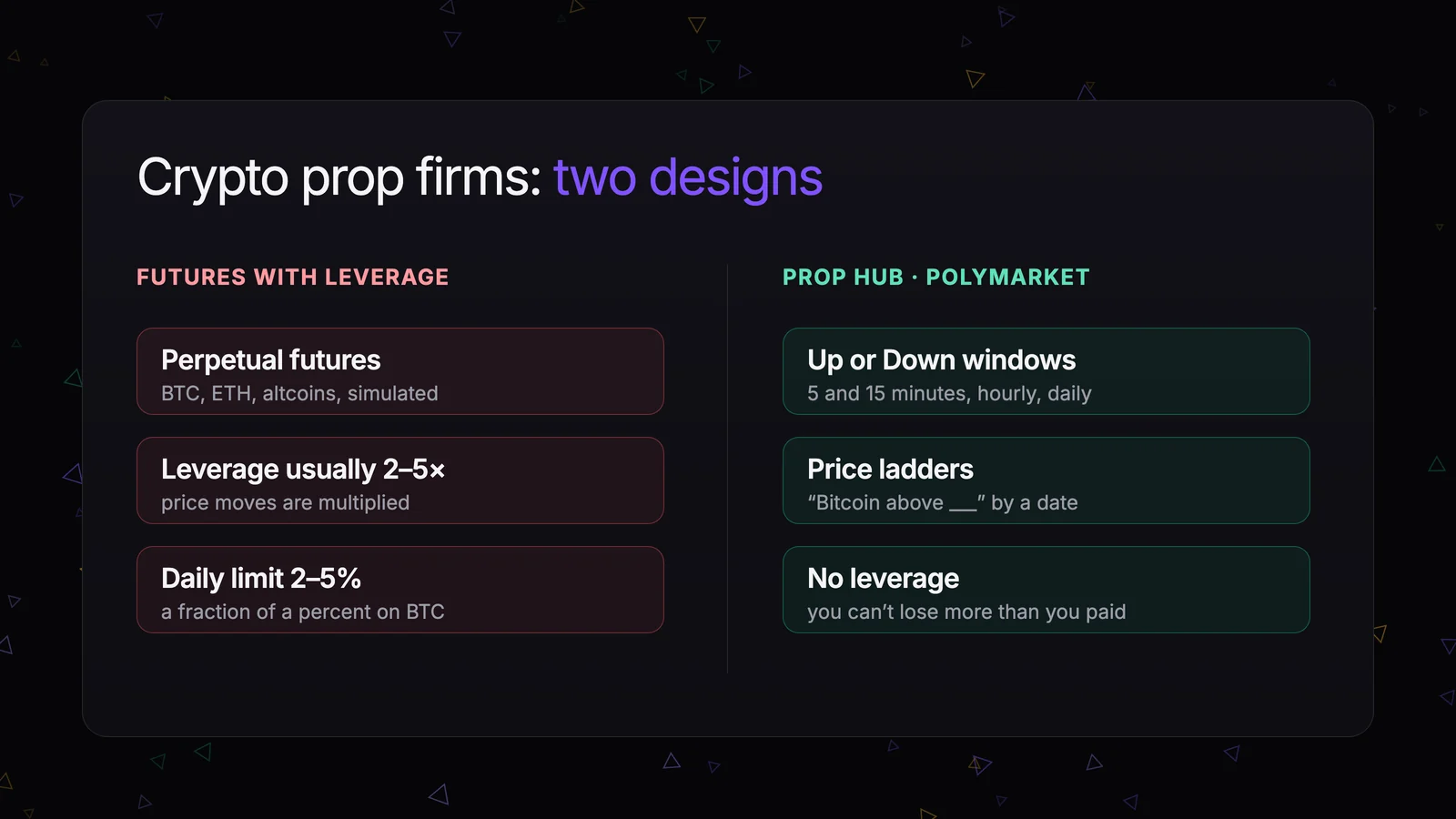
Below is how a typical crypto prop works, with two firms’ published terms as examples, and how crypto looks on Prop Hub, where you trade Polymarket’s bitcoin and altcoin markets instead of futures. The general comparison with other props is in forex prop vs prediction market prop and futures prop vs prediction markets; this piece sticks to crypto.
How a typical crypto prop firm works
The usual setup: you pay for a one- or two-step challenge and trade perpetual futures on BTC, ETH and altcoins on a simulated account that follows live exchange prices. Hit the target without breaching the loss limits, and you get a funded account and a share of the profit, paid in stablecoins.
Two examples, as their terms were published in autumn 2026:
| Breakout (owned by Kraken) | HyroTrader, Two-Step | |
|---|---|---|
| Instruments | simulated crypto pairs | USDT perpetuals on live Bybit or BloFin data |
| Leverage | up to 5x on BTC/ETH, 2x on altcoins | up to 150x on BTC/ETH, lower on most pairs |
| Profit target | about 9–12% depending on the plan | 10%, then 5% |
| Overall loss limit | static, about 3–6% depending on the plan | 10% |
| Daily loss limit | not given in Kraken’s overview | 5% |
| Profit split | 80%, 90% as a paid upgrade | from 80% up to 90% |
| Payouts | on demand, in USDC | within 24 hours, in USDT or USDC |
Sources: Kraken’s overview of its prop products (September 2026) and HyroTrader’s homepage (checked November 1, 2026). This isn’t a ranking: other firms land in the same ranges. Kraken’s own summary of the market puts typical terms at an 8–12% one-step target, 3–10% total drawdown, 2–5% daily loss and 2x–5x leverage.
Leverage turns small moves into the daily limit
Perpetual futures let you open a position several times larger than the account. That’s the point of them, and it’s also why crypto props keep their loss limits tight.
Take a $10,000 account at 5x on bitcoin: a $50,000 position. A 1% move against it costs $500, or 5% of the account. With a 3% daily limit, bitcoin only has to drop 0.6% for the day’s room to be gone. On a quiet day BTC can cover that in minutes, and on a news day in seconds.
The conclusion traders usually draw is to size by the daily limit, not by leverage. Leverage tells you how much you could open. The daily limit tells you how much you can afford to be wrong today.
Two more costs come with perpetuals: a trading fee on every entry and exit, and the funding rate, which longs and shorts pay each other while a position is open. Both come off the result even when price doesn’t move.
A market without weekends
Crypto trades around the clock, seven days a week. That removes the weekend gap forex and futures traders worry about, but it brings its own problem. The daily limit resets at a fixed time, usually in UTC, while your positions stay open through the night. A trade you open in the evening in Lagos, Singapore or Seoul can lose overnight against the next day’s limit.
On Prop Hub the daily limit also resets at 00:00 UTC and is measured from equity at the start of the day. Crypto markets there run nonstop too, so the same discipline applies: know what’s open when the day rolls over.
Crypto on Prop Hub: windows and price ladders
Prop Hub doesn’t offer futures. You trade Polymarket’s crypto markets on live prices and order books, and each market answers one question about the price.
- Up or Down, 5 and 15 minutes. BTC, ETH, SOL, XRP, DOGE, BNB, HYPE and ZEC. Polymarket resolves them on Chainlink: the average price over the last 60 seconds of the window (TWAP) against the price at the start. A tie counts as Up. How a window works is covered in bitcoin up or down in 5 minutes.
- Up or Down, hourly and daily. The same coins except ZEC. These settle on Binance candles: the hourly market compares a 1-hour candle’s close with its open, and the daily one compares noon in New York with noon the day before. Details in bitcoin hourly and daily markets.
- Price ladders. “Bitcoin above ___ on November 1?” is a set of levels, and each level is its own Yes/No market. That one settled on the Binance BTC/USDT 1-minute candle closing at 12:00 ET.
Each market’s rules name its source. Read them before you buy: Chainlink and Binance can differ by a few dollars, and right at the reference price that decides the result.
Here’s what a ladder looked like on the morning of November 1, 2026, about five hours before it settled: Yes on $76,000 cost 99.3¢, Yes on $78,000 cost 53.7¢, Yes on $80,000 cost 0.8¢. The real question was only around $78,000. Everything else was close to decided.
That matters on a prop account. Profit counts toward the challenge target and payouts only from positions bought between 10¢ and 90¢. A 99¢ level that pays a cent doesn’t count, and neither does a 1¢ buy on a level that’s almost out of reach.
Prop Hub only lists markets that settle within 2 days, so every crypto position here is short-dated. On 5- and 15-minute windows an order fills against the Polymarket book after a 150 ms delay, the same delay Polymarket applies to takers there.
Risk without leverage
An outcome share costs between $0 and $1 and pays $1 or nothing. Buy “Up” for $500 and $500 plus the fee is the most you can lose, whether bitcoin moves 0.1% or 10%. There’s no liquidation and no funding rate. You can sell before the window ends at the book price, but after a sharp move there may be few buyers near the old price.
The limits are built for that kind of risk:
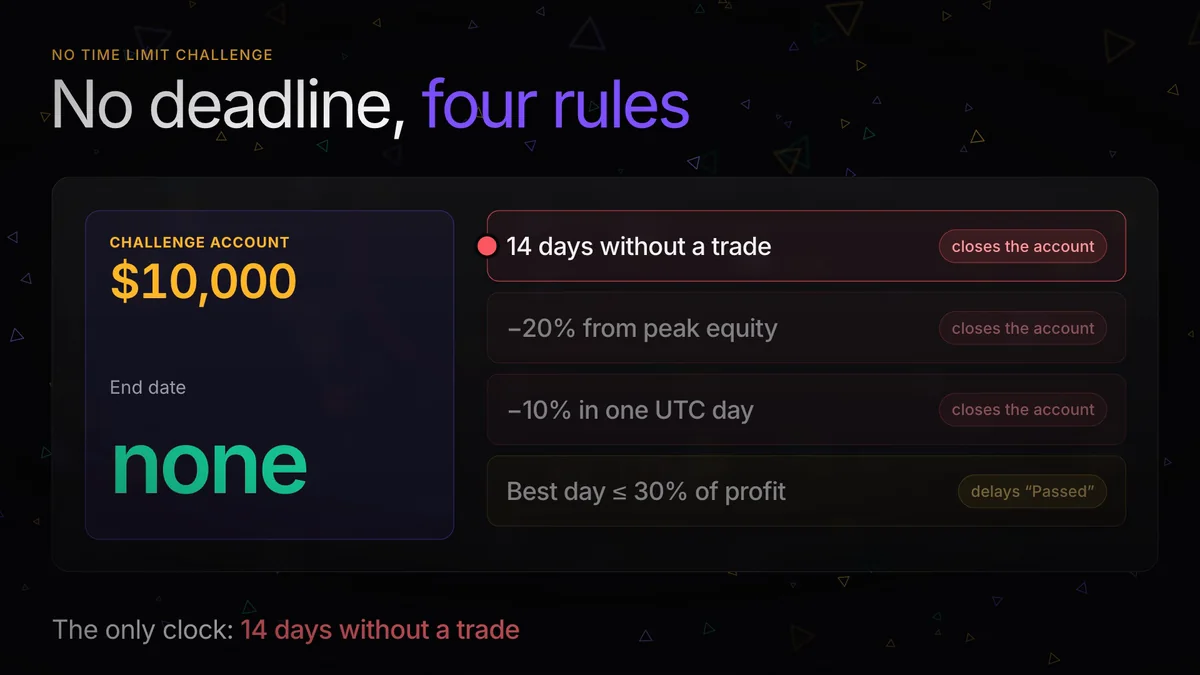
- total buys in one outcome are capped at 5% of the starting balance, or $500 on a $10,000 account;
- daily drawdown is at most 10% from equity at the start of the UTC day;
- total drawdown is at most 20% below peak equity.
Before every buy the system checks what happens if this position and every open one settle at zero. If equity would cross a limit, the order is rejected. A futures prop can’t run that check, because a futures loss isn’t capped by the entry.
Fees work differently too. Polymarket charges more on crypto markets than on most others: on November 1, 2026 their crypto fee rate was 0.07. As a share of the amount it’s the rate × (1 − price), so at 50¢ that’s 3.5%. Prop Hub deducts exactly what Polymarket would. Twenty trades an hour pay it twenty times. The formula is in Fees and execution.
Payouts in USDT and USDC
Here a crypto trader will feel at home. A funded account pays up to 90% of profit, in stablecoins:
| Coin | Networks |
|---|---|
| USDT | TRC20, BEP20 |
| USDC | ERC20, Polygon, Solana, BEP20 |
Payouts are sent by hand from the company wallet within 72 hours of the request, or of identity verification if it’s still pending. Each payout is limited to half of your available share and to a ladder: up to $1,000 the first time, $2,000 the second, $5,000 after that. The full rules are in the payouts guide.
Which one fits you
A futures-based crypto prop suits you if you have a working system on perpetuals: entries by level, stops, a clear sense of how much leverage you actually use. Be ready for tight daily limits and for counting funding costs.
Prop Hub fits if your edge is reading direction over a window or the odds of a price level by a set time, and you’d rather know your maximum loss before you buy. The challenge has one phase, a +30% target and no time limit. You can try the same crypto markets for free on the $100 welcome account, which opens when you sign up.