 Emmy
The Federal Reserve is the central bank of the United States. Its rate decisions move the dollar, bonds, stocks and bitcoin, and on Polymarket the market for each meeting draws millions of dollars. The next decision comes on December 9, 2026, at the end of a two-day meeting on December 8–9.
Here’s how the Fed is built, who votes, how a meeting unfolds and which markets trade around it. For how to read the prices on a specific decision, see our walkthrough of the October meeting market.
Where the Fed came from
The system was created by the Federal Reserve Act, signed by President Woodrow Wilson on December 23, 1913. Before that the US had no central bank, and banking panics, the last big one in 1907, were left to private bankers to contain. The Fed was designed as a lender of last resort: an institution that lends to banks when nobody else will.
Today the Fed has two goals set by Congress in 1977: maximum employment and stable prices, known as the dual mandate. Since 2012, stable prices has officially meant 2% inflation a year.
How the system is organized
The Fed has three parts.
- The Board of Governors in Washington: seven members nominated by the president and confirmed by the Senate for 14-year terms. The chair is picked from among them for four years. Kevin Warsh has been chair since May 22, 2026; Jerome Powell held the post from 2018.
- Twelve regional Federal Reserve Banks, in New York, Boston, Chicago, San Francisco and other cities. They supervise banks in their districts and gather data on the local economy.
- The Federal Open Market Committee (FOMC), which sets the rate.
Who votes on the FOMC
The FOMC has 12 votes: the seven governors, the president of the New York Fed, who always votes, and four of the other eleven regional bank presidents on an annual rotation. The rest join the discussion but don’t vote that year.
Decisions go by majority, and dissents are published with the statement. The number of dissents is a signal in itself: three votes against a decision can foreshadow a different next step.
What the FOMC actually decides
The Fed doesn’t set a single rate. It sets a target range for the federal funds rate, the rate banks charge each other for overnight loans. The range is a quarter point wide, such as 3.75–4.00%, and is held in place by other tools: interest paid on bank reserves and the overnight reverse repo facility.
Moves usually come in 25 bp steps. In a crisis the Fed goes further: under Paul Volcker in 1979–1981 the rate reached around 20%, in March 2020 it was cut to near zero within two weeks, and in 2022 it was raised in 75 bp steps.
Where it stands: on September 16, 2026 the FOMC unanimously raised the range by a quarter point to 3.75–4.00%. On October 28 it held the range by a 10–2 vote, with Lisa Cook and Beth Hammack preferring another quarter-point hike. The current range is always on federalreserve.gov.
How a meeting runs
There are eight scheduled meetings a year, about every six weeks, and they follow the same pattern:
- Blackout. About a week and a half before a meeting, FOMC members stop talking about policy in public.
- Two days of discussion. Fed staff present forecasts, each participant speaks, then the committee votes.
- The statement at 2:00 pm Eastern (19:00 UTC in December) with the decision, the economic assessment and the vote.
- The chair’s press conference at 2:30 pm.
- Minutes three weeks later with the details of the debate.
The dot plot
Four times a year, in March, June, September and December, the Fed publishes participants’ economic projections. The best-known part is the dot plot: each participant marks with a dot where they think the rate will be at the end of this year, next year and the year after. December is one of those meetings, so it’s read for the 2027 dots as much as for the decision.
Polymarket markets on the Fed
| Market | Question | Ends |
|---|---|---|
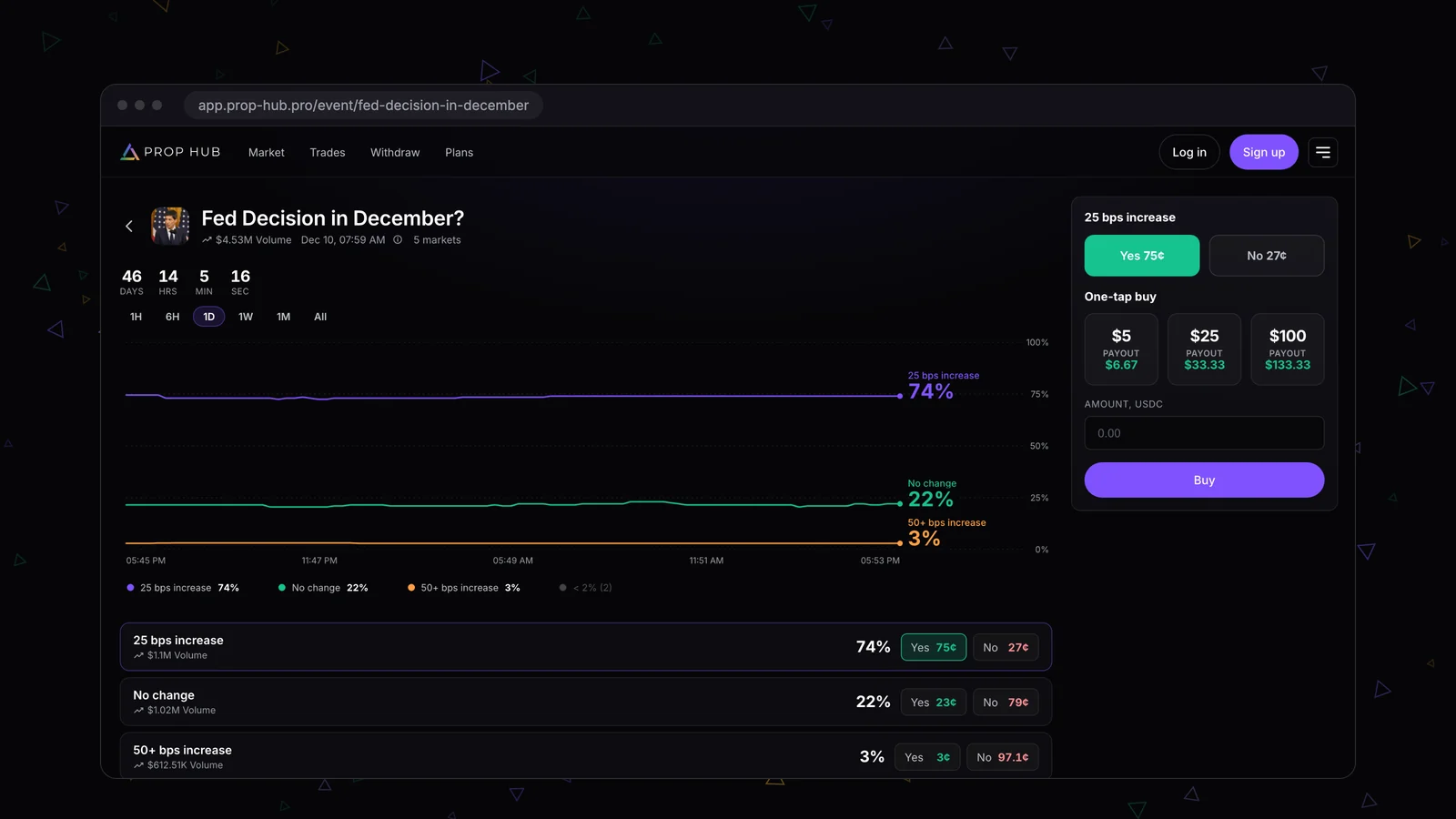
| Fed Decision in December? | the December 9 decision: cut, no change, or a hike of 25 bp or 50 bp+ | after the statement |
| How many dissent at the December Fed meeting? | number of votes against | after the statement |
| Another Fed rate hike in 2026? | whether there’s one more hike this year | December 10 |
| How many Fed rate cuts / hikes in 2026? | moves over the whole year | January 1, 2027 |
| What will Warsh say during the press conference? | whether specific words are said | on meeting day |
On October 20, “25 bp hike” in the December decision market traded at 77.5¢, “no change” at 19.5¢ and cuts below 1¢. The market was pricing a second autumn hike. On October 28 the Fed held, but two members voted to hike, and by November 1 “25 bp hike” traded at 70.5¢ and “no change” at 27.5¢. A price is a probability estimate, not a forecast: every inflation and jobs report can move it. For more on reading prices see prices are probabilities.
How it works on Prop Hub
Prop Hub lists markets that close within 2 days. The December decision outcomes end on December 9 at 23:59 UTC and enter the window late on December 7 UTC. The dissent market and “another hike in 2026” end on December 10 and become available at about the same time. The full-year cuts and hikes markets end on January 1, 2027, so they only enter the window at the end of December.
The statement lands at 19:00 UTC, while the market formally stays open until the end of the day. Once it’s out, market makers pull quotes on outcomes that can no longer happen, so you won’t buy at the old price. On Prop Hub an order fills against the Polymarket book at the volume-weighted average price, and it’s rejected outright if there isn’t enough on offer.
Risk points to keep in mind:
- no more than 5% of the starting balance in one outcome, or $500 on a $10,000 account;
- a hike at 77.5¢ is expensive: it pays 22.5¢ a share if right and loses 77.5¢ if wrong;
- “December decision” and “another hike in 2026” describe the same event. Holding both is one idea, even though the limit counts them separately;
- profit from positions bought above 90¢ or below 10¢ doesn’t count toward the challenge target or withdrawals.
Where to find other estimates of the December decision besides Polymarket is covered in central bank rate prediction. Account sizes are on the plans page.