 Emmy
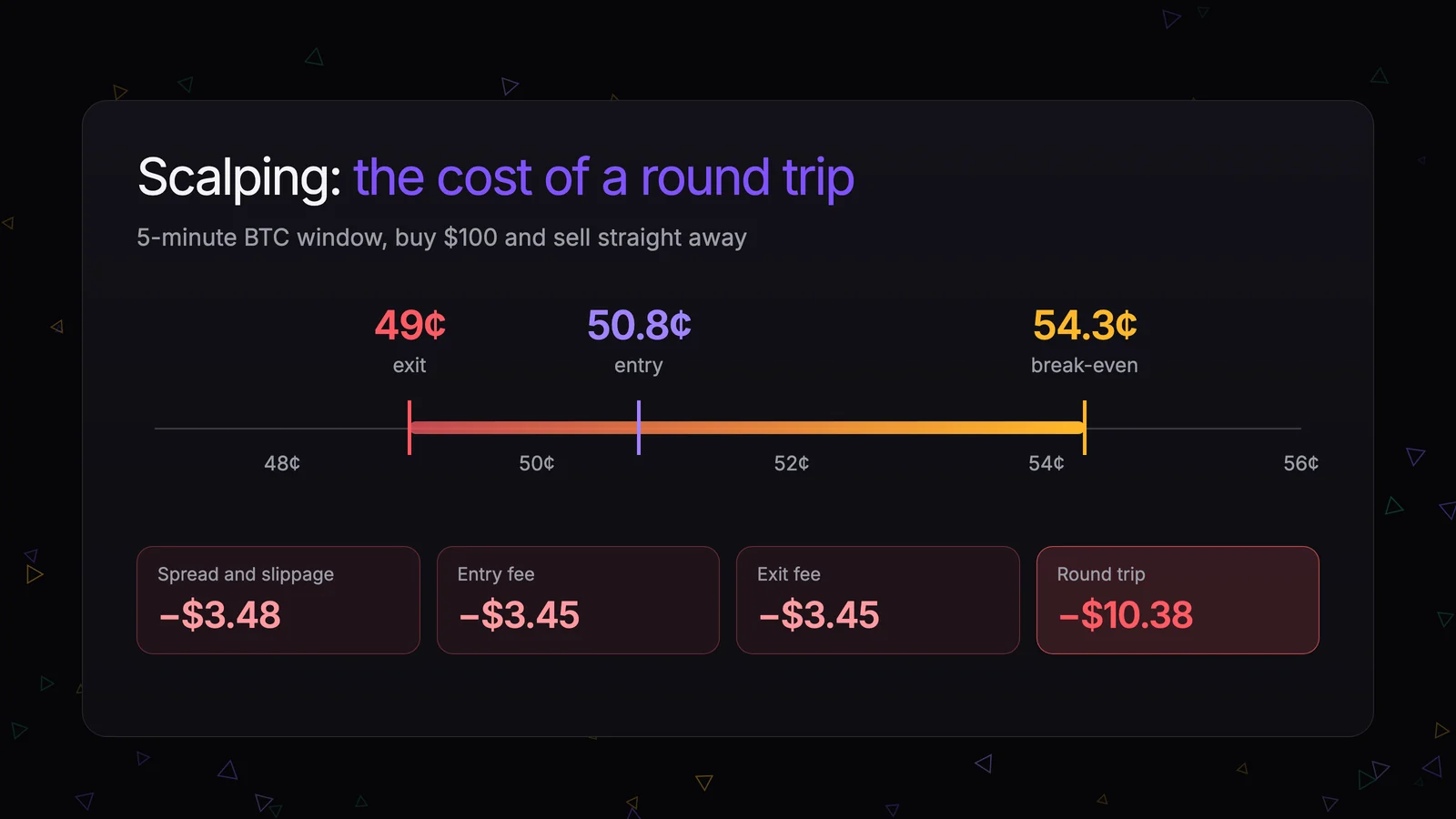
Scalping is trading in very short bursts: in and out within seconds or minutes to catch a small price move, many times a day. Each trade makes little, so costs decide everything: the spread, the fee and slippage. Forex and crypto scalpers spend years tuning their setup around those costs. Prediction markets have a different setup, and below is a live example from November 1, 2026 showing what one round trip costs on a 5-minute Bitcoin window.
What scalping is
A scalper isn’t forecasting where price will be tomorrow. The interest is the next move: a couple of pips on a currency pair, a few dollars on Bitcoin, a tick or two on a futures contract. A trade lasts from seconds to a few minutes, and the position is closed before the picture has time to change.
The classic venues for scalping:
- Forex. Liquid currency pairs, tight spreads, trading almost around the clock.
- Crypto. Spot and perpetual futures on major exchanges. Maker and taker fees usually differ there, so scalpers try to get in with limit orders.
- Stocks and futures. Liquid names and index contracts during the main session.
Order book scalping
A separate style is scalping off the order book. The trader watches the queue of orders rather than the chart: where the big size sits, how fast it’s getting eaten, who pulls first. A typical play is to get in just ahead of a large order and get out if it’s pulled. That takes fast access to the book, limit orders and low fees, because profit is measured in ticks.
What scalping earns on and what eats it
A scalper needs price to move further in their favor than the round trip costs. The round trip has three parts:
- Spread. You buy at the seller’s price and sell at the buyer’s. The difference is gone immediately.
- Fee. Paid twice: on the way in and on the way out.
- Slippage. If there’s little size at the best price, the order walks several levels of the book and the average comes in worse.
If a round trip costs 1 point and the average trade makes 1.5 points before costs, the strategy works. Double the costs and the same strategy starts losing. That’s why scalping is almost entirely a fight over costs.
Scalping a prediction market: a live example
On Polymarket an outcome share trades between $0 and $1, and the price is a probability. The fastest markets are the 5-minute “Bitcoin Up or Down” windows. On the surface they look made for scalping: the “Up” price follows BTC second by second.
Here’s the book for one such window on November 1, 2026, around 12:08 UTC. For “Up”, the best ask was 50¢ (45.57 shares), then 51¢ (338.55 shares); the best bid was 49¢. The market’s fee rate was 0.07.
A $100 round trip on a $10,000 account:
| Step | What happens | Money |
|---|---|---|
| Buy $100 | 45.57 shares at 50¢ and 151.40 at 51¢, average 50.8¢ | 196.97 shares |
| Entry fee | 196.97 × 0.07 × 0.508 × 0.492 | −$3.45 |
| Sell straight away | 196.97 shares at 49¢ | $96.52 |
| Exit fee | 196.97 × 0.07 × 0.49 × 0.51 | −$3.45 |
| Round trip | 100 + 3.45 − 96.52 + 3.45 | −$10.38 |
With no price move at all, one round trip costs about 10% of the amount. To break even, the best bid has to climb from 49¢ to 54.3¢, a 5.3-cent move. In a 5-minute window that takes a real shift in the BTC price, not noise in the book.
For comparison, the NFL game Chiefs vs. Broncos had a one-cent spread and a 0.03 rate in the same hour, and the same $100 round trip cost $4.80. That’s still almost 5% of the amount. How the fee is calculated and why it’s higher on cheap outcomes is covered in the article on Polymarket fees.
Why it works differently on Prop Hub
Prop Hub fills trades against the Polymarket order book and mirrors its fees, so the math above holds. On top of it come execution details and account rules.
Market orders only. Buys and sales fill immediately against the book; there are no limit orders. You can’t scalp from the maker side by resting in the book and collecting the spread. You always pay the spread and the taker fee.
No partial fills. If the book can’t take the full amount, the order is rejected outright. Positions also sell only in full. In the last seconds of a 5-minute window the book often thins out, and sometimes there’s simply nothing to sell into.
Execution delay. On crypto windows an order fills after a 150 ms pause; on sports markets, after the delay Polymarket sets for the market (usually about a second). After the pause we read the book again and fill at the fresh prices. Buying at a quote market makers have already pulled after a goal isn’t possible. More on the book in the article on the order book and slippage.
Per-outcome limit. Open buys in one outcome can’t exceed 5% of the starting balance, which is $500 on a $10,000 account. Closing a position frees the room, so the limit caps size, not the number of trades. How it’s counted is in the article on risk per trade.
Counted trades. Only profit from trades bought between 10¢ and 90¢ counts toward the challenge target and payouts. Quick entries at 95¢ seconds before a window closes change the balance but don’t count.
Consistency. The best day can be no more than 30% of total challenge profit (40% on a funded account). One great day of rapid-fire trades won’t complete a challenge if the other days are empty.
Daily drawdown. In one UTC day, equity can fall no more than 10% from the day’s opening equity. On a $10,000 account that’s $1,000.
That last rule and trading costs add up. Twenty $100 round trips on BTC windows, with a one-cent spread and no price move, cost about $207.50, or 20.75% of the daily limit. And that’s before a single forecast has gone wrong.
No automation. Bots, scripts and exploiting quote delays break the fair trading rules. Trading short-term by hand is fine.
When short trades make sense
A short trade earns its cost when there’s information behind it, not a tick. BTC jumps away from the Target on news and the “Up” price hasn’t caught up yet. Something happens in a game that the market is still underpricing. Your idea has stopped working, and it’s better to close now than wait for resolution.
A few working rules:
- Price the round trip before you enter. Spread, two fees and slippage at your size, compared with the move you expect.
- Hold to resolution if the idea still stands. A payout at resolution carries no second fee and no second spread.
- Pick longer windows. On a 15-minute or hourly window BTC has more time to move away from the Target, and the round-trip cost is the same. How the 5-minute window works is covered in the article on Bitcoin up or down in 5 minutes.
- Cap the trades per session. Five considered entries cost less than twenty impulsive ones.