 Emmy
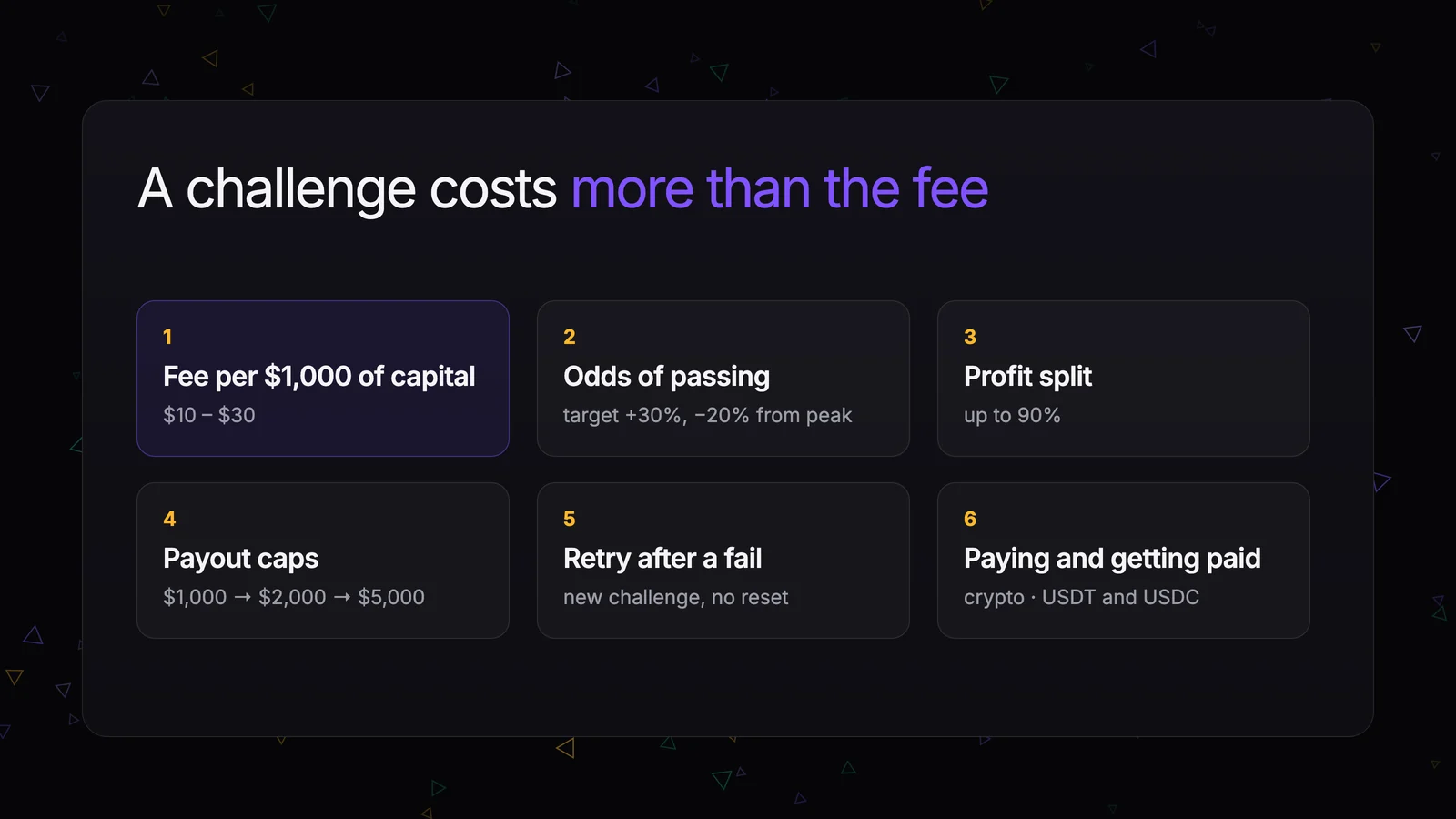
Most people looking for the cheapest prop firm challenge sort by the number on the buy button: $30, $50, $99. The fee is only the first line of the bill, though. What it really costs to reach a payout depends on the rules: how realistic passing is, how many times you’ll pay again, and how much of the profit you can actually withdraw afterwards. Here’s what to work out before you pay, and what those numbers look like at Prop Hub.
Cost per $1,000 of capital
Start by putting every price list on the same scale. Divide the fee by the account size and multiply by 1,000. A $30 challenge on a $1,000 account and a $300 challenge on $25,000 come out at $30 and $12 per thousand of capital.
Prop Hub has four plans:
| Account size | Fee | Profit target | Min. equity | Daily limit | Per-outcome limit |
|---|---|---|---|---|---|
| $1,000 | $30 | $1,300 (+30%) | $800 (−20%) | −$100 (−10%) | $50 (5%) |
| $10,000 | $125 | $13,000 (+30%) | $8,000 (−20%) | −$1,000 (−10%) | $500 (5%) |
| $25,000 | $300 | $32,500 (+30%) | $20,000 (−20%) | −$2,500 (−10%) | $1,250 (5%) |
| $50,000 | $500 | $65,000 (+30%) | $40,000 (−20%) | −$5,000 (−10%) | $2,500 (5%) |
| Account | Fee | Cost per $1,000 of capital |
|---|---|---|
| $1,000 | $30 | $30 |
| $10,000 | $125 | $12.50 |
| $25,000 | $300 | $12 |
| $50,000 | $500 | $10 |
The smallest fee buys the most expensive thousand. That’s expected: a small account is for testing yourself against real rules and losing little if it goes wrong. Which size fits which goal is covered in Prop Hub pricing plans.
Price per attempt vs. odds of passing
You pay for an attempt, not for a result. So the real price of a funded account is the fee divided by your probability of passing. A made-up example with two firms:
| Firm A | Firm B | |
|---|---|---|
| Fee | $40 | $100 |
| Odds of passing with your strategy | 1 in 10 | 1 in 3 |
| Average spend until you pass | $400 | $300 |
The odds here are invented to make the arithmetic work. Firms rarely publish pass rates, and every trader’s are different anyway. But the calculation makes the point: if a cheap challenge has rules that are hard to meet, you’ll pay the fee several times and spend more in total.
What moves your odds
Nobody can calculate your odds for you, but the rules show where they’re lower:
- Target vs. room to the limit. The more you have to make and the less you’re allowed to lose, the narrower the corridor. Prop Hub’s target is +30% with a 20% total drawdown. As a percentage, that target is higher than at forex prop firms, but the instrument is different too: an outcome share trades between $0 and $1 and can move tens of percent in a day either way.
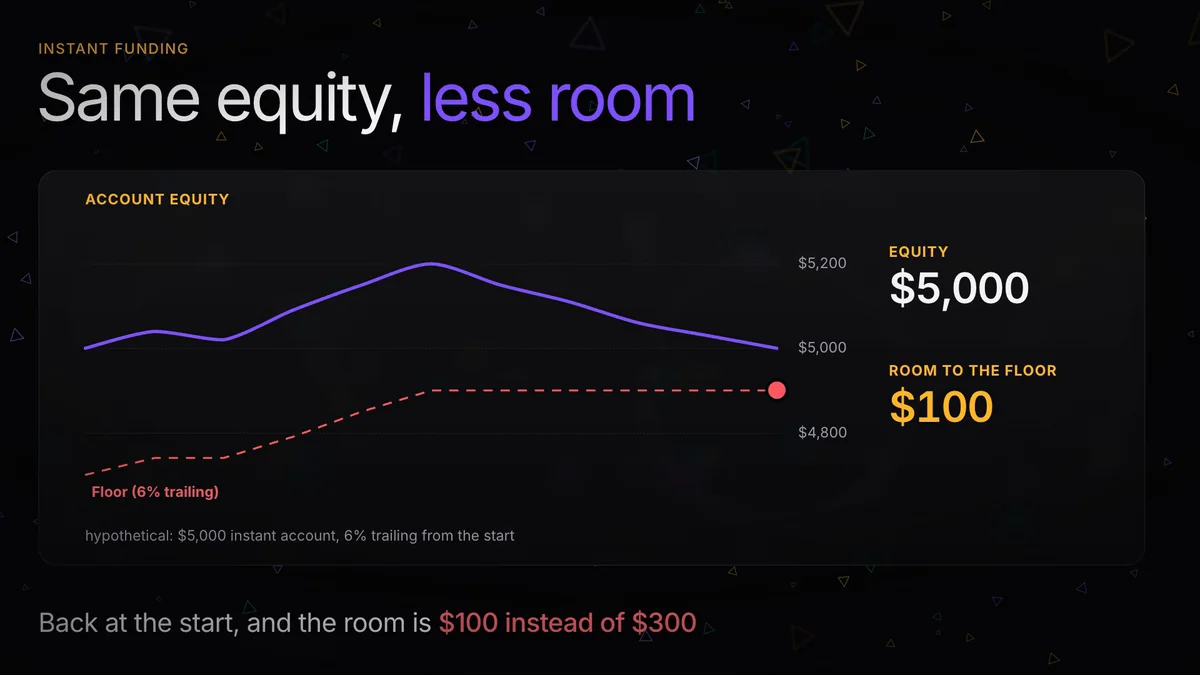
- What the total drawdown is measured from. A limit set from the starting balance stays put. A limit from the peak rises with profit, so after a good run you have less room than it seems. Prop Hub measures from peak equity. The numbers are worked through in daily and total drawdown.
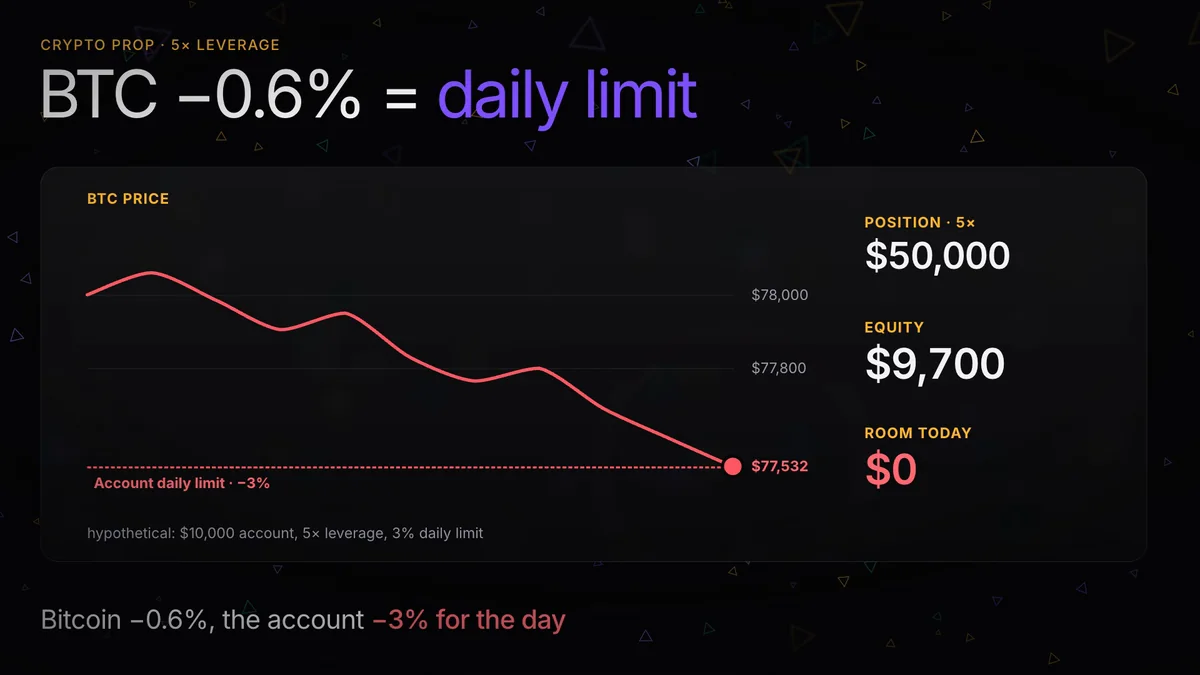
- Daily limit. A tight daily limit closes the account after one bad day. Prop Hub’s is 10% of equity at the start of the UTC day.
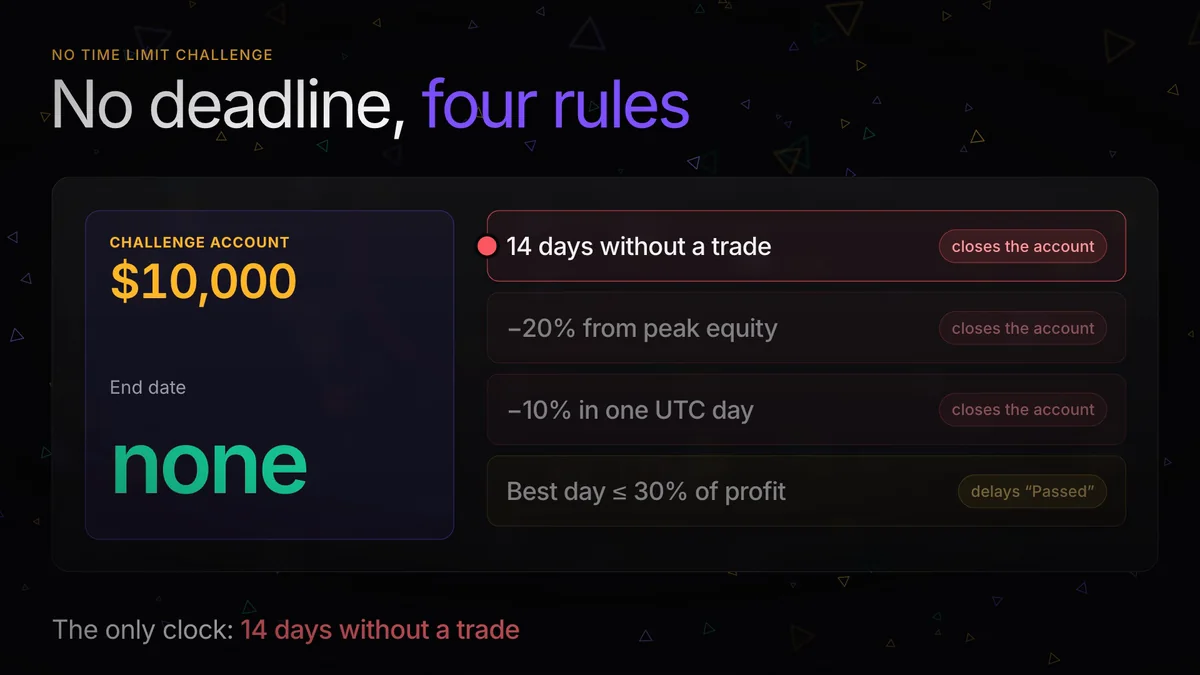
- Time limit. A 30-day challenge nudges you to size up as the deadline nears. Prop Hub has no time limit, just at least one trade every 14 days.
- Consistency. If the rules require evenly spread profit, one great day won’t finish the challenge. At Prop Hub the best day can be at most 30% of total profit, and it’s a condition for passing, not a breach.
What you get once you pass
A cheap fee doesn’t help much if money is hard to get out of the funded account. Check three things.
Profit split. What percentage you keep, and from which payout. At Prop Hub it’s up to 90% of eligible profit, from the very first payout.
Payout caps. Many firms cap early payouts. Prop Hub’s ladder is the same on every plan: the first payout is up to $1,000, the second up to $2,000, and after that up to $5,000. One request takes at most half of your available share, with at least 7 days between payouts. On a $10,000 account with $1,000 of eligible profit, your share is $900 and the first payout is $450; the rest comes in later requests.
What counts. At Prop Hub, only trades entered between 10¢ and 90¢ count toward the target and payouts. Buying an outcome at 97¢ a minute before it resolves changes your balance but isn’t counted. Plenty of firms have fine print like this, and it’s better to find it before you buy. How the payout amount is worked out is in funded account payouts.
Retrying after a failed attempt
Work out what a second attempt costs. Firms handle this differently: some offer a discounted reset for a few days after a breach, others refund the fee with your first payout, though then it’s usually built into the price.
Prop Hub has no reset: you buy a new challenge at the normal price whenever you like. The fee isn’t refunded whether you fail or pass. What you do get is a clear record: when an account closes, its page and the email show which rule triggered and at what numbers, such as equity of X against a minimum of Y. That tells you what to change next time.
Paying and getting paid
Two checks that save money:
- How the fee is paid. At Prop Hub, in crypto through payment gateways, priced in US dollars. In the Telegram bot you can also pay with Telegram Stars. The checkout window shows the methods available to you.
- How profit is paid out. Prop Hub sends payouts in USDT or USDC within 72 hours of the request, once your identity check is approved. Networks:
| Coin | Networks |
|---|---|
| USDT | TRC20, BEP20 |
| USDC | ERC20, Polygon, Solana, BEP20 |
Check your own country as well, wherever you trade from. Prop firm restrictions often apply to withdrawals rather than trading. Prop Hub’s list is in the Help Center under Country restrictions. Why firms charge for an evaluation at all is explained in why prop firms charge a fee.
Promo codes
A promo code takes a percentage off the fee. Each code has an expiry date and a usage limit, you enter it on the plans page, and the server calculates the final price before you pay. A 100% code opens the account with no payment. A code only changes the first line of the calculation: the rules and payouts stay the same.
Trying it for $0
The cheapest attempt is a free one. Prop Hub has two accounts with no fee:
- Welcome account: $100 for 3 days, drawdown capped at 50% of the start. You can withdraw its profit once, up to $100, after an identity check. Details in the free $100 account.
- Demo account: $10,000 with no time limit, on challenge rules, with no payout.
The demo is a good way to measure the one number the calculation above needs: how many times out of ten you reach the target without hitting a limit. That’s your odds of passing, measured on your own strategy.
A quick checklist
- Convert every fee to a cost per $1,000 of capital.
- Write down the target, total and daily drawdown, time limit and consistency rule, and note what each limit is measured from.
- Estimate your odds of passing, ideally on a free account.
- Divide the fee by those odds and compare firms on the result.
- Check the split, payout caps, withdrawal methods and your country.
Nine more questions to ask about the rules are in how to choose a prop firm.